Guide
Best Power Station for Summer Camping 2026: Our Top Picks by Trip Type

TL;DR
The best portable power stations for summer camping in 2026, organized by trip type: weekend car camping, week-long RV trips, and minimalist backpacking.
Summer camping and portable power stations go together naturally. But the right station for a two-night car camping trip looks nothing like the right station for a week-long RV adventure or a minimalist backpacking trip. Here’s how to match your power setup to your actual camping style — without overspending or lugging unnecessary weight into the woods.
Pick Your Trip Type
Weekend Car Camping (2-3 Nights)
What you’re powering: Phone charging for the group, LED string lights, a Bluetooth speaker, a portable fan, maybe a 12V mini-fridge or a blender for camp cocktails.
Ideal capacity: 500-1,000Wh
Weight tolerance: Higher — you’re parking next to your campsite, so 20-30 lbs is fine.
This is the sweet spot for most campers. You don’t need a massive battery bank for a weekend, but you want enough juice to keep everyone’s phones charged, run some lights after dark, and maybe keep drinks cold without buying ice every day.
Our top picks for weekend car camping:
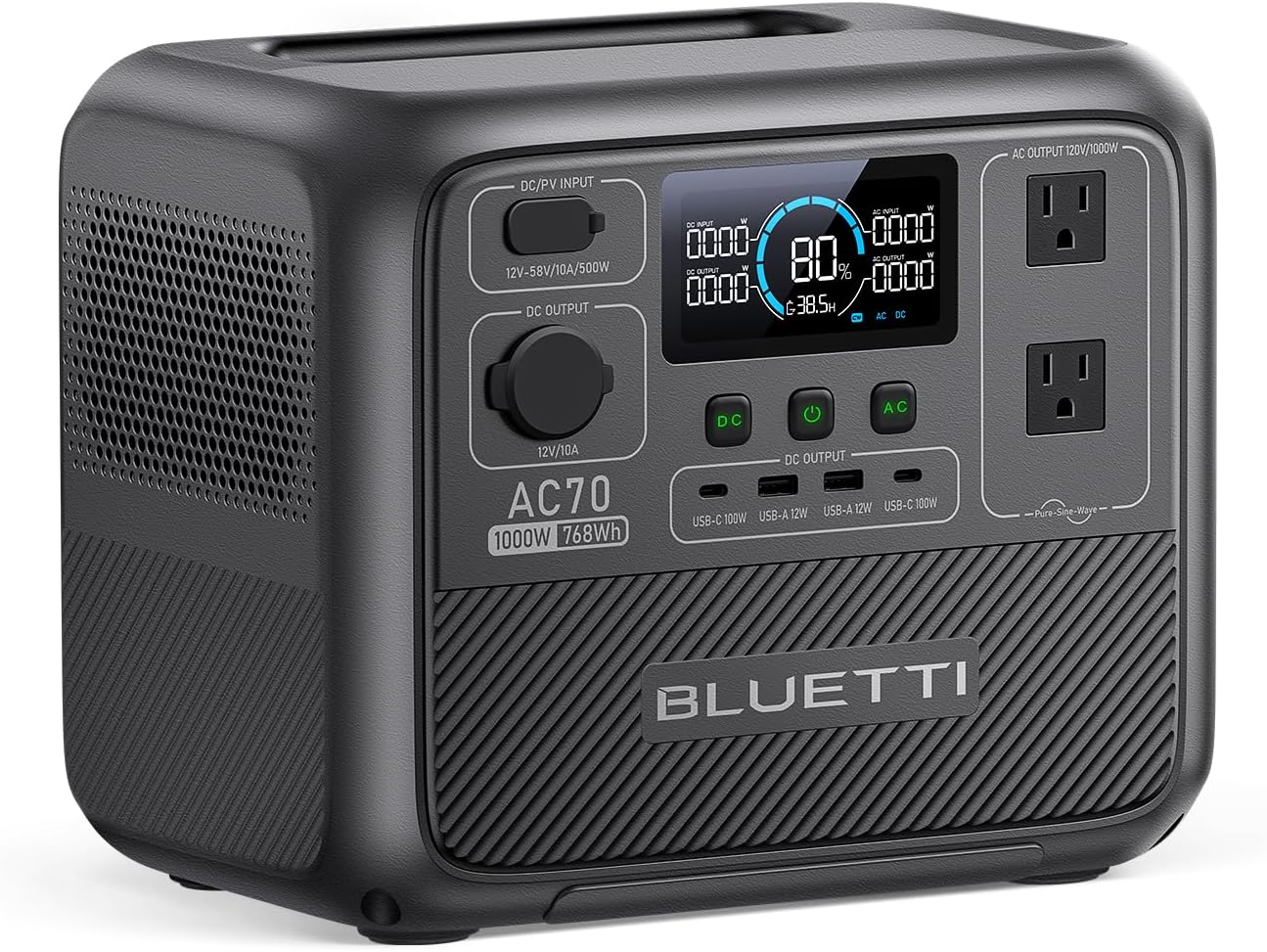
Bluetti AC70 ($499, 768Wh) — Best Value At 22 lbs and 768Wh, the AC70 hits the sweet spot of capacity, portability, and price. It runs a mini-fridge and camp lights all weekend with room to spare. The Power Lifting mode means it can handle an occasional high-draw appliance like a blender without tripping. Charges to 80% in 45 minutes before you leave home.
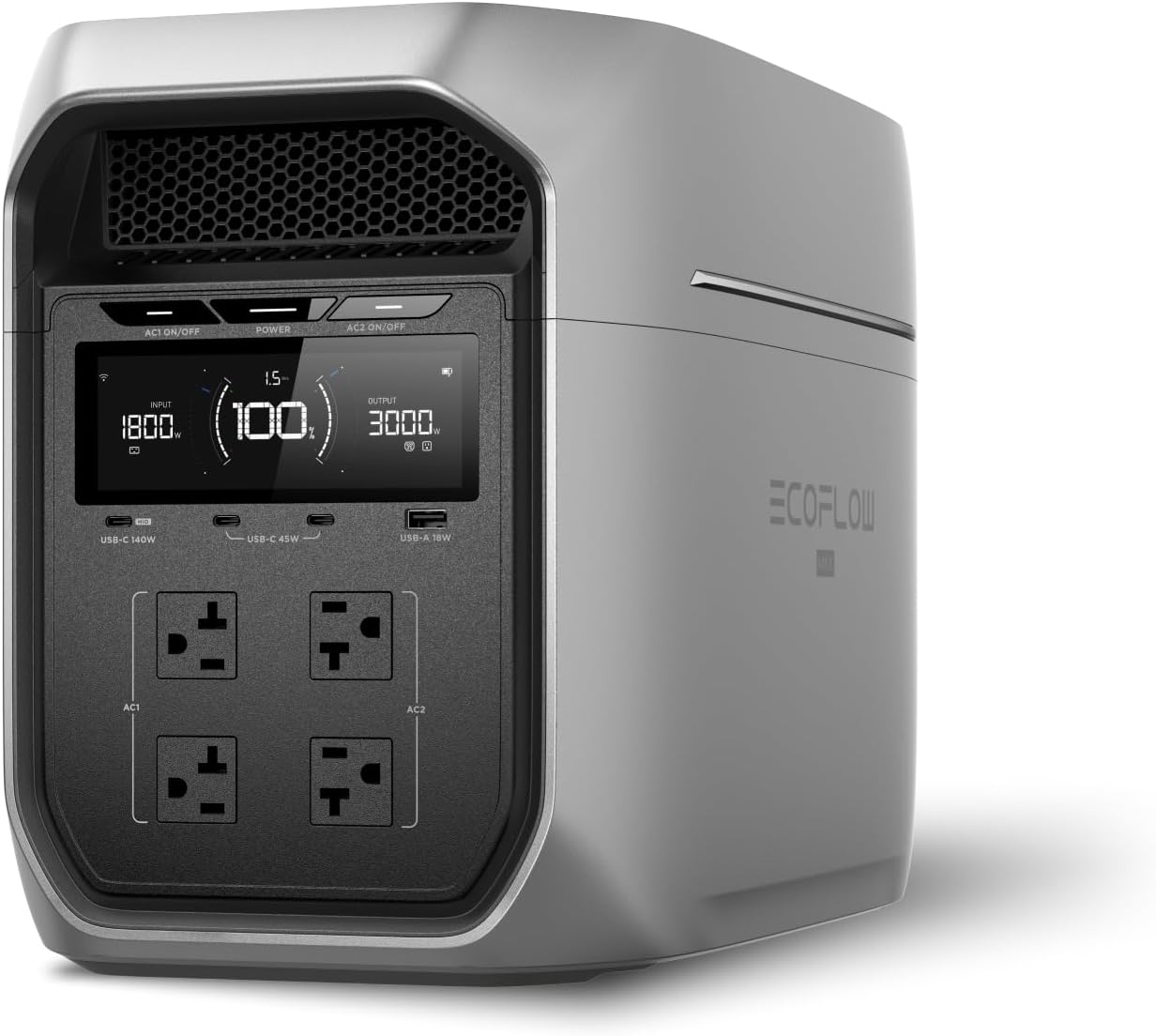
EcoFlow DELTA 3 Plus ($649, 1,024Wh) — Best Overall If you want zero anxiety about running out of power, the DELTA 3 Plus gives you 1,024Wh in a 23 lb package. That’s enough for a long weekend with a mini-fridge, fan, lights, and nonstop phone charging. The 56-minute charge time means you can top it off during a quick grocery run if needed.
Jackery Explorer 1000 v2 ($799, 1,070Wh) — Best for Campers The Jackery is purpose-built for camping. At 22 lbs, it’s the lightest 1kWh station on the market, and its near-silent operation (30dB) won’t disturb your neighbors. Jackery’s solar panel ecosystem is also the most seamless — pair it with a SolarSaga 100W or SolarSaga 200W and you have a self-sustaining campsite power system.
Week-Long RV & Extended Trips
What you’re powering: Everything above, plus a full-size 12V fridge, microwave (occasional), hair dryer, coffee maker, laptop for remote work, possibly a small portable AC unit.
Ideal capacity: 2,000Wh+ (or expandable system)
Weight tolerance: Doesn’t matter much — it lives in the RV.
Extended trips drain batteries fast. A mini-fridge alone uses 500-700Wh per day, and once you add coffee makers, microwaves, and hair dryers, you’re burning through kilowatt-hours in a hurry. You need serious capacity, ideally with solar recharging capability.
Our top picks for RV and extended camping:
Bluetti Elite 200 V2 ($1,099, 2,073Wh) — Best Value The Elite 200 V2 delivers 2,073Wh with a 6,000+ cycle battery for just $1,099 — that’s less per watt-hour than most 1,000Wh stations. The 2,600W continuous output handles a microwave or coffee maker without flinching. For a week-long trip with solar recharging, this is the ideal setup.
EcoFlow DELTA Pro 3 ($1,999, 4,096Wh) — Maximum Power If you camp like you’re at home — full appliances, portable AC, no compromises — the DELTA Pro 3 is the answer. With 4,096Wh of capacity (expandable to 48kWh), 4,000W output, and 240V capability, it’s essentially a portable home electrical panel. Pair with the EcoFlow 400W panel for serious daily recharging.
Jackery Explorer 2000 Plus ($1,999, 2,042Wh) — Most Expandable Start with 2,042Wh and add expansion batteries up to 24kWh as your needs grow. The modular design means you buy only what you need now and add capacity later. Great for RV owners who want a system that grows with them.
Minimalist Backpacking
What you’re powering: Phone, GPS watch, headlamp batteries, maybe a small camera.
Ideal capacity: 5,000-20,000mAh power bank (18-72Wh)
Weight tolerance: Every ounce counts. Under 1 lb is the target.
If you’re carrying everything on your back, a power station is too heavy. Period. Even a “compact” 10 lb unit is absurd when you’re counting grams. A quality power bank handles all your charging needs and fits in a pocket.
Our picks:
- Anker Nano 10,000mAh — Best Ultralight Option. Weighs 6.5 oz, charges an iPhone 2-3 times. USB-C in and out for fast charging. All you need for a weekend trip.
- INIU 25,000mAh — Best for Longer Trips. Weighs about 1 lb but charges a phone 5-6 times. Worth the extra weight for week-long treks.
For backpackers who want solar, a lightweight 10-20W foldable USB solar charger (not a full panel) can trickle-charge your power bank during the day while strapped to your pack.
Solar Panel Pairings for Camping
Solar transforms a camping power station from a limited battery into a renewable power source. Here’s how to match panels to your setup:
| Trip Type | Station Size | Recommended Panel | Daily Recovery |
|---|---|---|---|
| Weekend car camping | 500-1,000Wh | 100W panel | 300-500Wh |
| Extended / RV | 2,000Wh+ | 200W panel | 600-1,000Wh |
| Full off-grid | 2,000Wh+ | 400W panel | 1,200-1,800Wh |
Check our solar panel compatibility guide to verify your panel and station work together. For a full rundown of the best panels, see our solar panel rankings.
Summer Heat: Protect Your Battery
Lithium batteries lose efficiency above 100 degrees F (38 degrees C), and extreme heat can permanently reduce capacity. A black power station sitting in direct sun on a July afternoon can easily hit 120-140 degrees F internally.
Keep your station cool:
- Park it in shade — under a table, inside a tent vestibule, or under a tarp
- Never leave it in a sealed car on a hot day (car interiors can exceed 150 degrees F)
- If using solar panels, keep the station in shade with a long cable connecting to the panel in the sun
- LiFePO4 batteries tolerate heat better than NMC, but neither likes being cooked
Portable AC: The Luxury Option
Yes, you can run a portable AC unit while car camping. No, it’s not cheap on battery power.
The EcoFlow Wave 2 is the gold standard for camping AC — it draws about 600W on cooling mode. On a 2,000Wh power station, that’s roughly 3 hours of cooling. Pair with a 400W solar panel and you can extend that to 5-6 hours during sunny afternoons.
Realistically, portable AC while camping is best suited to RV setups or car camping with a large power station and solar. For tent camping, a good battery-powered fan is more practical. See our portable AC guide for a full breakdown.
The Bottom Line
Match your power station to your camping style, not the other way around. Weekend car campers are well-served by a 768-1,000Wh station like the Bluetti AC70 or Jackery Explorer 1000 v2. RV and extended-trip campers need 2,000Wh+ and solar recharging. Backpackers should skip the station entirely and bring a power bank.
Not sure what size you need? Our power calculator lets you plug in your exact camping appliances and get a personalized capacity recommendation. And our comparison tool makes it easy to stack any of these stations side-by-side.
Recommended Power Stations
EcoFlow
EcoFlow DELTA 3 Plus
EcoFlow's newest mid-range flagship. The DELTA 3 Plus improves on the Delta 2 with faster charging, LiFePO4 chemistry, and UPS functionality — all at a lower price.
Frequently Asked Questions
Do I need a power station for camping?
It depends on your camping style. Minimalist backpackers don't — a phone power bank is plenty. Weekend car campers benefit from a 500-1,000Wh station for lights, fans, phone charging, and a small fridge. RV and extended-trip campers often find a 1,000-2,000Wh station essential for running appliances off-grid. If you use a CPAP, a power station is non-negotiable.
How do I charge a power station while camping?
Three main ways: solar panels (most popular — 100-200W panels recharge a 1,000Wh station in 6-10 hours of sun), car charging (most stations include a 12V car adapter, but it's slow and drains your car battery), or shore power at a campsite with electric hookups. Solar is the best option for off-grid camping.
Can a power station run a portable AC unit?
Yes, but you need a big one. Portable AC units draw 300-900W continuously. A 1,000Wh station runs a small portable AC (like the EcoFlow Wave 2 at 600W) for about 1.5 hours — not very practical. A 2,000Wh+ station extends that to 3+ hours. For all-day cooling, you need solar panels recharging constantly or a generator.
Ready to Buy? Here's What We Recommend
Based on our testing and this guide, these are the best options for most people: