Guide
Solar Panel Maintenance 101: Spring Cleaning for Maximum Summer Output

TL;DR
A technical, step-by-step spring maintenance routine for portable solar panels. Learn exactly how dust, pollen, and connector corrosion rob you of output, and how to recover it before summer peak season.
Every spring I get the same question from readers staring at a solar input number that is lower than it was last fall: “Is my panel dying?” Almost always, the answer is no. The panel is fine. It is just dirty, slightly misaligned, or feeding through a connector that has started to corrode. As a power electronics engineer, I find this satisfying, because it means the fix costs almost nothing and the recovered output is real, measurable watts you can put on a meter.
Spring is the most important maintenance window of the year for one simple reason: pollen. From March through May across most of the US, panels accumulate a fine organic film daily, and that film sits there scattering photons right as the sun climbs toward its summer peak. Clean your panels properly now and you walk into the high-production months at full capacity. Here is the exact routine I use, and the engineering reasoning behind each step.
Why Output Drops: The Three Loss Mechanisms
If you understand what you are fighting, the maintenance steps stop feeling like superstition. There are three distinct ways a portable panel loses output, and they call for different responses.
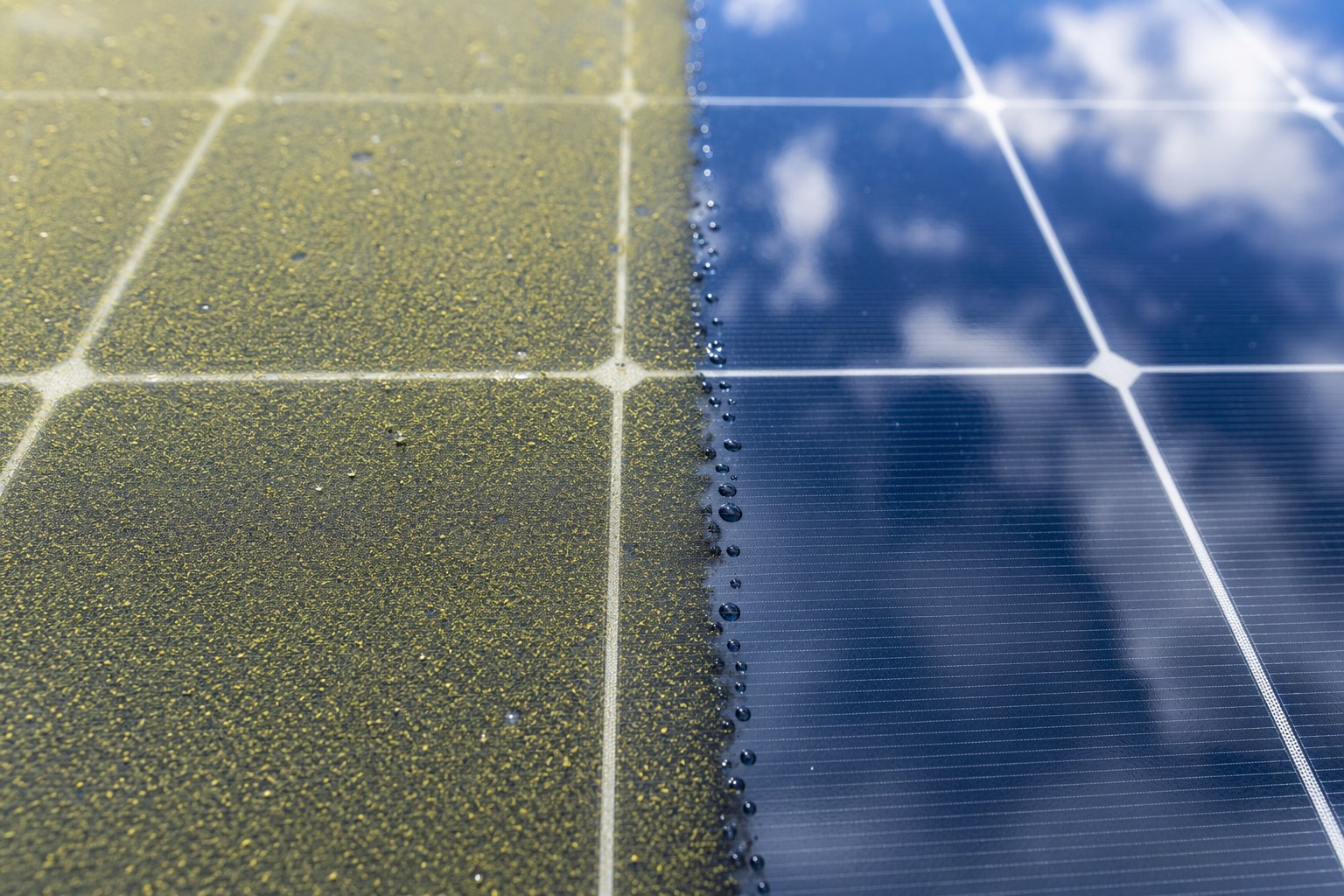
1. Soiling losses (optical). Anything on the glass that absorbs or scatters light before it reaches the cell costs you power. A uniform dust-and-pollen film is the gentlest case, typically 5-15% in spring. The dangerous case is localized: a bird dropping, a leaf, or a smear of sap. Because the silicon cells inside a portable panel are wired in series strings, the lowest-current cell sets the current for the whole string. Shade one cell hard enough and its bypass diode fires, cutting that entire string out of the circuit. That is why a single dropping can cost 30-50% while a thin overall haze costs 10%.
2. Mismatch and temperature losses (electrical). Panel efficiency falls roughly 0.3-0.5% for every degree Celsius the cells rise above 25C. A panel baking on hot asphalt at 65C is already down 12-20% from its nameplate before dirt enters the picture. This is not a cleaning problem, but it is a maintenance habit: get airflow under the panel.
3. Connector and conductor degradation (resistive). MC4 connectors and cable jackets are the slow killers. Corrosion at the contact, a partially seated connector, or a UV-cracked jacket all add series resistance. Power lost to resistance scales with the square of current, so on a high-output panel a few tenths of an ohm in a bad connector turns into measurable heat and lost watts. This is the failure I tell people to inspect for every spring, because it gets worse silently.
For a deeper background on how these panels turn light into usable DC, our year-round solar panel maintenance guide walks through the inspection side in more detail. This article focuses on the spring reset.
The Spring Deep Clean, Step by Step
This is a once-a-season thorough clean. During peak pollen weeks you will want a quick wipe every few days on top of it, but the deep clean resets your baseline.
What you need: two or three microfiber cloths reserved for panels only, a spray bottle of distilled or soft water, one drop of pH-neutral dish soap in a bucket, cotton swabs, and a soft brush for loose debris. Total kit cost is under $20.
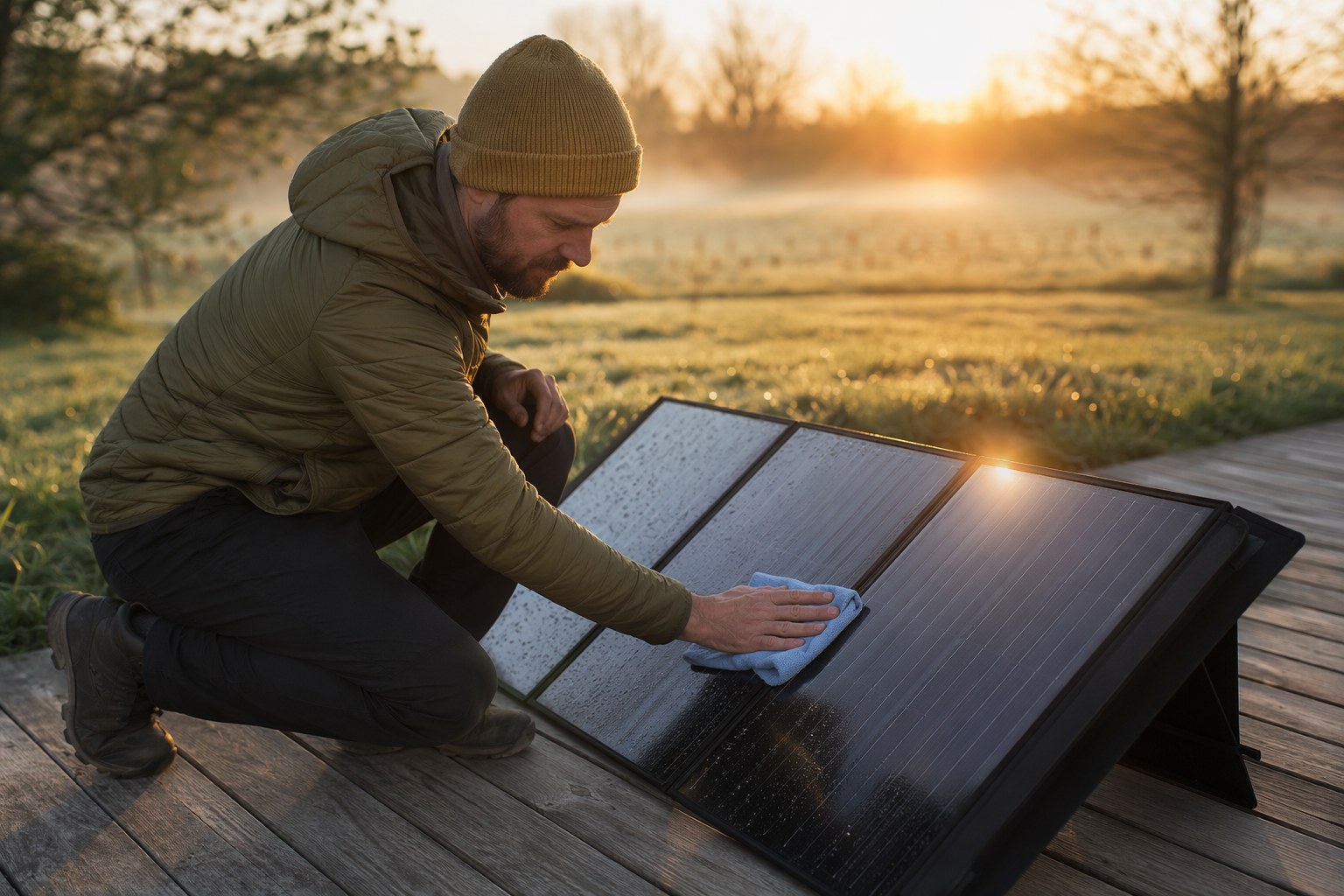
- Wait for cool glass. Do this at sunrise or after sundown, or fold the panel and let it sit in shade for 15 minutes first. Cold water on hot glass is the single most common way people quietly damage panels over time.
- Dry-brush loose material first. Pollen clumps and grit are abrasive. Knock them off with a soft brush before any cloth touches the surface so you are not grinding particles into the anti-reflective coating.
- Rinse, do not scrub dry. Mist the glass, let the water lift the film for 30 seconds, then wipe.
- Wipe in straight parallel passes with light pressure. Circular scrubbing is how micro-scratches accumulate. Overlap your passes by about a third.
- Treat sap and grease with soapy water, then rinse with clean water and buff dry. Residual soap film attracts new dust.
- Detail the perimeter where the frame meets the glass. A cotton swab pulls out the packed grime that a flat cloth skips.
The payoff is immediate and measurable. Connect the panel afterward and watch the input figure on your station climb. If you want to verify the recovery properly, our solar charging setup guide explains how to read your station’s solar input wattage and what a healthy number looks like.
The Connector and Cable Inspection You Are Probably Skipping
This is the engineer’s section, and it is the one most owners ignore until a panel “stops working” mid-trip. Spring, when you are handling the gear anyway, is the time to do it.
- MC4 contacts: Unmate the connectors and look inside. You want bright metal, not dull gray or green oxide. A blast of compressed air clears grit. If you see corrosion on a coastal or humid-climate panel, the contact resistance is already rising. A spare MC4 end is a $5 insurance policy worth keeping in the bag.
- Cable jackets: Flex the cable near the strain relief and the connector body. Surface cracking after two to three UV-exposed seasons is normal; exposed copper is not, and it is a fire and corrosion risk. Replace the lead.
- Seating: MC4s should click. A connector that is not fully latched looks connected but carries current through a tiny contact area that heats up. If a connector feels warm during charging, that is resistive loss you can hear in the silence of wasted watts.
- Hinges and kickstand on folding panels: Spring is when fabric hinges that survived a hard winter start to fray. A failed kickstand means you cannot angle the panel, and angle is worth 20-30% on its own.
Panels with rugged, well-documented MC4 wiring make this inspection easy. The EcoFlow 220W Bifacial Solar Panel uses standard MC4 and adds a rear-facing cell layer that recovers reflected ground light, which is genuinely useful on bright spring days over light gravel or fresh grass. The Bluetti PV200 is another clean MC4 implementation that is easy to service. If you are running a Jackery station, the Jackery SolarSaga 200W uses Jackery’s plug-and-play leads instead, so your inspection focuses on the connector body rather than bare MC4 pins. Match panel connectors to your station carefully; our panel and station compatibility guide covers the voltage and connector pairings in detail.
Positioning: The Free Output Most People Leave on the Ground
Cleaning recovers watts you lost. Positioning unlocks watts you never collected. The cell produces maximum current when light hits it perpendicular, and the difference between a flat panel and a correctly angled one is dramatic.
- Tilt to roughly your latitude. Across the continental US that is about 25-45 degrees from horizontal. In spring, bias a few degrees flatter than your winter setting as the sun climbs higher.
- Face due south in the Northern Hemisphere. East or west costs you 15-25% versus south at solar noon.
- Reposition every few hours if you are at camp. Manual sun tracking adds 20-30% to daily harvest over a fixed panel.
- Hunt for hidden shade. A guy line, an awning edge, even a tree branch’s shadow crossing one cell will trip a bypass diode. Inspect the whole surface, not just the obvious spots.
Smaller panels make repositioning painless because you can pick them up and move them in seconds. The Renogy 100W portable solar panel is light enough to chase the sun all afternoon, which often beats a larger fixed panel in real daily energy. For cloudy spring weather common in the Pacific Northwest and Northeast, the BougeRV Yuma 200W uses CIGS thin-film cells that hold up better than monocrystalline in diffuse, overcast light.
Build a Spring Baseline You Can Trust
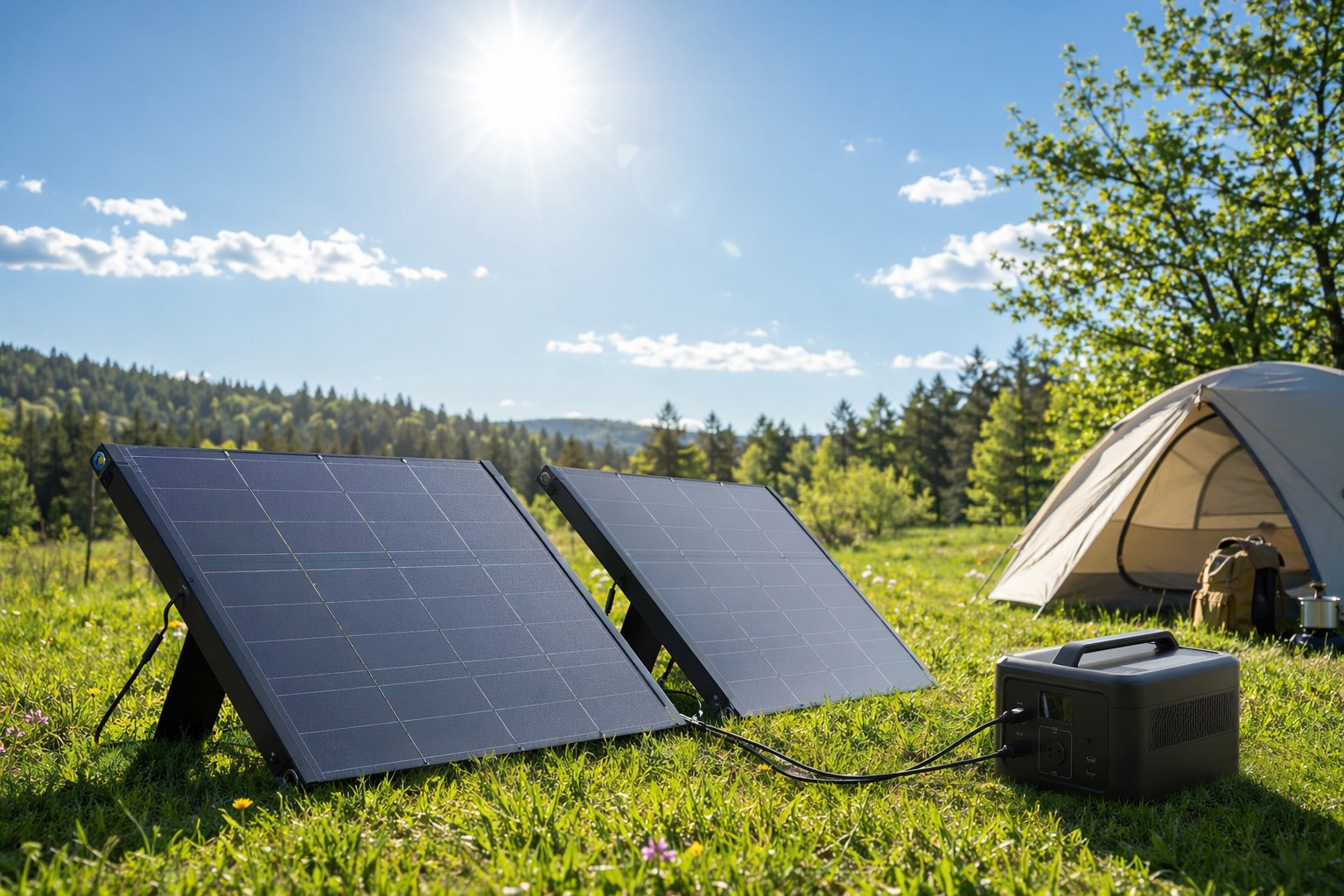
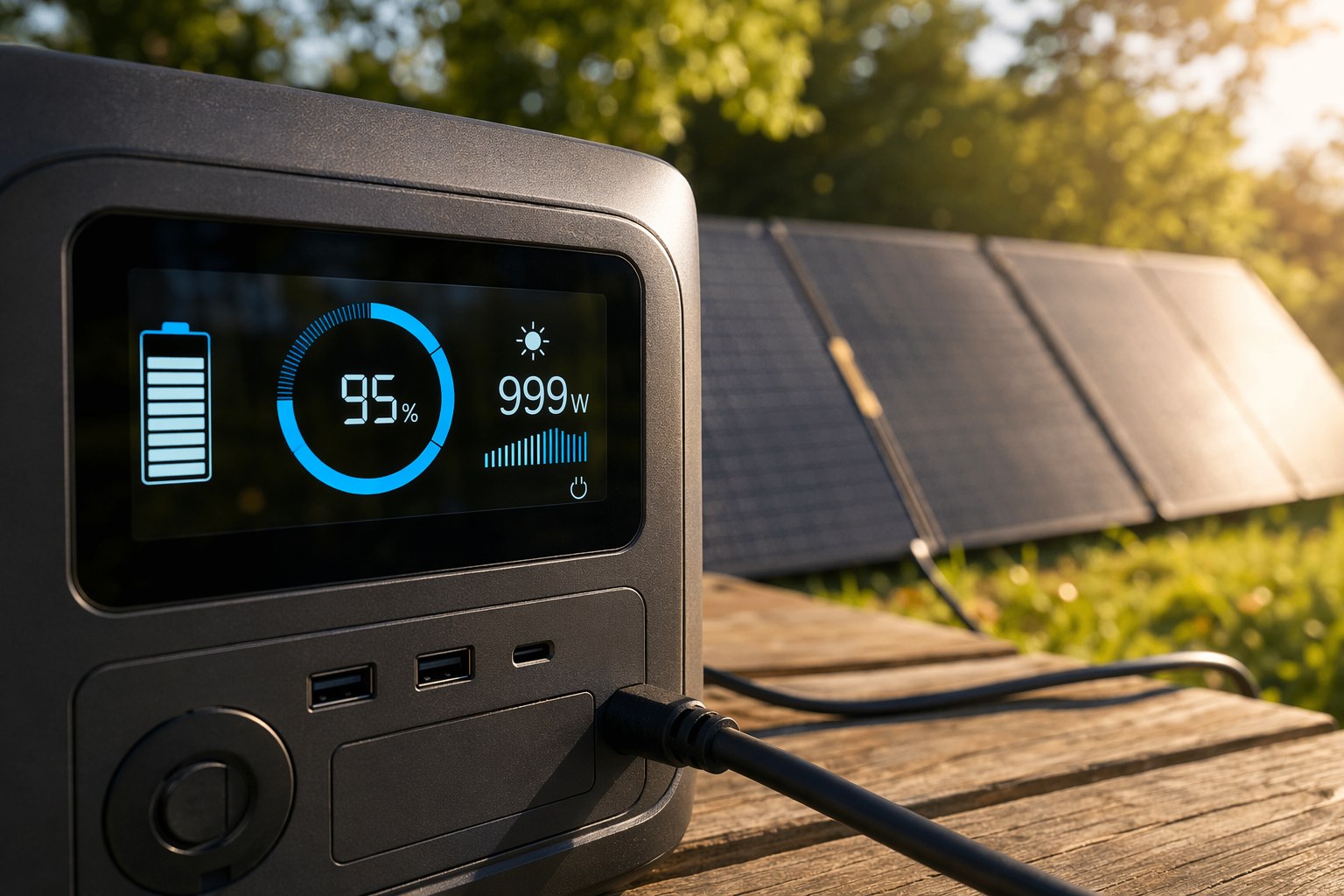
Maintenance without measurement is guessing. Pick a clear day, clean the panel, angle it correctly, and record the peak solar input wattage your station reports near solar noon. Write it down with the date and conditions. That number is your spring baseline.
Now you have a reference. If midsummer output is 15% below that baseline on an equally clear day with a clean, well-angled panel, you have a real fault to chase: a connector, a cracked cell, or creeping delamination. Without the baseline, you would be left wondering. I keep these readings in a notes app, and over the years they have caught two failing connectors before they stranded me.
What Healthy Spring Numbers Look Like
Real-world panel output runs about 60-80% of the nameplate rating under good sun, before soiling and temperature losses. So a clean, well-angled 200W panel realistically delivers 120-160W at solar noon in spring. If you are seeing that range, your system is healthy. If a freshly cleaned, correctly angled panel cannot break 50% of its rating on a clear day, stop blaming the weather and inspect the hardware.
Done consistently, this routine costs you one morning each spring and a $20 kit, and it pays back in full-capacity production right through the summer peak. The watts were always there. You just have to stop letting pollen, heat, and a loose connector skim them off the top.
Related Reading
- Solar Panel Maintenance Guide: Clean, Inspect, and Maximize Output — the full year-round routine
- How to Charge a Power Station With Solar Panels — setup and charge-time math
- Solar Panel and Power Station Compatibility Guide — matching panels to your station’s input
Recommended Power Stations
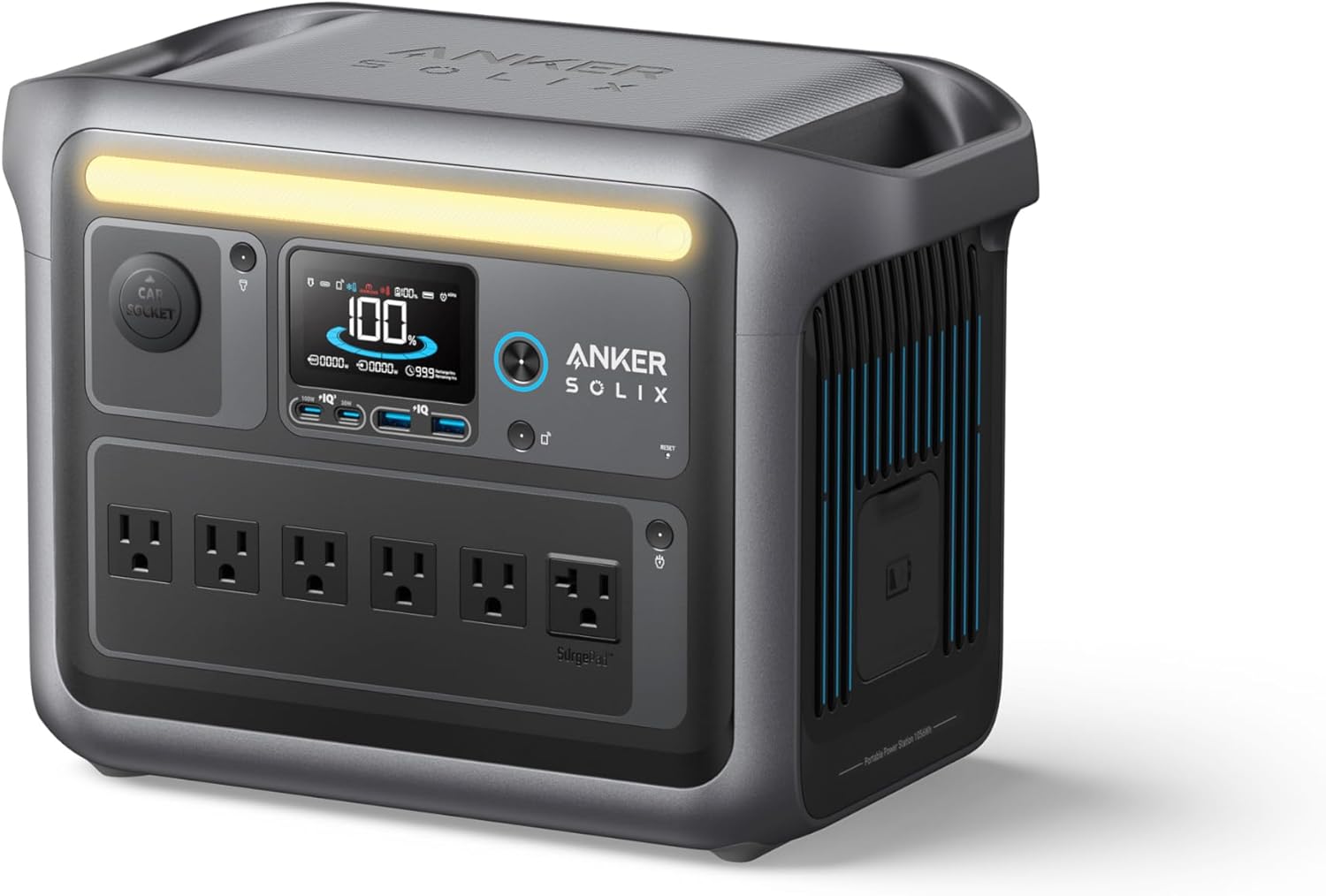
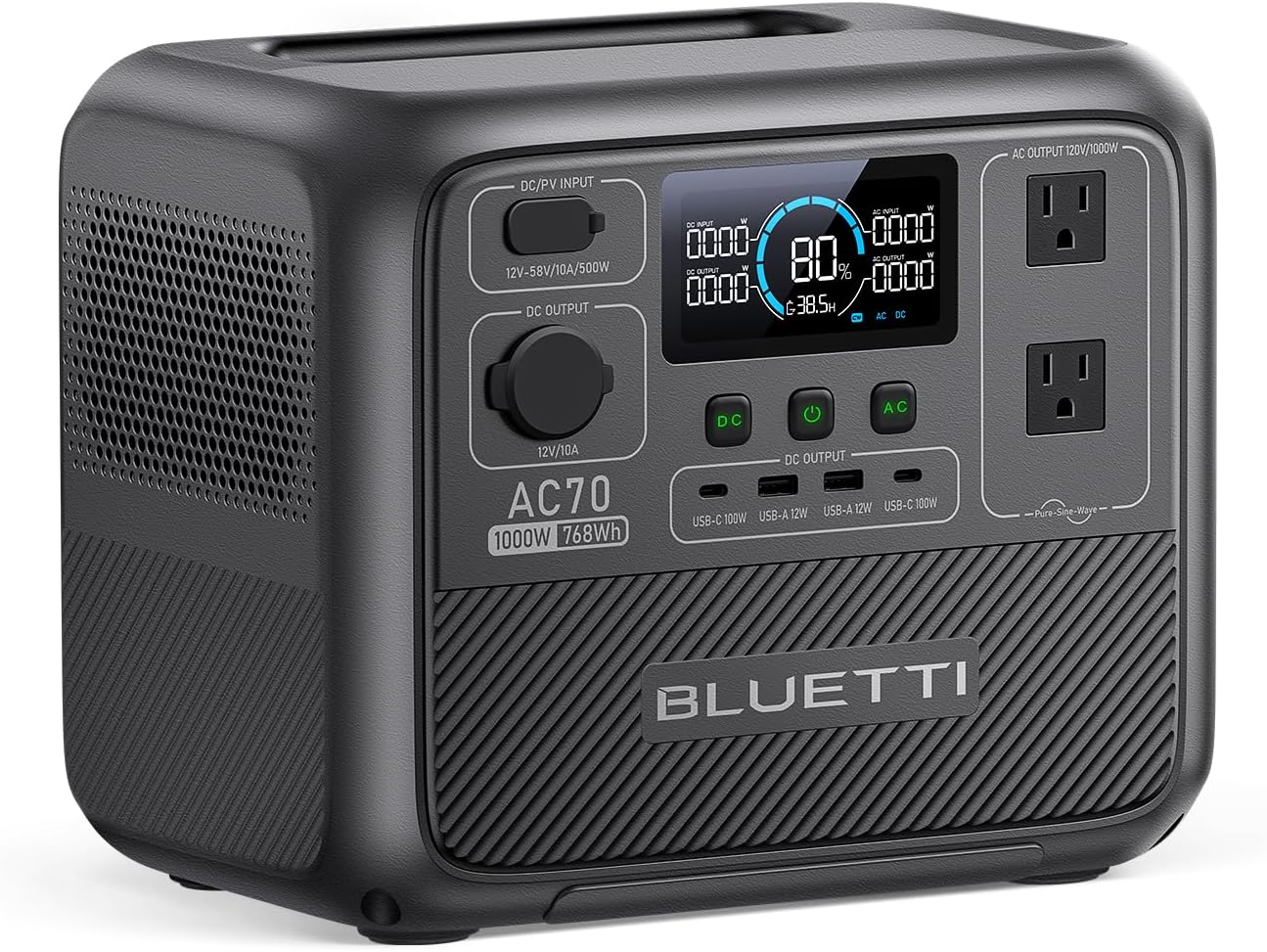
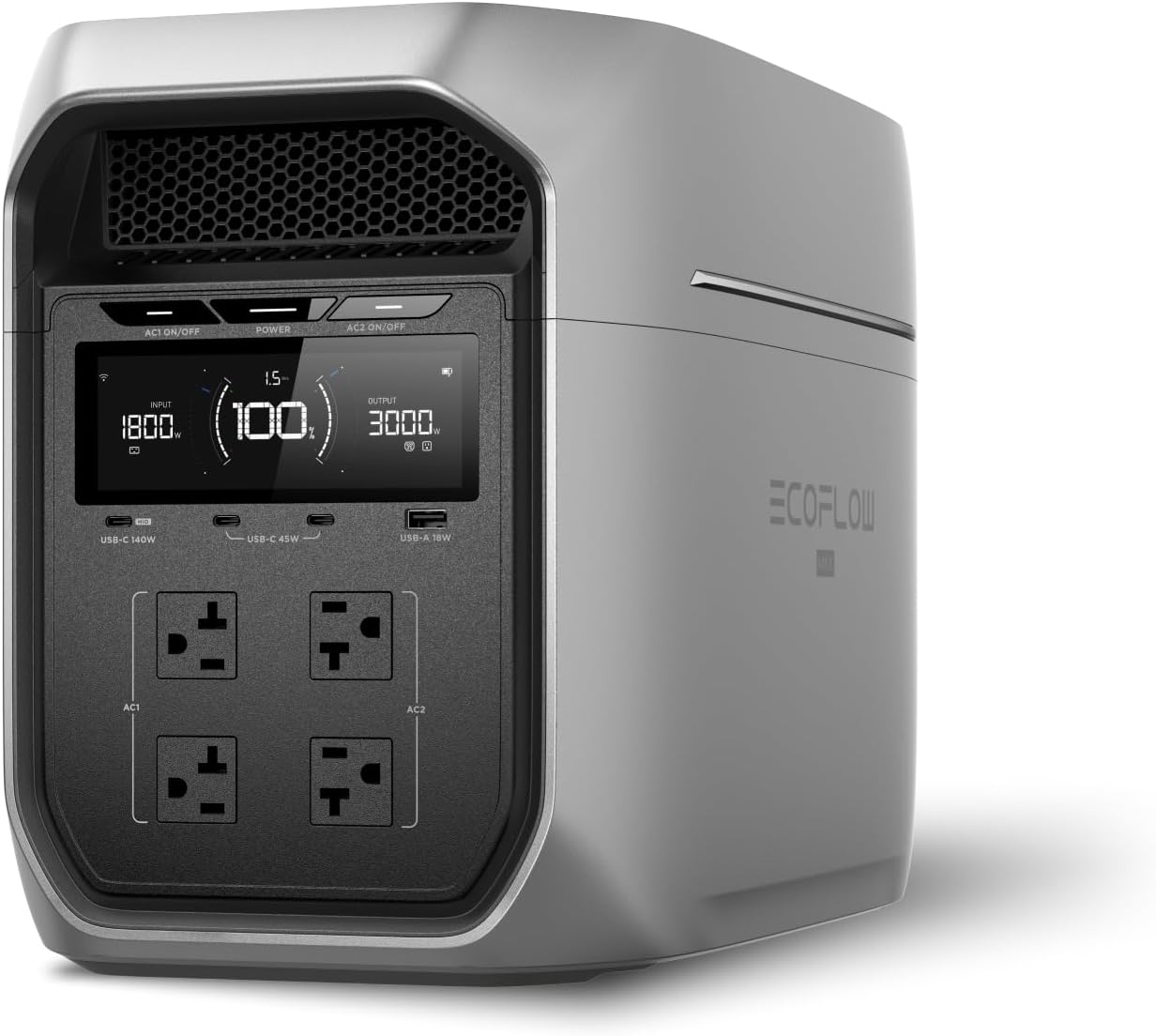
EcoFlow
EcoFlow DELTA 3 Plus
EcoFlow's newest mid-range flagship. The DELTA 3 Plus improves on the Delta 2 with faster charging, LiFePO4 chemistry, and UPS functionality — all at a lower price.
Frequently Asked Questions
How much output does a dirty solar panel actually lose?
It depends on the contaminant. A uniform film of dust and pollen typically costs 5-15% in diffuse soiling losses. Localized contamination like bird droppings is far worse because portable panels wire their cells in series. One fully shaded cell can throttle the entire string through that cell's bypass diode, so a single dropping can drop a 200W panel's output by 30-50% even though only one cell is blocked. After a heavy pollen week without rain, I have measured a clean panel recover from 138W to 191W on the same station under identical sun.
What is the best time of day to clean solar panels?
Early morning or late evening, when the glass is cool to the touch. Photovoltaic glass and the EVA encapsulant behind it expand when hot. Spraying cold water onto glass that is sitting at 60-70 degrees C in direct sun creates a thermal gradient that, over many cycles, stresses cell solder joints and can promote microcracks. Cleaning cool also avoids leaving mineral spots, because the water does not flash-evaporate before you can wipe it dry.
Do I need special solar panel cleaning chemicals?
No. Distilled or soft water plus a soft microfiber cloth handles the vast majority of soiling. For greasy residue or tree sap, add a drop of pH-neutral dish soap and rinse thoroughly. Avoid ammonia, alcohol, and abrasive pads. The anti-reflective coating on solar glass is a thin engineered layer, not the same tempered float glass as a window, and harsh solvents etch it permanently, leaving a haze that lowers transmission across the whole panel.
Ready to Buy? Here's What We Recommend
Based on our testing and this guide, these are the best options for most people: