Guide
Best Power Station for Outdoor Events: Movies, Parties, Tailgating, and More

TL;DR
How to power outdoor movie nights, backyard parties, tailgates, and vendor booths. Wattage breakdowns, runtime math, and top picks by event type.
Outdoor events and portable power stations are a perfect match — no extension cords running from the house, no gas generator noise drowning out conversation, no venue limitations dictating where you set up. Just clean, quiet, portable electricity wherever you need it.
The trick is matching the right station to the right event. A backyard movie night has very different power needs than a vendor booth at a farmers market. Here’s the breakdown by event type, with specific wattage math and product recommendations for each.
Outdoor Movie Nights
This is the most popular use case we hear about, and the one where people most often undersize their station.
The Power Math
| Device | Wattage |
|---|---|
| Mini projector (LED) | 150-300W |
| Powered speakers/soundbar | 30-50W |
| String lights | 15-20W |
| Phone charging (2 phones) | 20W |
| Total | 215-390W |
For a 3-hour movie at 300W average draw, you need roughly 900Wh of usable energy (1,060Wh of rated capacity accounting for inverter losses). A 1000Wh station cuts it close. A 2000Wh station gives you comfortable margin for a double feature.
The Projector Matters Most
Your projector choice determines whether a 1000Wh station works or whether you need to step up. Lamp-based projectors pull 250-350W. Newer LED/laser projectors can be as low as 100-200W for the same brightness. If you’re buying a projector specifically for outdoor use with a power station, go LED.
Top Pick: EcoFlow DELTA 2 Max
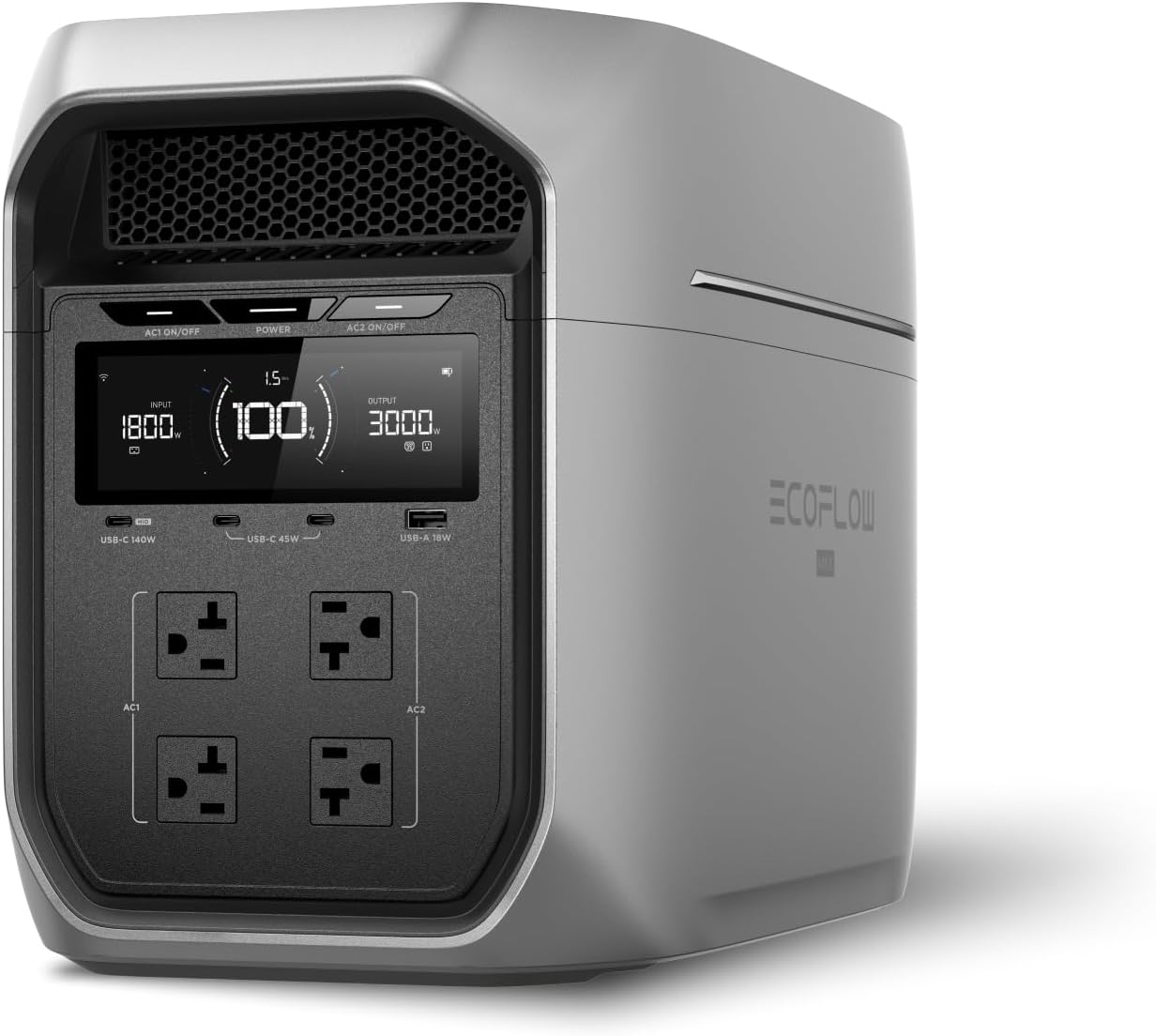
The DELTA 2 Max at 2048Wh with 2400W continuous output is purpose-built for this scenario. It runs a 300W projector setup for 5+ hours without breaking a sweat, and has enough outlets (6 AC) to power the entire setup from a single unit. It’s heavy at 50.7 lbs, but for a backyard event, weight doesn’t matter — you’re not carrying it far.
For a budget setup with an LED projector under 200W, a 1000Wh station from our rankings handles a single movie.
Backyard Parties
Party power needs are lower than you’d think — most of it is lighting and music, with brief high-draw spikes from a blender.
Typical Load
| Device | Wattage | Duration |
|---|---|---|
| String lights (100ft LED) | 20-40W | 4-5 hours |
| Bluetooth speaker or powered PA | 30-80W | 4-5 hours |
| Blender (margaritas) | 300-600W | 2-3 min per batch |
| Phone charging station | 30-40W | Continuous |
| Average draw | ~120W |
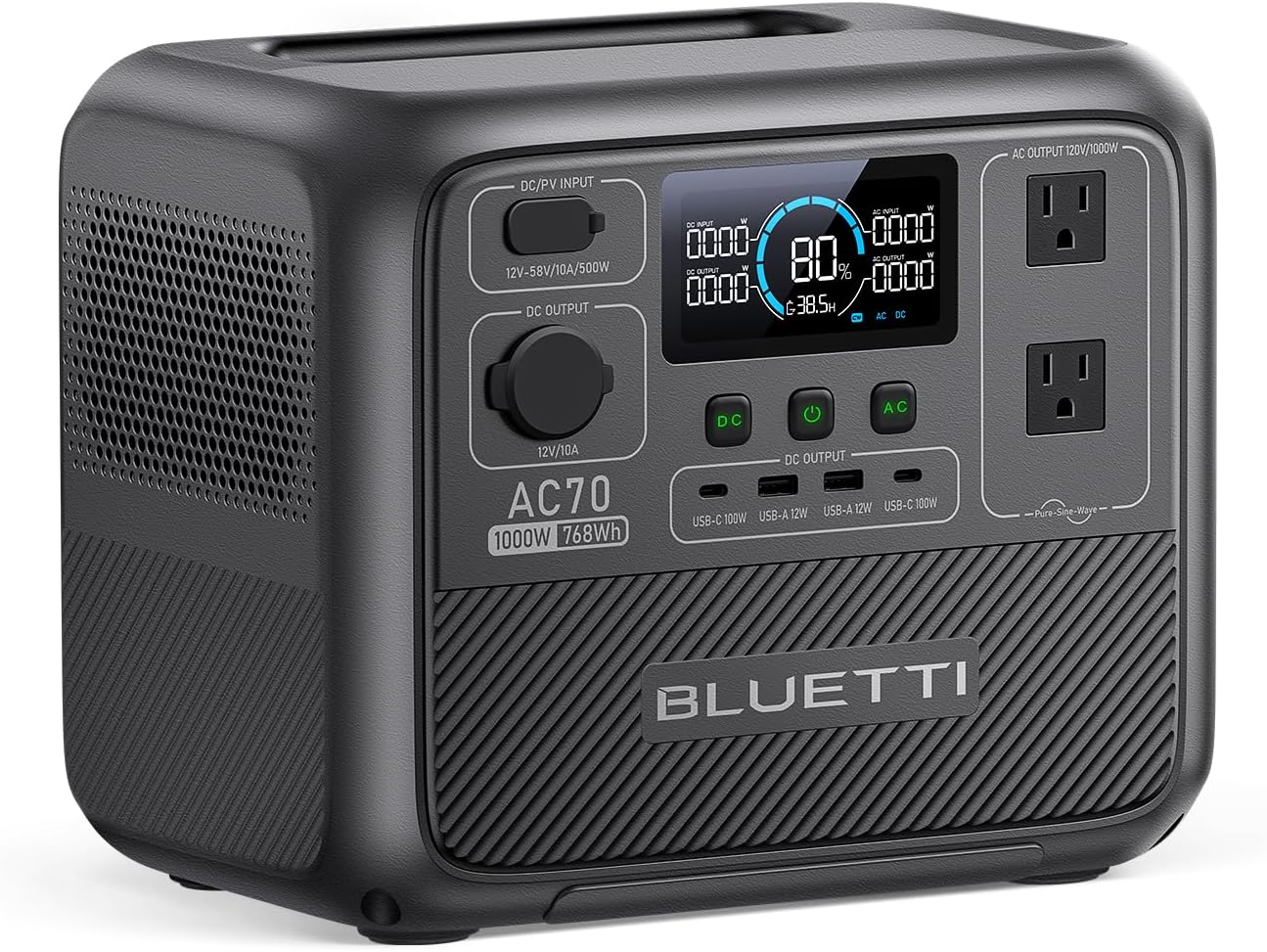
Over a 5-hour party, that’s roughly 600Wh — well within range of a 768Wh station like the Bluetti AC70. The blender spikes are short and intermittent, so they barely dent the total energy consumption even though they demand high wattage in the moment.
The AC70’s Power Lifting mode pushes output up to 2000W, which comfortably covers blender surges. At $499, it’s the ideal party power station: light enough to carry to the patio, powerful enough for anything short of a commercial kitchen.
Tailgating
Game day power needs are straightforward: TV, sound, phone charging, and maybe a small appliance.
Typical Tailgate Setup
| Device | Wattage |
|---|---|
| 50” LED TV | 70-100W |
| Soundbar | 30-50W |
| Phone charging (4-5 phones) | 40-50W |
| LED lights | 15-20W |
| Electric griddle (if you’re ambitious) | 1200-1500W |
| Without griddle | ~185W |
| With griddle | ~1500W peak |
Without the griddle: A 1000Wh station runs this setup for 4-5 hours — enough for pregame through halftime. A 500Wh station covers a single game if you skip the TV and just use a phone or tablet for streaming.
With the griddle: You need serious output wattage. A griddle at 1500W demands a station rated for at least 1800W continuous. The Jackery Explorer 2000 Plus at 2042Wh and 3000W output handles a griddle and the rest of the setup simultaneously. But honestly, a propane grill is simpler for cooking. Save the station for electronics.
For more tailgating-specific advice, see our tailgating power guide.
Vendor Booths and Farmers Markets
For vendors, reliability over a full 8-10 hour day is the priority. You can’t lose power mid-transaction.
Typical Vendor Booth
| Device | Wattage |
|---|---|
| Phone/tablet (POS system) | 10-15W |
| Small fan | 30-50W |
| String lights or banner lights | 20-40W |
| Mini display cooler | 50-80W |
| Laptop (if needed) | 50-65W |
| Total | 160-250W |
At 200W average draw over 8 hours, you need 1,600Wh of usable capacity. That puts you firmly in 2000Wh territory.
Top Pick: Bluetti Elite 200 V2
The Elite 200 V2 at 2073Wh delivers exactly what vendors need: enough capacity for a full market day, 2600W continuous output for any appliance, and a 6,000+ cycle LFP battery that handles daily use for years. At $1,099, the cost-per-market-day drops to practically nothing over its lifespan.
For food vendors running warming trays (200-500W each), a hot plate (1000-1500W), or commercial blenders, the Jackery Explorer 2000 Plus with 3000W output provides the wattage headroom you need.
Weddings and Special Events
Outdoor weddings and events have unique power demands: lighting rigs, DJ equipment, catering warmers, and photo booth setups.
Typical Event Power
| Device | Wattage |
|---|---|
| DJ speakers + mixer | 300-500W |
| String lights (200-300ft) | 60-100W |
| Photo booth (laptop + printer + lights) | 200-300W |
| Catering warmers (2-3 trays) | 600-900W |
| Total | 1,160-1,800W |
This is where you need the big guns. A single 2000Wh station handles the electronics (DJ, lights, photo booth) for 4-6 hours. Catering warmers push you into needing either a second station or a much larger unit.
For multi-thousand-watt event setups, consider two EcoFlow DELTA 2 Max units — one dedicated to entertainment, one to catering. This gives you 4,096Wh total and redundancy if one station fails.
Top Picks by Event Type
| Event | Recommended Station | Why |
|---|---|---|
| Backyard movie (LED projector) | EcoFlow DELTA 2 Max | 2048Wh covers a double feature |
| Backyard party | Bluetti AC70 | 768Wh, Power Lifting for blender |
| Tailgating (TV + sound) | Jackery Explorer 1000 v2 | 1070Wh, lightweight at 22 lbs |
| Vendor booth | Bluetti Elite 200 V2 | 2073Wh for a full market day |
| Wedding/large event | Jackery Explorer 2000 Plus | 3000W output, expandable to 24kWh |
Practical Tips for Event Power
Scout your venue. Walk the location before the event. Measure distances from where the station will sit to where power is needed. Bring enough extension cords.
Bring a full charge. This seems obvious, but charge your station the night before. Don’t assume you’ll have time to charge on-site.
Have a backup plan. For critical events (weddings, paid vendor gigs), bring a second station or a gas generator as backup. A client’s wedding is not the time to discover your station has 30% less capacity than the spec sheet claims on a hot day.
Manage heat. Stations in direct sun at a summer event lose capacity and can overheat. Keep the unit in the shade — under a table, behind the booth, inside a canopy.
Label your cables. At an event with multiple vendors or setups, label what plugs into what. When something trips a breaker or a station shuts down on overload, you need to identify the offending device fast.
The Bottom Line
A portable power station turns any outdoor space into a powered venue — no generators humming, no extension cords running to the nearest outlet, no venue restrictions limiting your options. Match the station capacity to your event’s total watt-hours, make sure the continuous output wattage covers your peak draw, and bring a full charge.
Browse our power station rankings to compare capacity, output, and price for any event size.
Related Reading
- Portable Power Station for Tailgating — tailgate-specific recommendations and setup tips
- What Can a 1000Wh Power Station Actually Run? — full runtime table for common devices
- Portable Power Station Safety Guide — safe operation rules for outdoor use
- Best Solar Panel + Power Station Combos 2026 — add solar for all-day outdoor events
Recommended Power Stations
EcoFlow
EcoFlow DELTA 3 Plus
EcoFlow's newest mid-range flagship. The DELTA 3 Plus improves on the Delta 2 with faster charging, LiFePO4 chemistry, and UPS functionality — all at a lower price.
Frequently Asked Questions
What size power station do I need for an outdoor movie night?
An outdoor movie setup — mini projector (200-300W), powered speakers (50W), and string lights (20W) — draws 270-370W total. For a 3-hour movie, you need 810-1,110Wh of capacity. A 1000Wh station handles one movie comfortably. For a double feature or a projector on the higher end, step up to 2000Wh. Check your projector's actual wattage — LED projectors under 200W are much more power-station-friendly.
Can a portable power station run a blender for a party?
Yes. Most blenders draw 300-600W, with brief surges up to 900W when crushing ice. A power station rated for 1000W+ continuous output handles any consumer blender. The actual energy used is low since you only blend for 30-60 seconds at a time — maybe 10-20Wh per batch. Even a 500Wh station can run a blender for dozens of batches. Just make sure the station's continuous wattage rating exceeds the blender's running watts.
What power station do I need for a vendor booth or farmers market?
Most vendor booths need 200-500W: a phone/tablet for payment processing (15W), a small fan (30-50W), string lights (20-40W), and maybe a mini fridge or cooler (50-80W). A 1000Wh station covers a full 8-hour market day at 300W average draw. For food vendors running warming trays or small appliances, step up to 2000Wh with at least 2000W continuous output.
Can I power a TV for tailgating with a portable power station?
Absolutely. A 50-inch LED TV draws 70-100W. On a 1000Wh power station, that's roughly 9-12 hours of watch time — far more than any tailgate or game day. Add a soundbar (30-50W) and phone charging (15W), and you're still looking at 7-8 hours. A 500Wh station gets you through a single game with room to spare.
Ready to Buy? Here's What We Recommend
Based on our testing and this guide, these are the best options for most people: