Guide
Atlantic Hurricane Season Begins: Emergency Power Prep (Early Warning)

TL;DR
June 1 starts Atlantic hurricane season. Late May is your final window to set up backup power before peak storms and price spikes hit. A hurricane-zone checklist for power stations, generators, and solar.
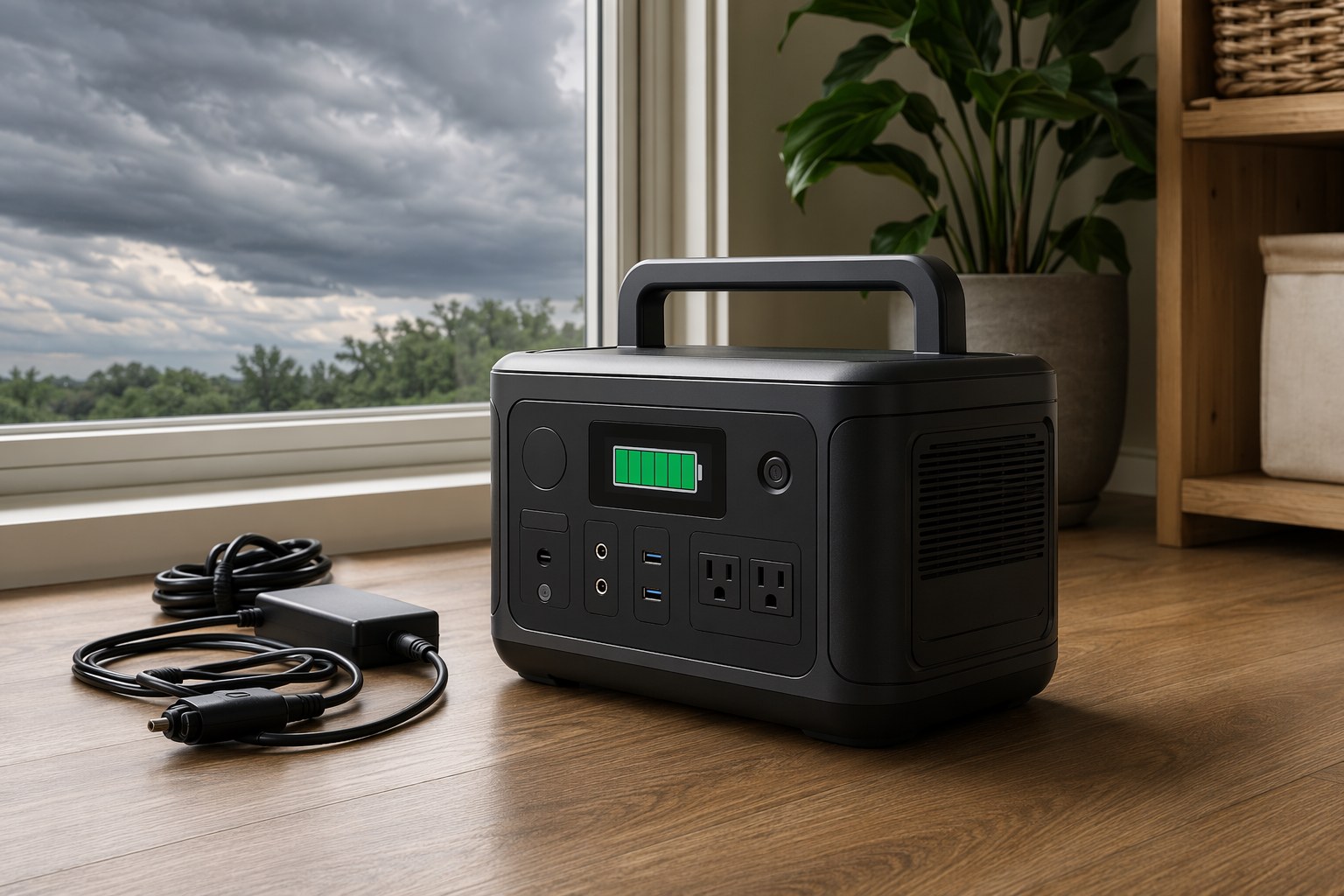
June 1 is the official start of Atlantic hurricane season, and I’m writing this on May 22 for one reason: you have roughly a week and a half of breathing room left. After that, every decision about backup power gets harder, more expensive, and more rushed. The calm, well-stocked, normally-priced version of this shopping trip is happening right now. The panicked, sold-out, marked-up version starts the day the first named system organizes in the Gulf.
I’ve watched this cycle play out every year along the Gulf and Atlantic coasts. The forecasters release their seasonal outlook in late spring, everyone nods, and almost nobody acts until a storm has a name and a track. By then the power stations that were in stock at fair prices in May are showing “Currently Unavailable,” and the ones still available cost 20-30% more with shipping estimates that won’t beat the storm. This article is your early warning. Treat the next ten days as your final prep window, not a suggestion.
Why late May is the real deadline, not June 1
The official June 1 start date is a calendar marker, not a starting gun for danger. Historically, the Atlantic basin doesn’t get serious until mid-August, and the peak runs through September into October. That’s good and bad news. Good, because a June 1 storm is statistically unlikely, so missing the literal first day costs you almost nothing in risk. Bad, because that long quiet stretch is exactly what lulls people into waiting.
Here’s the timing that actually matters for power prep:
- Late May to mid-June: Inventory is full, prices are at their annual baseline, and you can order, receive, charge, and test a system without any pressure. This is the window you’re in.
- July: Activity starts ticking up. Prices are still normal but the smart buyers are already done.
- Mid-August through October: Peak season. The moment a system threatens land, demand spikes within hours and doesn’t recover for weeks.
The whole point of preparing now is that backup power is useless if it shows up after the storm or arrives untested. A power station you’ve never charged, or a generator you’ve never started, is a gamble. Buying in the next week gives you time to plug everything in, run it, and learn its quirks while the sky is still clear. If you want the full strategic breakdown of tiers and budgets, our complete hurricane season power prep guide goes deeper than I can here; this piece is about getting you across the finish line before June.
Start with what you actually need to keep running
Before you spend a dollar, write down what cannot go dark. Not what would be nice — what’s non-negotiable. In my experience the list is shorter than people expect, and that’s what makes the math manageable.
For most coastal households the real essentials draw far less than you’d think:
| Device | Typical draw | Notes |
|---|---|---|
| Phones (charging) | 5-15W each | A few Wh per full charge; trivial |
| LED lanterns / lights | 2-10W | Negligible all night |
| Wi-Fi router / modem | 10-15W | Keep weather updates flowing |
| Full-size refrigerator | 50-80W average | Cycles on and off; biggest steady load |
| Box fan | 50-75W | Critical for heat in a no-AC home |
| CPAP machine | 30-60W | Medical; size with margin |
| Window AC (small) | 500-1,000W | Heavy; generator territory |
Add up your must-runs over a 24-hour window and you get your daily watt-hour target. A fridge, a router, phones, a couple of lights, and a fan land most families around 1,000-1,500Wh per day. A CPAP or other medical device on top pushes you higher and changes the priority order entirely. If you’ve never built one of these lists, our emergency power kit guide walks through it item by item and turns the abstract “how much battery do I need” question into a concrete number.
Pick your power, by how long you need to last
Once you have a daily target, the choice gets straightforward. I break it into three real-world levels.
One to two days: a single 1,000-2,000Wh station
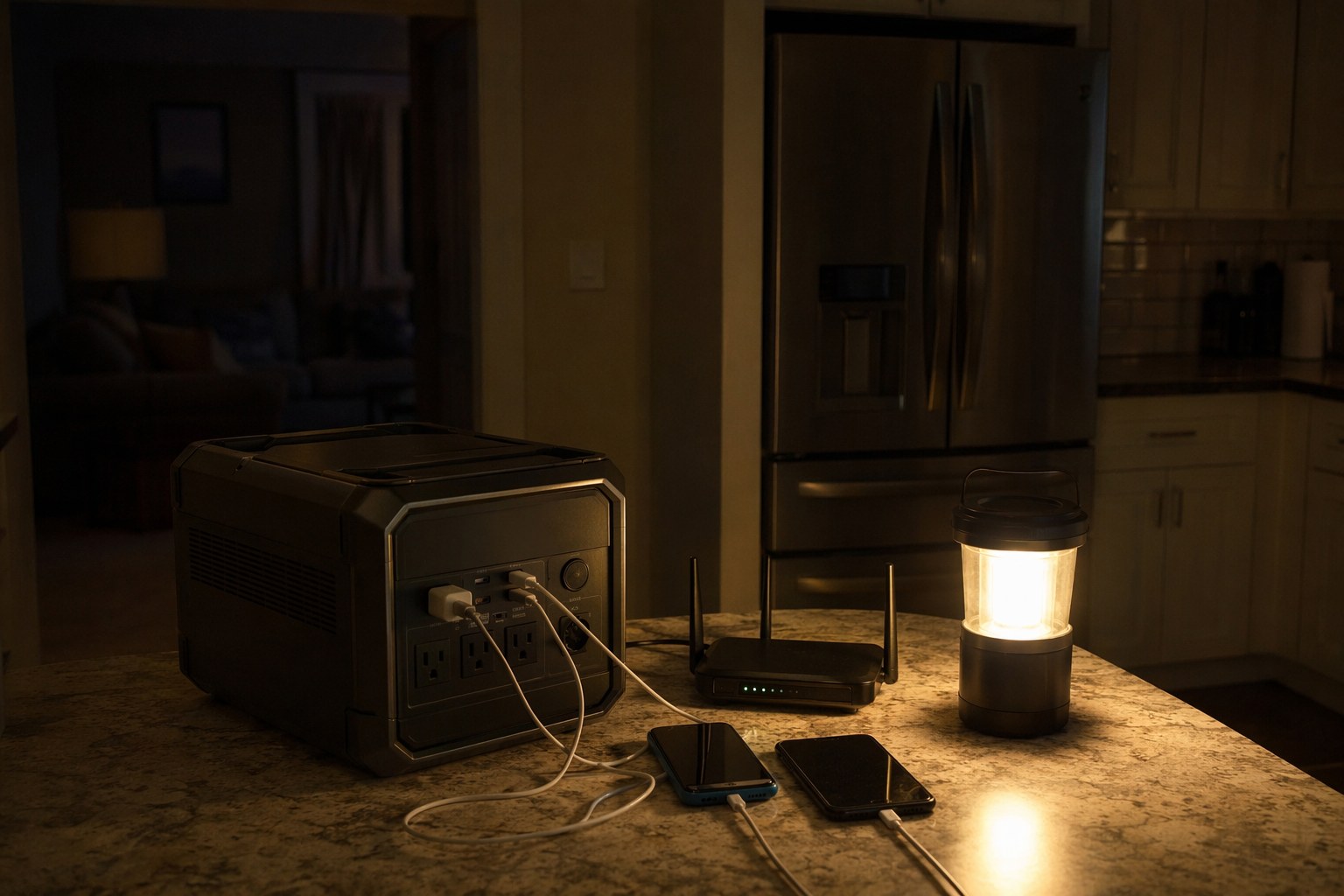
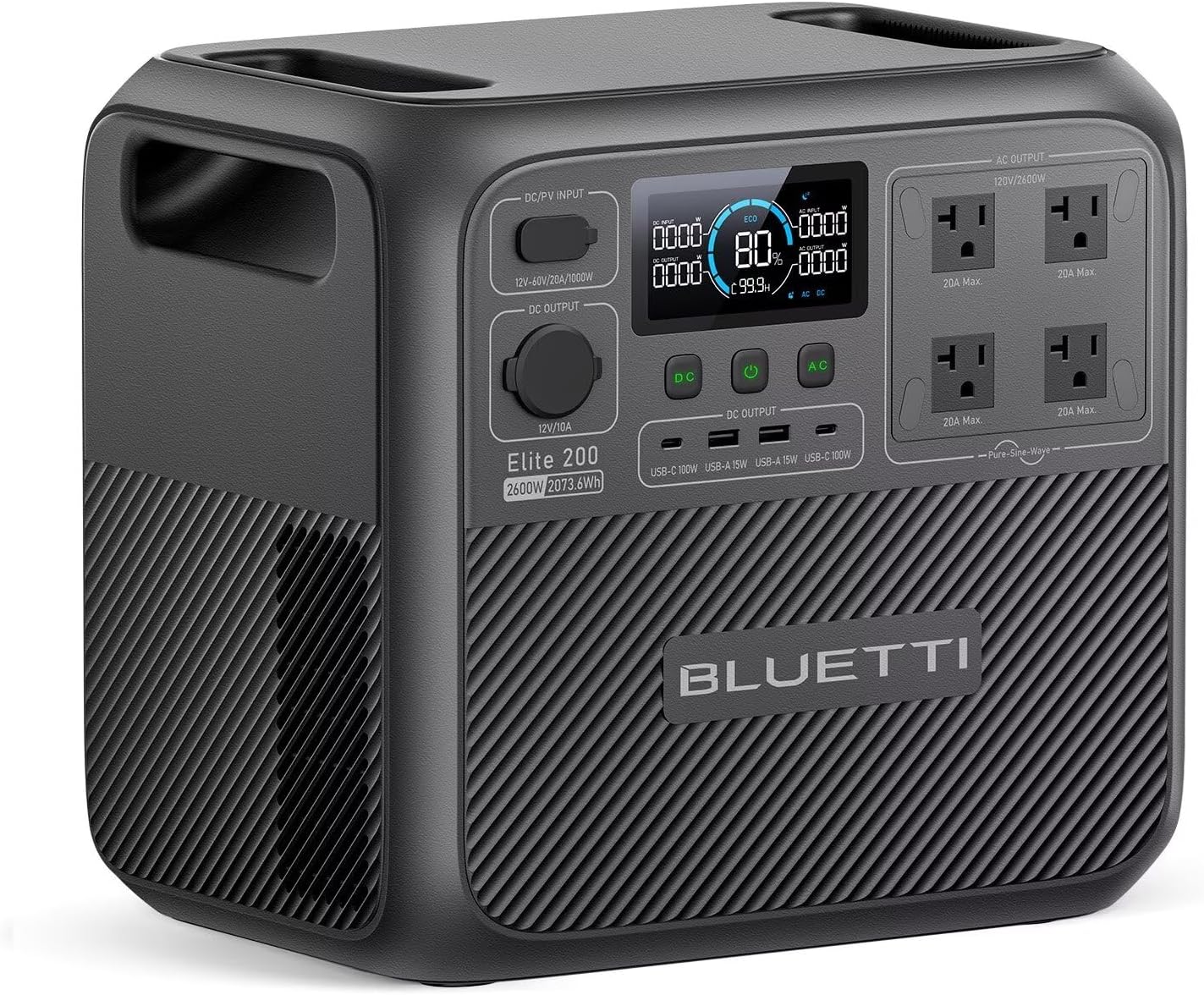
If you live somewhere outages typically clear within a day or two, a single midsize-to-large LiFePO4 power station handles it cleanly and silently. My pick here is the Bluetti Elite 200 V2. It packs 2,073Wh, runs a full-size fridge for the better part of a day, keeps phones and a router going, and its battery is rated for 6,000+ cycles — meaning it’ll still be healthy a decade of hurricane seasons from now. It’s safe indoors, makes no noise overnight, and there’s no fuel to source.
Three to five days: a 2,000Wh-class station plus solar
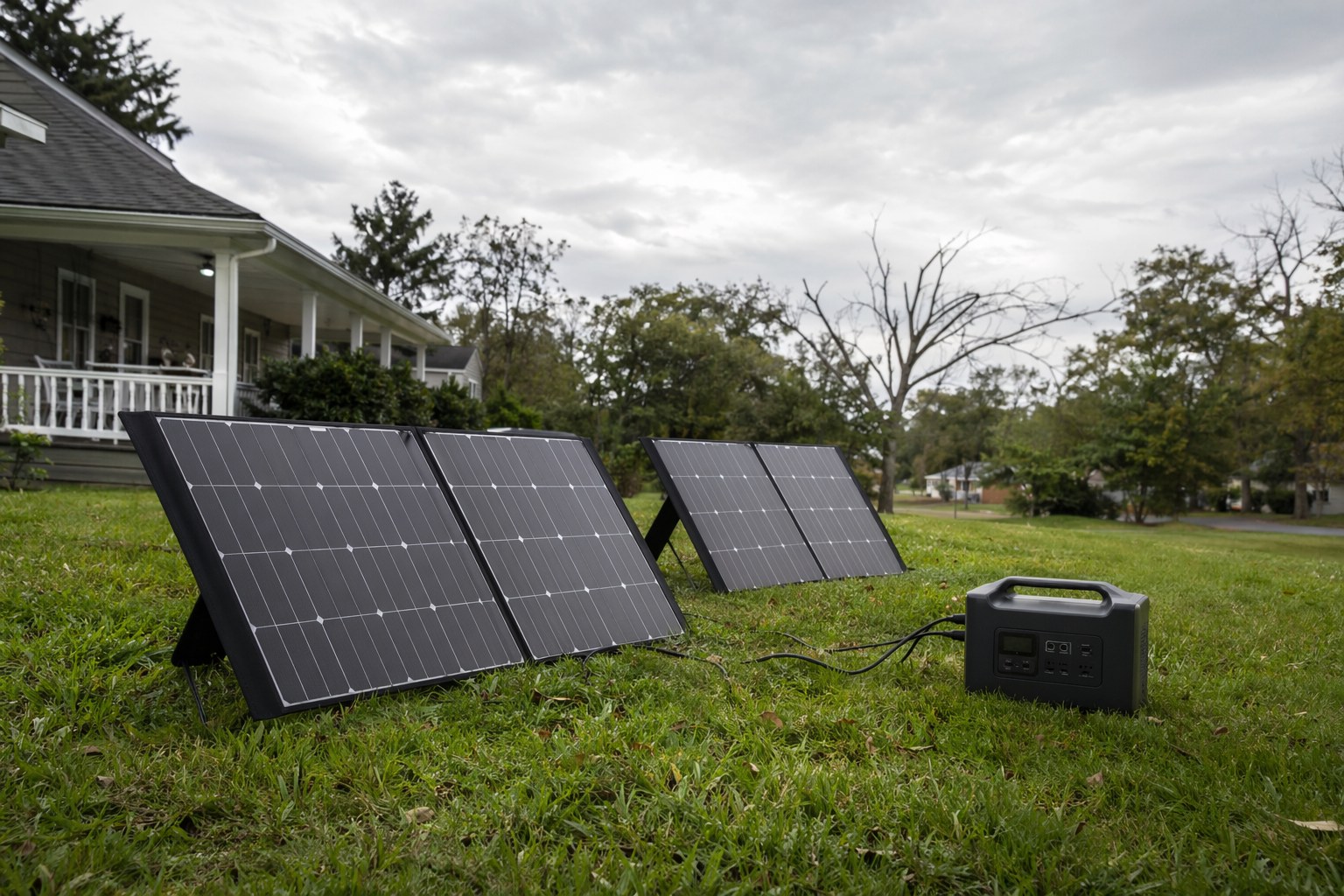
This is the sweet spot for most of the Gulf and Atlantic coast, where multi-day outages are common after a direct hit. A power station without a way to refill is just a countdown timer; pairing it with solar turns it into a renewable supply. The Jackery Explorer 2000 Plus is built for exactly this — it starts at a strong capacity and expands modularly up to 24kWh if you add batteries, so you can scale your investment over a few seasons. Feed it 200-400W of folding solar panels and even cloudy post-storm days recover enough to keep a fridge and your devices alive indefinitely.
Five days or more, or whole-home loads: go expandable, or add a generator
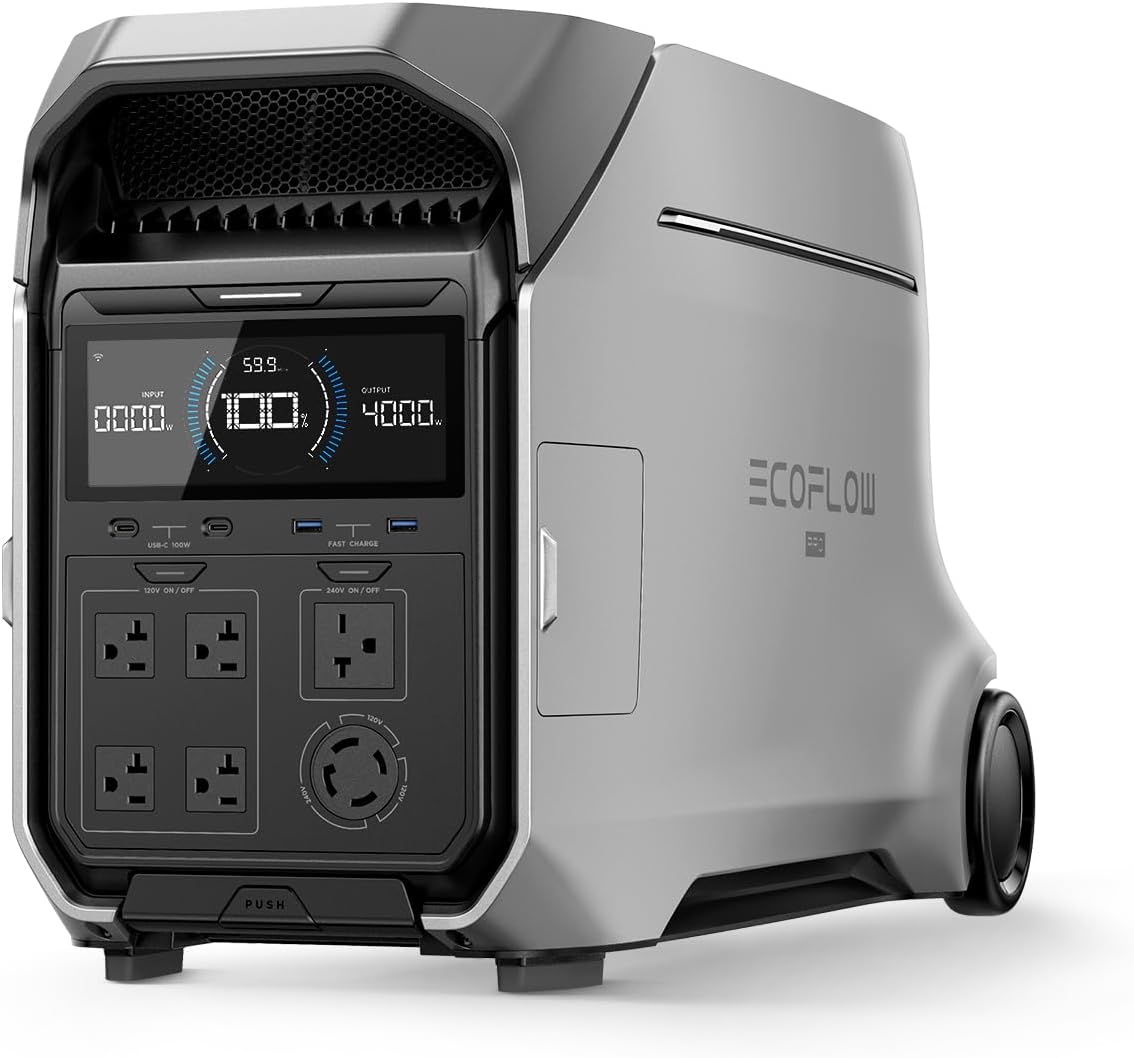
If your area has a history of week-plus outages, or you need to run a window AC unit, a well pump, or multiple freezers, you need serious capacity. The EcoFlow DELTA Pro 3 is the heavyweight here: 4,096Wh in the base unit, expandable to 48kWh, with 240V output that can drive heavy appliances most portable stations can’t touch. It is the closest a portable unit comes to whole-home backup without a permanent installation.
That said, batteries hit a wall when the sun won’t cooperate and the load is huge. That’s where fuel earns its keep. A Champion 4500W dual-fuel inverter generator runs on either gasoline or propane — and propane stores for years without going stale, which is exactly what you want for an asset that sits idle most of the time. For a quieter, lighter option that sips fuel, the Honda EU2200i is the gold standard for reliability and is famously easy to start after months in the garage. The smartest hurricane-zone setups I see use both: a generator for daytime heavy loads, and a power station for silent, fume-free overnight power.
Solar is the difference between days and weeks
I’ll say it plainly because it’s the single most overlooked piece: a station without solar buys you one outage; a station with solar buys you the whole storm. Even on the overcast days that follow a hurricane, a 200W folding panel can recover several hundred watt-hours — enough to offset a fridge and keep phones and a router topped off. Add a second panel and you’re often running entirely off the sun by midday while the battery floats.
For the 1,000-2,000Wh stations above, 200W of solar is the practical minimum and 400W is comfortable. For the DELTA Pro 3 or a multi-battery Jackery setup, you’ll want 400W or more to make meaningful daily progress against the bigger pack. Order the panels in the same trip as the station — they sell out alongside everything else once a storm is named.
The next ten days: a concrete prep timeline
Here’s how I’d spend the window between now and June 1. None of it is hard; it just has to actually happen.
- This week — buy. Lock in your station, panels, and (if needed) generator while inventory is full and prices are normal. Don’t agonize over the perfect unit; any of the picks above is a sound choice. The worst option is no option.
- On arrival — charge and test. Fully charge the station and confirm it holds. Plug in your fridge, your CPAP, your router — the things on your non-negotiable list — and verify they run. Start the generator if you bought one. Find the problems now, not at 2 a.m. in a blackout.
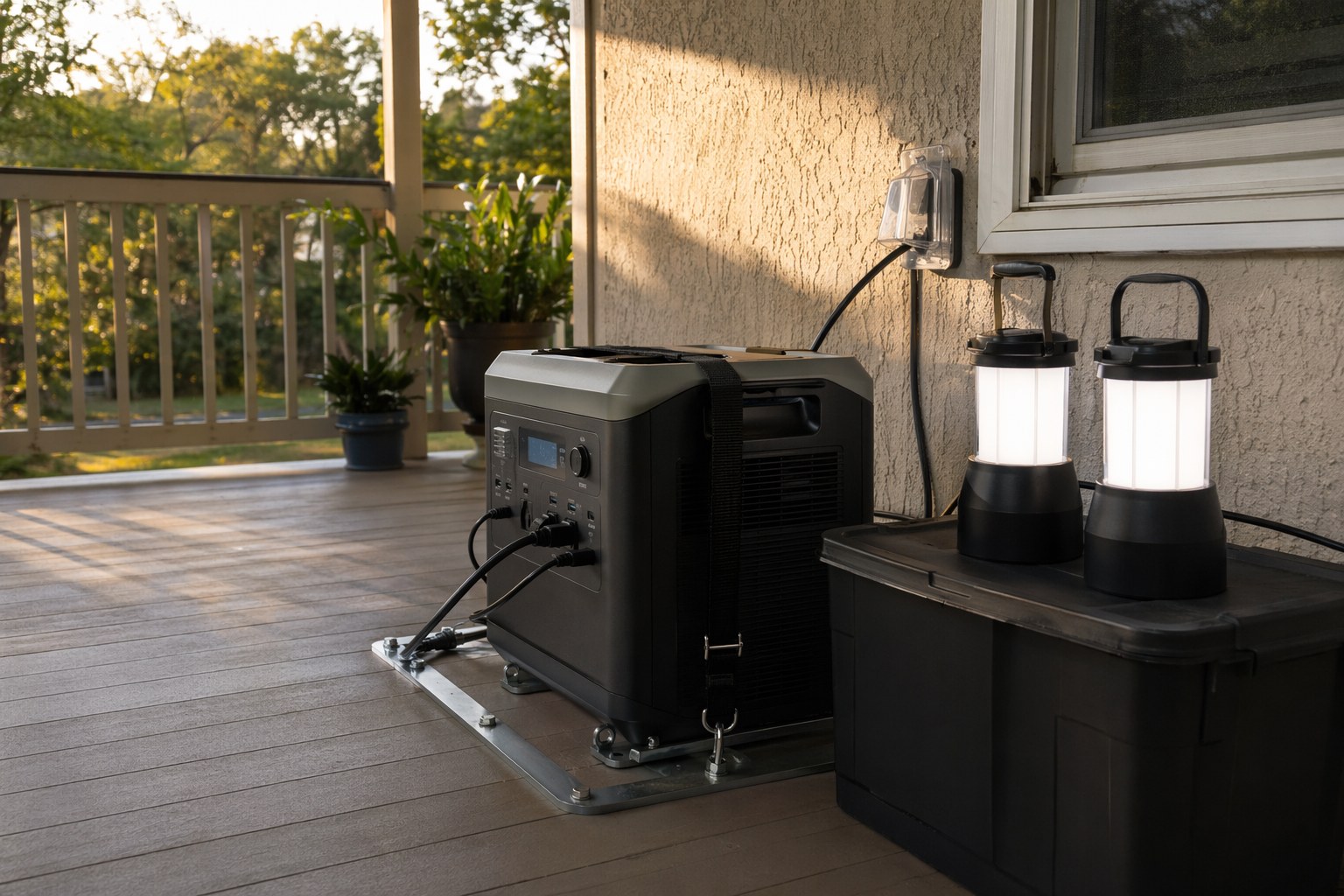
- Stage it. Store the station charged to 80-100%, with all cables, adapters, and a couple of LED lanterns in one labeled spot you can reach in the dark. Stock fuel or propane for the generator and store it safely outdoors per local code.
- Write your shutdown-and-startup order. Know what you’ll power first and what you’ll switch off. When the lights actually go out, having a plan removes the panic — our power outage survival guide lays out exactly what to do in the first ten minutes, the first hour, and the first day.
A word on what to power first
When the grid drops, prioritize in this order, every time: medical devices first (CPAP, oxygen, medication fridges — non-negotiable), then one phone kept fully charged for emergency communication, then the refrigerator, then lighting, then fans, then your internet router. Lights and routers draw almost nothing; the fridge and any fan are your real ongoing loads. Keeping that order in your head means you stretch every watt-hour toward what actually keeps your household safe.
The bottom line
Hurricane season starts June 1, but your deadline is sooner than that. The equipment that protects your family through a multi-day outage is sitting in stock at fair prices for maybe another week and a half. After that you’re either set up and tested, or you’re refreshing an out-of-stock page while a storm closes in. For most coastal households, a 1,000-2,000Wh LiFePO4 station paired with 200-400W of solar is the right answer; if you face long outages or heavy loads, add a dual-fuel generator and step up to an expandable system.
Don’t wait for the storm to have a name. Order this week, charge it, test it, stage it — and then let the season come.
Related Reading
- Hurricane Season 2026 Power Prep: Complete Guide — the full three-tier breakdown by budget and household
- How to Build an Emergency Power Kit — the complete checklist beyond just the station
- Power Outage Survival Guide: What to Do First — your minute-by-minute playbook when the grid drops
Recommended Power Stations
EcoFlow
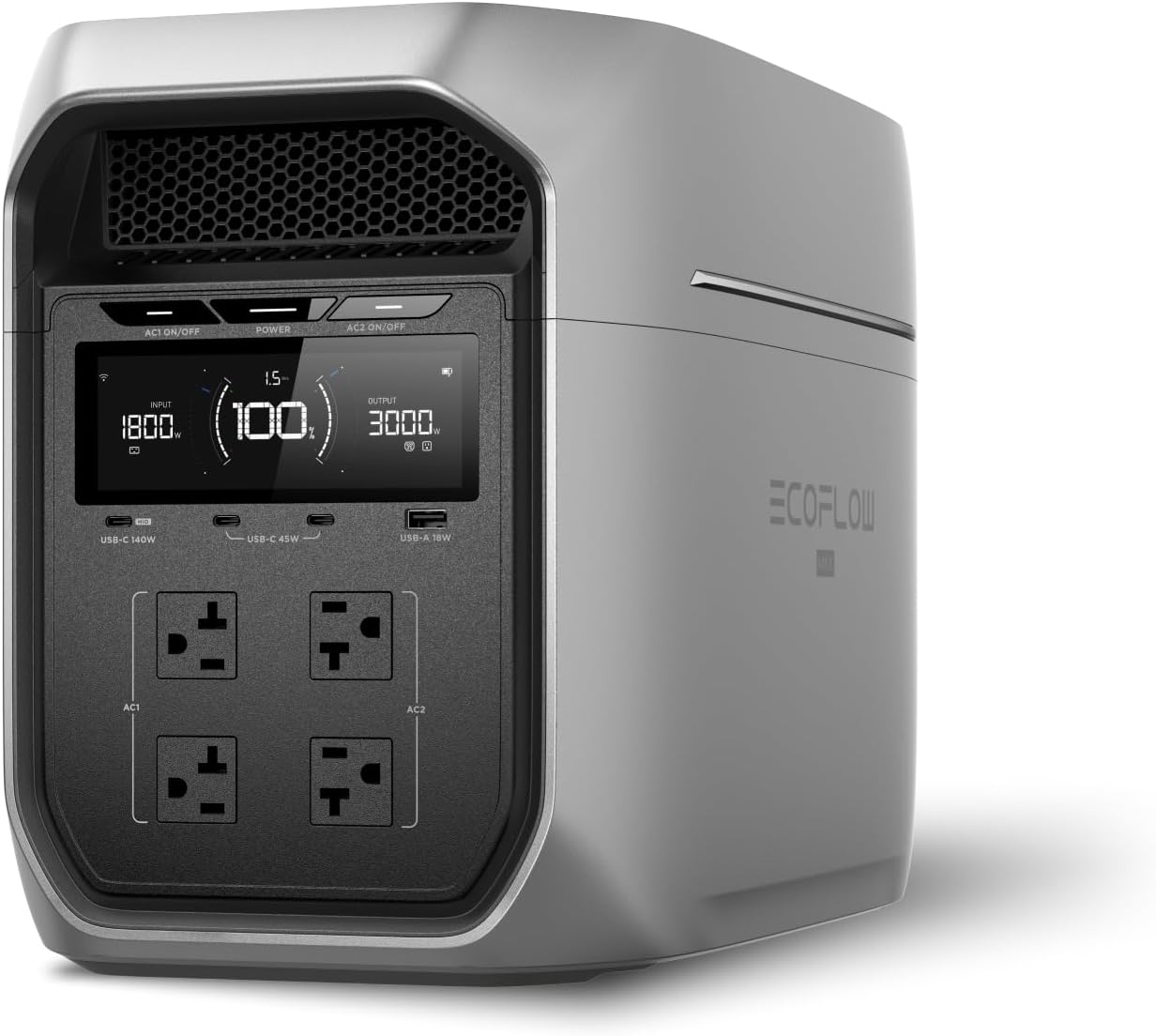
EcoFlow DELTA 3 Plus
EcoFlow's newest mid-range flagship. The DELTA 3 Plus improves on the Delta 2 with faster charging, LiFePO4 chemistry, and UPS functionality — all at a lower price.
Frequently Asked Questions
Is it too late to buy emergency power before hurricane season?
No, but late May is the last comfortable window. Atlantic hurricane season officially opens June 1, and the dangerous stretch runs mid-August through October. If you order a power station or generator in the next week or two, it arrives, charges, and gets tested with weeks to spare. Wait until a named storm enters the Gulf and you'll face 20-30% price spikes, sold-out inventory, and shipping delays of a week or more. The equipment exists right now at normal prices. That stops being true the moment a cone of uncertainty points at your coast.
How big a power station do I need for a hurricane outage?
For phones, lights, a router, and a CPAP, a 1,000Wh station like the Bluetti Elite 200 V2 covers 1-2 days and runs a full-size fridge for 12-18 hours per charge. To keep a fridge, fans, and devices going for 3-5 days, step up to a 2,000Wh-class unit and pair it with 200W of solar so it recharges daily. For a whole-home setup with a window AC or well pump, you want a 4,000Wh expandable system or a dual-fuel generator. Most coastal families land in the 1,000-2,000Wh range plus solar.
Should I get a generator or a power station for hurricanes?
For most households, a power station with solar is the better primary backup: it runs indoors with zero fumes, needs no fuel (which sells out before every storm), and recharges from the sun for free. A dual-fuel inverter generator like the Champion 4500W makes sense when you need to run a window AC, a well pump, or several large appliances at once, or when you need days of runtime that solar alone can't sustain. The strongest setup in a hurricane zone is both: a quiet power station for overnight and a generator for daytime heavy loads.
Ready to Buy? Here's What We Recommend
Based on our testing and this guide, these are the best options for most people: