Guide
A Family of Four's Complete Camping Power Setup: Real-World Tested Across 12 Trips

TL;DR
We took four different power stations on 12 camping trips with a family of four. Here's exactly what worked, what didn't, and the specific setup we recommend after a year of real-world testing.
Last year, my family decided to upgrade our camping setup from “flashlights and a car charger” to a proper power station system. After 12 camping trips across four seasons, borrowing and testing different setups, here’s what we learned — and the specific configuration that’s now permanently in our car.
Our Family’s Power Needs
Before buying anything, I tracked what we actually use on a typical camping weekend:
The family:
- Two adults, two kids (ages 7 and 11)
- Mix of campground and dispersed (boondock) camping
- 2-3 night trips, occasionally 5-7 day summer trips
Our devices and daily power consumption:
| Device | Watts | Daily Hours | Daily Wh |
|---|---|---|---|
| 4x smartphone charging | 15W each | 1.5h each | 90 Wh |
| 2x kid tablet charging | 15W each | 1h each | 30 Wh |
| 12V mini fridge (Alpicool C20) | 45W avg | 24h (cycles) | 360 Wh |
| LED string lights | 10W | 4h | 40 Wh |
| LED lantern (inside tent) | 5W | 3h | 15 Wh |
| Portable fan (summer) | 15W | 8h | 120 Wh |
| Bluetooth speaker | 5W | 4h | 20 Wh |
| Electric kettle (morning coffee) | 1,200W | 0.05h (3 min) | 60 Wh |
| Total | 735 Wh/day |
Adding a 20% buffer: ~880 Wh/day
This immediately told us a 500Wh power station wouldn’t cut it for more than one day, and even a 1,000Wh unit would need solar for trips longer than 2 nights.
The Four Setups We Tested
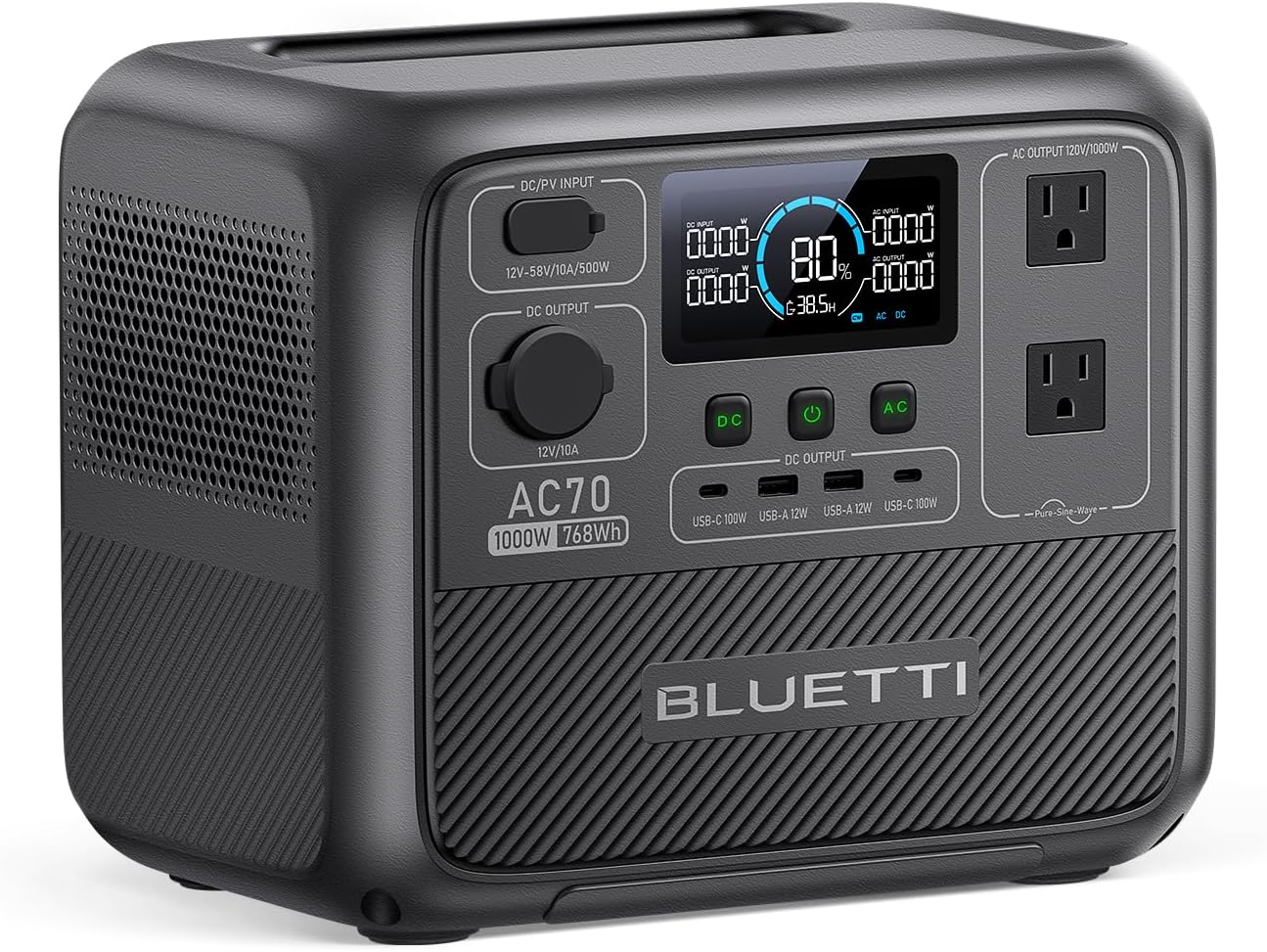
Setup 1: Budget Option — Bluetti AC70 (768Wh)
Cost: $499 | Weight: 22.7 lbs
Trip: 2-night campground trip, spring (no fan needed)
Results: The AC70 handled our lighter-use spring trips well. We used about 600Wh/day without the fan, leaving us at about 20% by morning on day two. The 1,000W output easily ran the electric kettle for morning coffee (our single biggest power draw). We didn’t run out, but it was tight.
Verdict: Adequate for 1-2 night trips without heavy fan or AC use. You’ll be watching the battery percentage nervously on the second night. For a family, this is the minimum — we’d feel more comfortable with more headroom.
See current price and full review →
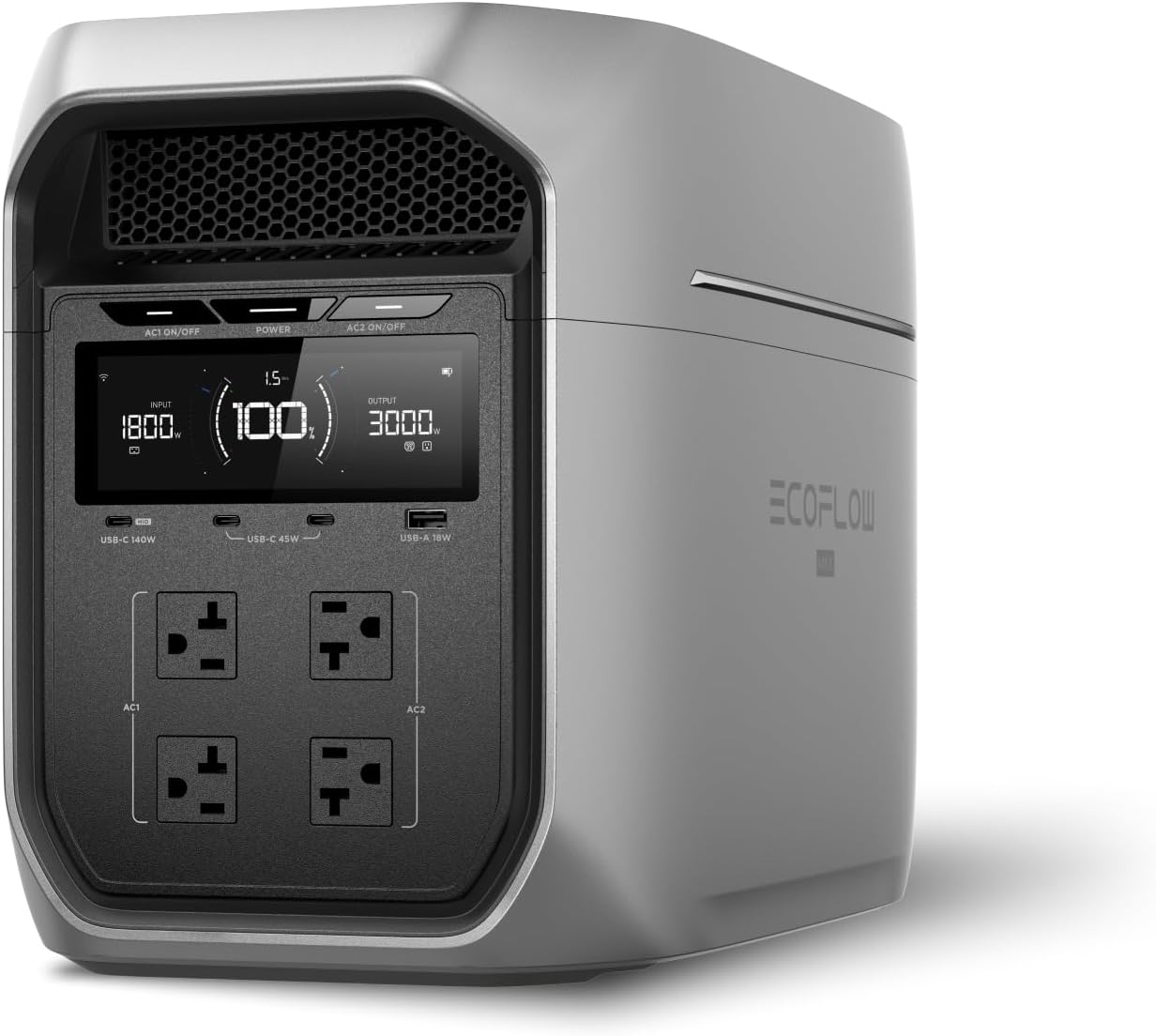
Setup 2: Our Pick — EcoFlow DELTA 3 Plus (1,024Wh)
Cost: $649 | Weight: 17.6 lbs
Trip: 3-night summer trip (dispersed camping), paired with EcoFlow 220W solar panel
Results: This is where things clicked. The DELTA 3 Plus has enough capacity (1,024Wh) to handle our daily draw with room to spare, and the 500W maximum solar input meant our 220W panel was replenishing 600-800Wh during the day. We ended every day with more battery than we started.
The 1,800W output ran everything we threw at it, including a hair dryer for my daughter (briefly) and a portable induction cooktop for dinner one night. At 17.6 lbs, it’s lighter than the Bluetti despite having more capacity — genuinely easy to carry from car to campsite.
The game changer: The EcoFlow app showed real-time solar input and load, so we could see exactly how much power we were generating and using. It turned energy management into a fun math project for the kids.
Verdict: The best balance of capacity, weight, output, and solar charging for a family. This is what we keep in our car permanently now.
See current price and full review →
Setup 3: Heavy-Duty Option — Bluetti Elite 200 V2 (2,073Wh)
Cost: $1,099 | Weight: 50.7 lbs
Trip: 5-night summer trip (dispersed camping, hot weather), no solar panel
Results: Massive capacity meant we didn’t worry about power at all for the first 3 days. We ran the fan all night (120Wh/night), used the kettle twice daily, charged every device freely, and even ran a portable blender for smoothies. By day 4, we were at about 25% — we could have made it to day 5 with careful management, but would’ve had to cut the fan.
At 50 lbs, this unit is heavy. Getting it from the car to our campsite (about 100 yards) required two trips with breaks. It’s better suited to car-adjacent camping or RV use where you don’t need to carry it far.
Verdict: Overkill for most weekend trips, but great for extended stays. The weight is the dealbreaker for us — the DELTA 3 Plus with a solar panel gives us more effective daily capacity in a package we can actually carry.
See current price and full review →
Setup 4: Solar-First Option — Jackery Explorer 1000 v2 + SolarSaga 200W
Cost: $799 + $499 = $1,298 | Weight: 24.2 lbs (station) + 17.5 lbs (panel)
Trip: 3-night campground trip, mixed sun/clouds
Results: The Jackery produced excellent results on sunny days (the SolarSaga 200 put out a consistent 140-160W in direct sun). On the cloudy second day, solar dropped to about 60W, but we still generated enough to run the fridge and charge devices.
The Jackery 1000 v2 is well-built and the app works smoothly, but the 1,500W output means no electric kettle or induction cooktop (our kettle draws 1,200W, which technically fits, but the startup surge sometimes tripped protection). We switched to a pour-over coffee setup on this trip.
Verdict: Great combo if solar is central to your strategy. The panel is high quality. But the lower output ceiling compared to the DELTA 3 Plus (1,500W vs. 1,800W) limits what appliances you can run, and the total system cost is $650 more.
See current price and full review →
What We Learned After 12 Trips
Lesson 1: The fridge is the biggest power draw — and the most worth it
Our 12V Alpicool mini fridge uses 360Wh/day, which is nearly half our total budget. We debated dropping it many times. But cold drinks, fresh fruit for the kids, and not worrying about food safety on hot days make camping dramatically more enjoyable. If you’re going to invest in a power station for camping, run a fridge. It’s the single upgrade that most improves the experience.
Lesson 2: Solar changes everything for trips over 2 nights
Without solar, you’re draining a finite tank. With solar, you have a daily income. Our 220W panel generating 600-800Wh/day means we could camp indefinitely — daily solar income exceeds daily consumption on sunny days. For weekend trips, solar is nice. For anything longer, it’s essential.
Lesson 3: Weight matters more than specs
The 50-lb Bluetti Elite 200 V2 has amazing specs. We stopped bringing it because carrying it was miserable. The 17.6-lb EcoFlow DELTA 3 Plus does everything we need and is easy for one person to carry. When comparing power stations, carry the one you’re considering before buying — it may be heavier than you expect.
Lesson 4: Kids love managing the power budget
Unexpected benefit: our 11-year-old became obsessed with the EcoFlow app, tracking solar input and calculating how long the battery would last. It’s practical math with real consequences. “If we’re making 180W from solar and using 65W total, how many watt-hours do we gain per hour?”
Lesson 5: Keep morning coffee simple
Our electric kettle (1,200W) burns through 60Wh every morning — not a lot in absolute terms, but it’s a high-wattage draw that stresses the system. A camp stove with a pot of water uses zero battery. We now save our power station’s output for things that can’t easily be replaced with analog alternatives.
Our Recommended Family Camping Power Setup
After 12 trips, this is our permanent car camping loadout:
Power Station: EcoFlow DELTA 3 Plus ($649)
- 1,024Wh capacity, 1,800W output
- 17.6 lbs — easy to carry
- 500W solar input for fast recharge
- App for monitoring
Solar Panel: EcoFlow 220W Bifacial ($350)
- Generates 600-800Wh on a good day
- Folds compact, includes kickstand
- Bifacial design captures reflected light for a small boost
Total investment: ~$1,000
Optional add: A second 220W panel ($350) for cloudy conditions or very heavy use. With 440W of solar, you’ll fully recharge the DELTA 3 Plus by early afternoon even on partly cloudy days.
For other camping power station options, see our complete best power stations for camping guide or compare models in our comparison tool.
Related Reading
- Best Portable Power Stations for Camping — our top camping picks
- Complete Campsite Power Guide — detailed setup and placement tips
- How to Set Up an Off-Grid Solar System — step-by-step solar guide
- Best Solar Panel + Power Station Combos 2026 — matched kits
- How to Size a Power Station — calculator for your specific needs
- Power Station for Tailgating — another outdoor use case
Recommended Power Stations
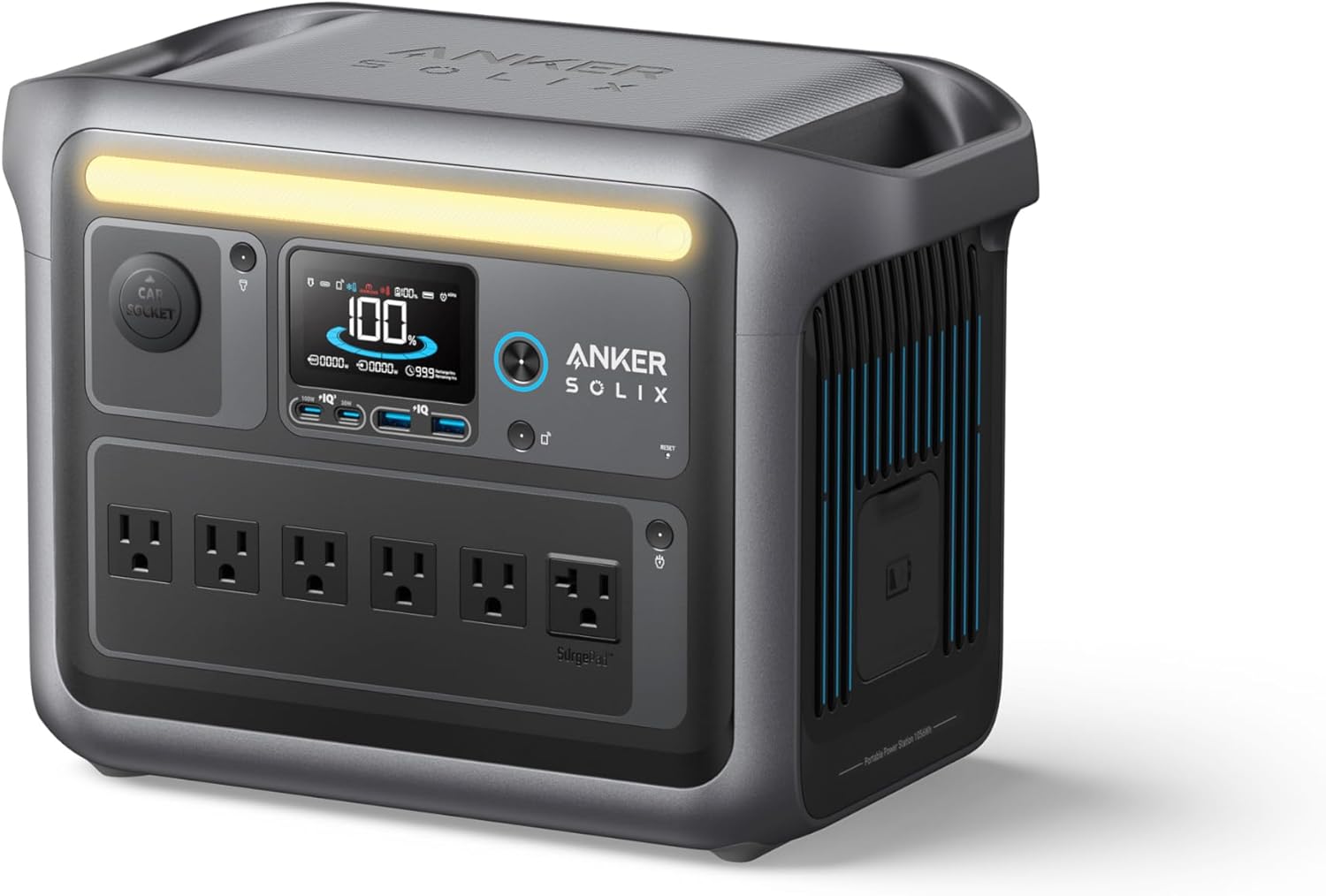
EcoFlow
EcoFlow DELTA 3 Plus
EcoFlow's newest mid-range flagship. The DELTA 3 Plus improves on the Delta 2 with faster charging, LiFePO4 chemistry, and UPS functionality — all at a lower price.
Frequently Asked Questions
What size power station does a family of 4 need for camping?
For a typical 2-3 night car camping trip, a family of four needs 800-1,200Wh of capacity. This covers phone charging for everyone, a mini fridge, LED lights, a small fan, and device charging for kids' tablets. If you add a portable blender, coffee maker, or electric stove, step up to 1,500-2,000Wh. Adding a 200W solar panel extends any system for longer trips.
Can kids safely use a power station?
Yes, with basic precautions. Modern power stations have safety features that prevent shock from the outlets. However, keep the power station off the ground (away from water and dirt), teach kids not to insert objects into AC outlets, and keep the unit away from tent fabric (ventilation heat). USB outlets are completely safe for kids to plug devices into independently.
Is a power station or generator better for family camping?
Power stations are dramatically better for family camping. They're silent (won't disturb neighbors or wildlife), produce zero emissions (safe inside tents and vehicles), and require no fuel management. Generators are noisy (65-80 dB), produce carbon monoxide (deadly in enclosed spaces), and are banned at most campgrounds. The only scenario where a generator wins is multi-day dry camping with very heavy power needs (running AC or large appliances).
Ready to Buy? Here's What We Recommend
Based on our testing and this guide, these are the best options for most people: