Guide
Portable Power Glossary: 60+ Terms Explained in Plain English

TL;DR
A complete glossary of portable power terms. From amp-hours to X-Boost, every technical term you'll encounter when shopping for power stations, solar panels, generators, and batteries — defined simply.
Shopping for portable power products means encountering a wall of technical jargon. This glossary defines every term you’re likely to see on spec sheets, product pages, and in our reviews — in plain language, with context for why each term matters.
Terms are organized alphabetically. Use Ctrl+F (Cmd+F on Mac) to search for a specific term.
A
AC (Alternating Current)
The type of electricity used in wall outlets and household appliances. In AC, the current direction reverses 60 times per second (60Hz in the US). Power stations use an inverter to convert stored DC battery power to AC for standard outlets.
Ah (Amp-Hour)
A unit of charge capacity. One amp-hour means the battery can deliver 1 amp of current for 1 hour. Common for RV and car batteries. To convert to Wh: Ah × Voltage = Wh. See also: Wh (Watt-Hour).
Amps (A) / Amperage
A measure of electrical current — how many electrons flow through a conductor per second. Higher amps = more current flow. In the US, standard household outlets provide 15-20 amps at 120V.
Anderson Connector
A type of DC power connector commonly used in RV and marine applications. Some power stations include Anderson ports for connecting to RV battery systems or high-current DC loads.
B
Battery Cycle
One complete discharge and recharge of a battery. A cycle doesn’t have to be 0% → 100%; two 50% discharges equal one full cycle. LiFePO4 batteries last 3,000-6,000 cycles; Li-NMC lasts 500-2,500 cycles. See our battery chemistry guide.
Battery Management System (BMS)
The electronic circuit board inside a battery pack that monitors and protects the cells. The BMS manages cell voltage balancing, temperature monitoring, overcharge/over-discharge protection, and short circuit protection. The quality of the BMS significantly affects battery longevity and safety.
Bifacial Solar Panel
A solar panel that captures light on both its front and back surfaces. Light reflected off the ground (especially light-colored surfaces like sand or snow) hits the back of the panel, boosting output by 5-25%. EcoFlow’s 220W bifacial panel is a popular example.
Bypass Diode
A component in solar panels that allows current to flow around a shaded cell rather than through it. Without bypass diodes, one shaded cell in a series string would reduce the entire string’s output. Most quality portable panels include 2-4 bypass diodes.
C
Capacity (Wh)
The total amount of energy a power station can store, measured in watt-hours. A 1,000Wh station stores 1,000 watt-hours. Real-world usable capacity is typically 85-90% of rated capacity due to inverter losses and BMS cutoffs. See our watts and watt-hours guide.
Charge Controller
The electronics that regulate power flow from solar panels to a battery. Prevents overcharging and optimizes power extraction. See: MPPT, PWM.
Continuous Output / Continuous Watts
The maximum power (in watts) a power station can deliver indefinitely. Different from peak/surge watts, which is a brief maximum. A station rated at 1,800W continuous can run any device drawing up to 1,800W for as long as the battery lasts.
Cycle Life
The number of charge-discharge cycles a battery can complete before degrading to 80% of its original capacity. LiFePO4: 3,000-6,000 cycles. Li-NMC: 500-2,500 cycles. This is the most important longevity spec on a power station.
D
DC (Direct Current)
Electricity that flows in one direction. Batteries store and deliver DC power. Solar panels produce DC. USB ports, 12V car outlets, and most electronic devices use DC. Opposite of AC.
Depth of Discharge (DoD)
How much of a battery’s total capacity is used before recharging. 80% DoD means you used 80% and recharged at 20% remaining. Shallower DoD (e.g., 50%) extends cycle life because it puts less stress on the battery.
Dual Fuel Generator
A generator that can run on two fuel types, typically gasoline and propane. Dual-fuel capability provides fuel flexibility during emergencies when one fuel may be unavailable.
E
EcoFlow X-Boost
EcoFlow’s proprietary technology that allows a power station to run devices rated higher than its continuous output by intelligently reducing voltage. For example, a 1,800W station with X-Boost might run a 2,400W device at reduced performance. Works best with resistive loads (heaters, hair dryers) but not motors or compressors.
ETFE (Ethylene Tetrafluoroethylene)
A tough, UV-resistant plastic coating used on portable solar panels. ETFE-coated panels are more durable and scratch-resistant than PET-laminated panels. Look for ETFE coating on panels that will see heavy use.
Expandable / Expansion Battery
An additional battery pack that connects to a compatible power station to increase its total capacity. For example, the EcoFlow DELTA Pro 3 (4,096Wh) can add extra batteries up to 48kWh total. Expansion batteries are sold separately and share the main unit’s inverter and charge controller.
F
Fast Charging
Charging a power station at a high wattage for reduced charge time. Modern stations like the EcoFlow DELTA 3 Plus can charge from 0-100% in as little as 40 minutes using 1,800W AC input. Fast charging generates more heat and may slightly reduce long-term battery life compared to slower charging.
G
Ground Fault Circuit Interrupter (GFCI)
A safety device that cuts power when it detects current flowing through an unintended path (like through a person). Some power station AC outlets include GFCI protection. Required by electrical code for outlets near water sources.
H
Hertz (Hz)
The frequency of AC power — how many times per second the current reverses direction. US standard is 60Hz. European standard is 50Hz. Most power station inverters output 60Hz for North American compatibility.
Hot-Swappable
The ability to swap or add batteries to a power station while it’s running, without interruption. Some expandable systems support hot-swapping expansion batteries.
I
Ingress Protection (IP) Rating
A two-digit code indicating a device’s resistance to dust and water. The first digit is dust protection (0-6), the second is water protection (0-9). Common ratings for portable power:
- IP54: Protected against dust and water splashes
- IP65: Dust-tight and protected against water jets
- IP67: Dust-tight and can be briefly submerged
- IP68: Dust-tight and can be submerged for extended periods
Inverter
An electronic circuit that converts DC (battery power) to AC (household current). See also: Pure Sine Wave, Modified Sine Wave.
Inverter Efficiency
The percentage of DC energy that’s successfully converted to AC. A 90% efficient inverter wastes 10% as heat. Most modern power station inverters are 88-93% efficient. This is why real-world runtime is less than the simple “capacity ÷ device watts” calculation.
L
LiFePO4 (Lithium Iron Phosphate)
The dominant battery chemistry in modern power stations. Offers 3,000-6,000 cycle life, excellent thermal stability, and no cobalt. Slightly heavier than Li-NMC for the same capacity. See our complete battery chemistry guide.
Li-NMC (Lithium Nickel Manganese Cobalt)
An older lithium battery chemistry with higher energy density but shorter cycle life (500-2,500 cycles) and greater thermal runaway risk. Being phased out in favor of LiFePO4 in power stations.
M
MC4 Connector
The standard connector used in solar panels. MC4 (Multi-Contact 4mm) connectors are waterproof, snap-lock connectors rated for outdoor use. Most portable solar panels use MC4 connectors, and most power stations include MC4 solar input ports or MC4-to-proprietary adapter cables.
Modified Sine Wave
A cheaper type of AC output waveform that approximates (but doesn’t match) the smooth sine wave from the utility grid. Modified sine wave can cause buzzing in audio equipment, flickering in dimmable lights, and overheating in some motors. Most quality power stations produce pure sine wave output.
MPPT (Maximum Power Point Tracking)
An advanced solar charge controller algorithm that continuously adjusts the electrical load to extract maximum power from solar panels. MPPT controllers are 95-99% efficient, significantly outperforming PWM controllers (70-85%). All recommended power stations use MPPT.
N
NMC — See: Li-NMC
O
Open Circuit Voltage (Voc)
The voltage a solar panel produces when not connected to a load (no current flowing). Voc is always higher than operating voltage. Important for determining solar panel compatibility with your power station — the Voc of your panels (especially in series) must not exceed the station’s maximum input voltage.
Output Wattage
The maximum power a power station can deliver to connected devices. See: Continuous Output, Peak/Surge Watts.
P
Parallel Connection
Wiring two or more solar panels (or batteries) so that their currents add while voltage stays the same. Used when you need more current without exceeding a voltage limit. Compare with: Series Connection.
Passthrough Charging
The ability to charge a power station while simultaneously powering connected devices. Enables use as a UPS (uninterruptible power supply). During passthrough, grid power charges the battery and feeds devices; if grid power fails, the battery seamlessly takes over.
Peak Sun Hours (PSH)
The number of equivalent hours at 1,000 W/m² of solar irradiance per day. A location with 5 PSH receives the equivalent of 5 hours of maximum-intensity sunlight per day. This is the key metric for estimating daily solar energy production. See our solar panel guide.
Peak Watts / Surge Watts
The maximum power a power station can deliver for a brief period (typically 1-10 seconds) to handle device startup surges. Usually 2x the continuous output rating. A station rated 1,800W continuous / 3,600W peak can start a device that surges to 3,600W as long as it settles below 1,800W.
Power Delivery (PD)
A USB-C charging protocol that allows higher power transfer, up to 240W. USB-C PD enables fast charging for laptops, tablets, and phones. Power stations with 100W+ USB-C PD ports can fast-charge a MacBook Pro at maximum speed.
Pure Sine Wave
A clean, smooth AC waveform identical to what the utility grid produces. Pure sine wave output is required for sensitive electronics, variable-speed motors, and medical devices. All recommended power stations produce pure sine wave AC.
PWM (Pulse Width Modulation)
A simpler, less efficient solar charge controller technology. PWM controllers are 70-85% efficient compared to MPPT’s 95-99%. Not used in quality power stations; common in budget standalone charge controllers.
R
Rated Capacity vs. Usable Capacity
Rated capacity is the total energy a battery can theoretically store. Usable capacity is what you actually get — typically 85-90% of rated, due to BMS cutoffs (the system shuts down before the battery is truly empty to prevent damage) and inverter conversion losses.
S
SEI Layer (Solid Electrolyte Interface)
A thin chemical layer that forms on a lithium battery’s anode during charging. The SEI is necessary for battery function but gradually thickens over time, trapping lithium ions and reducing capacity. This is the primary mechanism of battery aging. See our battery science guide.
Series Connection
Wiring two or more solar panels (or batteries) so that their voltages add while current stays the same. Used when you need higher voltage for longer cable runs or to meet a charge controller’s voltage window. Compare with: Parallel Connection.
Solar Input (Max)
The maximum wattage of solar power a power station can accept. Going above this limit doesn’t speed charging — the charge controller caps intake. Going below means slower but still functional charging.
State of Charge (SoC)
The current charge level of a battery, expressed as a percentage of total capacity. 100% SoC = fully charged, 0% SoC = fully discharged. Displayed on power station screens and apps.
T
Temperature Coefficient
How much a solar panel’s output decreases for every degree Celsius above 25°C (the standard test temperature). Typical value: -0.3% to -0.5% per °C. At 65°C cell temperature (a hot summer day), a panel with -0.4%/°C coefficient loses 16% output. See our solar panel guide.
Thermal Runaway
A dangerous condition where a lithium battery cell overheats and triggers a self-sustaining chemical reaction, potentially causing fire or explosion. LiFePO4 batteries are highly resistant to thermal runaway (stable to 270°C/518°F). Li-NMC cells can enter thermal runaway at 150°C/302°F. This is the primary safety advantage of LiFePO4.
U
UPS (Uninterruptible Power Supply)
A device that provides backup power during grid outages with zero transfer time (no interruption). Dedicated UPS units are designed for computers and servers. Power stations with passthrough charging can function as a UPS, though some have a small transfer time (10-20ms) that may briefly interrupt sensitive equipment. See our UPS category page.
USB-A
The older, larger rectangular USB connector. Typically limited to 5V/2.4A (12W) charging. Found on most power stations for basic device charging.
USB-C / USB-C PD
The newer, reversible USB connector supporting USB Power Delivery (PD) for higher wattage charging. USB-C PD ports on power stations typically deliver 60-140W, enough to fast-charge laptops and phones simultaneously.
V
Voltage (V)
The electrical pressure or force that pushes current through a circuit. Higher voltage = stronger push. See our complete electrical units guide.
V-Mount Battery
A professional video/photography battery system using a standardized V-shaped mounting plate. V-mount batteries are used for cinema cameras, LED panels, and professional monitoring equipment. They can be charged from a power station’s AC outlets using standard V-mount chargers.
W
Watts (W)
A unit of power — the rate of energy transfer. Watts = Volts × Amps. A device rated at 100W consumes energy at a rate of 100 watt-hours per hour. See: Continuous Output, Peak Watts.
Wh (Watt-Hour)
A unit of energy — the total amount of energy consumed or stored. A 100W device running for 10 hours uses 1,000Wh (1 kWh). This is the most important capacity specification on a power station. See our electrical units guide.
X
X-Boost — See: EcoFlow X-Boost
Y
Y-Connector / Y-Splitter
A cable that splits one connection into two, used to connect two solar panels in parallel to a single power station input. Available in MC4 and proprietary connector types.
Didn’t find what you were looking for? Our complete guides library covers these concepts in depth, or use our comparison tool to see how specific power stations stack up on the specs that matter to you.
Recommended Power Stations
EcoFlow
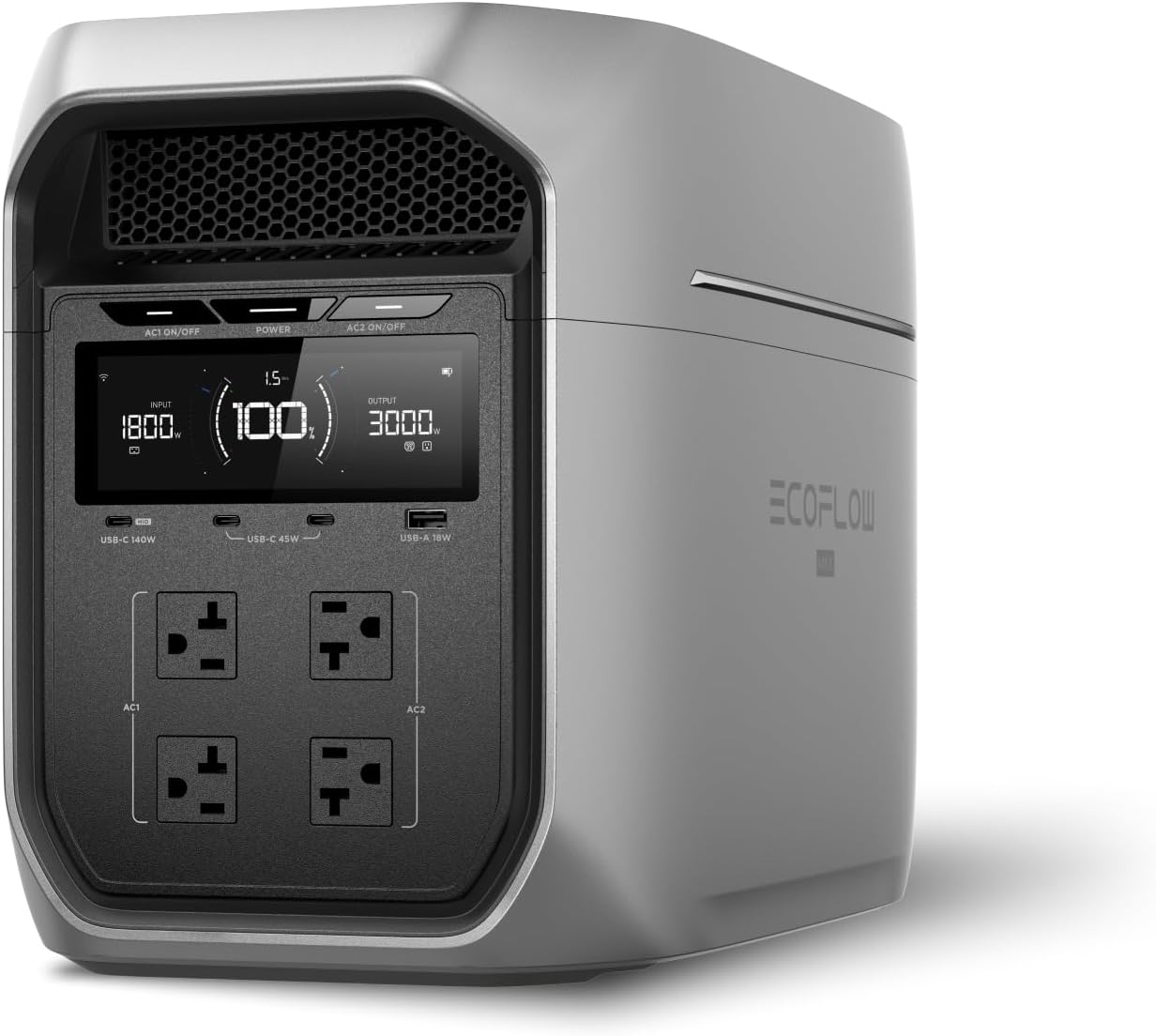
EcoFlow DELTA 3 Plus
EcoFlow's newest mid-range flagship. The DELTA 3 Plus improves on the Delta 2 with faster charging, LiFePO4 chemistry, and UPS functionality — all at a lower price.
Frequently Asked Questions
What does LiFePO4 stand for?
LiFePO4 stands for Lithium Iron Phosphate, a type of lithium battery chemistry. The chemical formula is LiFePO₄. It's the preferred battery chemistry for modern power stations because of its long cycle life (3,000-6,000 cycles), thermal stability (resistant to thermal runaway), and environmental friendliness (no cobalt). Nearly every power station released in 2025-2026 uses LiFePO4.
What is the difference between inverter and converter?
An inverter converts DC (direct current, from batteries) to AC (alternating current, used by wall outlets and household devices). A converter (or adapter) changes the voltage level of DC or AC power. In power stations, the inverter is the component that creates the 120V AC output from the battery's DC storage. The quality of the inverter (pure sine wave vs. modified sine wave) affects whether sensitive electronics run properly.
What does MPPT mean on a power station?
MPPT stands for Maximum Power Point Tracking. It's a type of charge controller that optimizes the electrical load seen by solar panels to extract the maximum possible power. MPPT controllers are 95-99% efficient, compared to 70-85% for simpler PWM (Pulse Width Modulation) controllers. All quality power stations use MPPT solar charge controllers.
What is passthrough charging?
Passthrough charging (also called UPS mode or pass-through) means the power station can charge from a wall outlet while simultaneously providing power to connected devices. This allows the unit to function as an uninterruptible power supply (UPS) — if grid power fails, devices stay running on battery power without interruption. Not all power stations support passthrough; check the specs if this feature matters to you.
Ready to Buy? Here's What We Recommend
Based on our testing and this guide, these are the best options for most people: