Guide
Watts, Volts, Amps, and Watt-Hours Explained: The Complete Guide to Electrical Units

TL;DR
Confused by watts, volts, amps, and watt-hours? This plain-English guide explains every electrical unit you need to understand when buying a power station, solar panel, or generator.
If you’ve ever stared at a power station spec sheet and felt confused by watts, volts, amps, watt-hours, and amp-hours — you’re not alone. These electrical units are the foundation of everything in portable power, and understanding them transforms you from a confused shopper into an informed buyer.
This guide explains each unit in plain English with real-world examples, so you’ll never second-guess a spec sheet again.
The Water Analogy: The Easiest Way to Understand Electricity
Electricity behaves a lot like water flowing through pipes. This analogy isn’t perfect, but it makes the abstract concrete:
| Electrical Concept | Water Analogy | What It Measures |
|---|---|---|
| Voltage (V) | Water pressure | Force pushing electrons |
| Current/Amps (A) | Flow rate (gallons/min) | How many electrons are flowing |
| Resistance (Ω) | Pipe diameter | How much the flow is restricted |
| Watts (W) | Power of the stream | Rate of energy transfer |
| Watt-hours (Wh) | Total water delivered | Total energy over time |
A fire hose (high amps) at low pressure (low voltage) can deliver the same power as a pressure washer (low amps, high voltage). Watts = Volts × Amps, just as water power = pressure × flow rate.
Voltage (V): The Electrical Pressure
What it means: Voltage is the force that pushes electrical current through a circuit. Higher voltage means electrons are being pushed harder.
Key voltages you’ll encounter:
| Voltage | Where You’ll See It |
|---|---|
| 3.7V | Single lithium battery cell, phone batteries |
| 5V | USB-A charging |
| 9V / 12V / 15V / 20V | USB-C PD (Power Delivery) negotiated voltages |
| 12V | Car outlets, RV systems, most DC devices |
| 24V / 48V | Some solar panel systems, larger battery banks |
| 120V | US household AC outlets |
| 220-240V | European outlets, US dryer/oven outlets |
Why it matters for power stations: Most portable power stations output both 12V DC (car-style outlets) and 120V AC (standard wall outlets). The AC inverter inside the power station converts the battery’s DC voltage to the 120V AC your household devices expect. Solar panels typically output 18-45V, which the power station’s charge controller converts to the battery’s charging voltage.
Current / Amps (A): The Electron Flow
What it means: Amperage measures how many electrons are flowing through a circuit per second. More amps = more electrons = more energy delivery (at a given voltage).
Key amperages you’ll encounter:
| Amps | Context |
|---|---|
| 0.5-1A | Slow USB-A phone charging |
| 2-3A | Fast USB-A charging |
| 3-5A | USB-C fast charging |
| 8-15A | Power station AC outlets |
| 15-20A | Household circuit breakers |
| 30-50A | RV shore power connections |
Why it matters: When a power station says it has a 15A AC outlet, that means it can deliver up to 15 amps at 120V — which equals 1,800W (15A × 120V). This is the same as a standard household outlet and will run any normal household device.
Watts (W): The Power Rating
What it means: Watts measure the rate of energy transfer — how much electrical power is being used or produced right now. It’s the product of voltage and current.
The formula: Watts = Volts × Amps
Key wattages for common devices:
| Device | Typical Watts |
|---|---|
| LED light bulb | 5-15W |
| Smartphone charging | 10-25W |
| Laptop charging | 45-100W |
| 12V mini fridge | 45-60W |
| Full-size refrigerator | 100-200W (when compressor runs) |
| WiFi router | 10-20W |
| CPAP machine | 30-60W |
| Television (55”) | 80-120W |
| Microwave | 800-1,200W |
| Hair dryer | 1,000-1,800W |
| Coffee maker | 800-1,200W |
| Space heater | 750-1,500W |
| Window AC unit | 500-1,500W |
| Electric kettle | 1,200-1,500W |
Why it matters for power stations: A power station’s continuous output wattage determines the most demanding device you can run. The EcoFlow DELTA 3 Plus at 1,800W continuous output can run a hair dryer. The EcoFlow RIVER 3 at 600W cannot. Always check that the power station’s continuous wattage exceeds your device’s draw.
Peak/Surge Watts vs. Continuous Watts
Many devices draw a brief power surge on startup — especially motors (refrigerators, AC units, power tools, blenders). This startup surge lasts fractions of a second to a few seconds.
Example: A refrigerator might run at 150W normally but surge to 500W when the compressor kicks on.
Power stations list both:
- Continuous watts: What it can deliver indefinitely
- Peak/surge watts: What it can handle for brief startup surges (typically 2x continuous)
A station rated at 2,000W continuous / 4,000W peak can start a device that surges to 4,000W, as long as the device settles down to under 2,000W for running.
Some power stations (like EcoFlow with X-Boost) can electronically limit voltage to run higher-wattage devices at reduced power — useful for resistive loads like heaters where running at lower power is acceptable.
Watt-Hours (Wh): The Energy Tank
What it means: Watt-hours measure total energy stored or consumed over time. If watts are “speed,” watt-hours are “distance.”
The formula: Watt-hours = Watts × Hours
Examples:
- A 100W TV running for 5 hours uses 500Wh
- A 60W laptop running for 8 hours uses 480Wh
- A 10W LED light running for 24 hours uses 240Wh
- A 1,200W microwave running for 5 minutes uses 100Wh
Why this is the most important spec on a power station: Watt-hours tell you how long you can run your devices. A 1,000Wh power station can deliver 1,000 watts for one hour, 100 watts for 10 hours, or 50 watts for 20 hours (approximately — real-world efficiency losses reduce these numbers by about 10-15%).
Kilowatt-Hours (kWh): The Utility Bill Unit
1 kWh = 1,000 Wh. This is the unit your electric company uses to bill you. The average US household uses about 30 kWh per day. A 1,000Wh power station holds 1 kWh — about 3% of a day’s household electricity. That sounds tiny, but it’s enough for essentials: a fridge, router, phone chargers, and lights can run on 1-2 kWh for 12-24 hours. See our home power usage guide for detailed breakdowns.
Amp-Hours (Ah) and Milliamp-Hours (mAh): Charge Capacity
What they mean: Amp-hours measure how much charge a battery holds, independent of voltage. One amp-hour means the battery can deliver 1 amp for 1 hour.
The conversion: Wh = Ah × Voltage
Where you’ll see them:
- mAh (milliamp-hours): Phone batteries (3,000-5,000 mAh), power banks (10,000-30,000 mAh)
- Ah (amp-hours): RV batteries (100-300 Ah), car batteries (40-80 Ah)
The problem with mAh: It’s misleading without knowing the voltage. A 20,000 mAh power bank at 3.7V has only 74Wh of energy. After conversion losses to 5V USB output, you’ll get about 55-60Wh of usable energy — enough for about 3 phone charges, not 4-5 as marketing might suggest.
Why power stations use Wh instead: Watt-hours account for voltage, giving you a direct, comparable measure of total energy regardless of the battery’s internal voltage. A 1,000Wh power station has 1,000Wh whether its internal battery is 12V, 24V, or 48V. This is why we always compare power stations by Wh capacity in our power station comparison tool.
Putting It All Together: Reading a Power Station Spec Sheet
Here’s how to interpret a real spec sheet, using the EcoFlow DELTA 3 Plus as an example:
| Spec | Value | What It Means |
|---|---|---|
| Capacity | 1,024Wh | Can store 1,024 watt-hours of energy. That’s 1.024 kWh. |
| AC Output | 1,800W (3,600W peak) | Can run any device up to 1,800W continuously. Can handle brief surges up to 3,600W for motor startups. |
| Solar Input | 500W max, 11-60V | Accepts up to 500W from solar panels in the 11-60V range. Two 220W panels in series would work well. |
| USB-C | 140W PD | Can fast-charge a MacBook Pro at maximum speed (140W USB-C PD). |
| AC Charging | 1,800W | Charges from a wall outlet at 1,800W, reaching full in about 40 minutes. |
| Weight | 17.6 lbs | The tradeoff for this much capacity and power. See our camping power station picks if weight matters. |
The Quick Decision Framework
- What do I want to run? → Check continuous watts
- Will anything surge on startup? → Check peak watts
- How long do I need to run it? → Check watt-hours (Wh)
- Will I use solar? → Check max solar input (W) and voltage range (V)
- How fast do I need to recharge? → Check AC charging watts
Use our power sizing calculator to input your devices and get a personalized recommendation, or browse our complete power station comparison to compare specs across models.
Common Misconceptions
”Higher watts means more energy”
Not necessarily. Watts is output power (how fast), not capacity (how much). A 2,000W power station with 500Wh capacity will run a 2,000W heater for only 13 minutes. A 1,000W station with 2,000Wh capacity can run a 500W load for 4 hours.
”I need a 3,000W power station to run my 3,000W load”
If the load is brief (like a microwave for 3 minutes), the power station only uses 150Wh despite the high wattage. High-wattage devices used briefly need a high-output power station, but not necessarily a high-capacity one.
”More USB ports means faster charging”
USB-C PD wattage is what determines charge speed, not the number of ports. One 100W USB-C port charges a laptop faster than four 15W USB-A ports. However, total USB power is shared — plugging in more devices reduces per-device charging speed.
”My power station has 2,000Wh so it delivers 2,000Wh”
Real-world output is about 85-90% of rated capacity due to inverter efficiency losses, battery management overhead, and the fact that batteries can’t be fully drained without damage (the BMS cuts off before true zero). Expect about 1,700-1,800Wh of usable energy from a 2,000Wh station. Learn more in our how to size a power station guide.
Related Reading
- How to Size a Power Station — calculator and guide for choosing the right capacity
- What Can a 1,000Wh Power Station Run? — practical runtime examples
- How Much Power Does Your Home Actually Use? — household energy audit guide
- How Lithium Batteries Work — the science behind your power station
- Best Portable Power Stations 2026 — our top picks
Recommended Power Stations
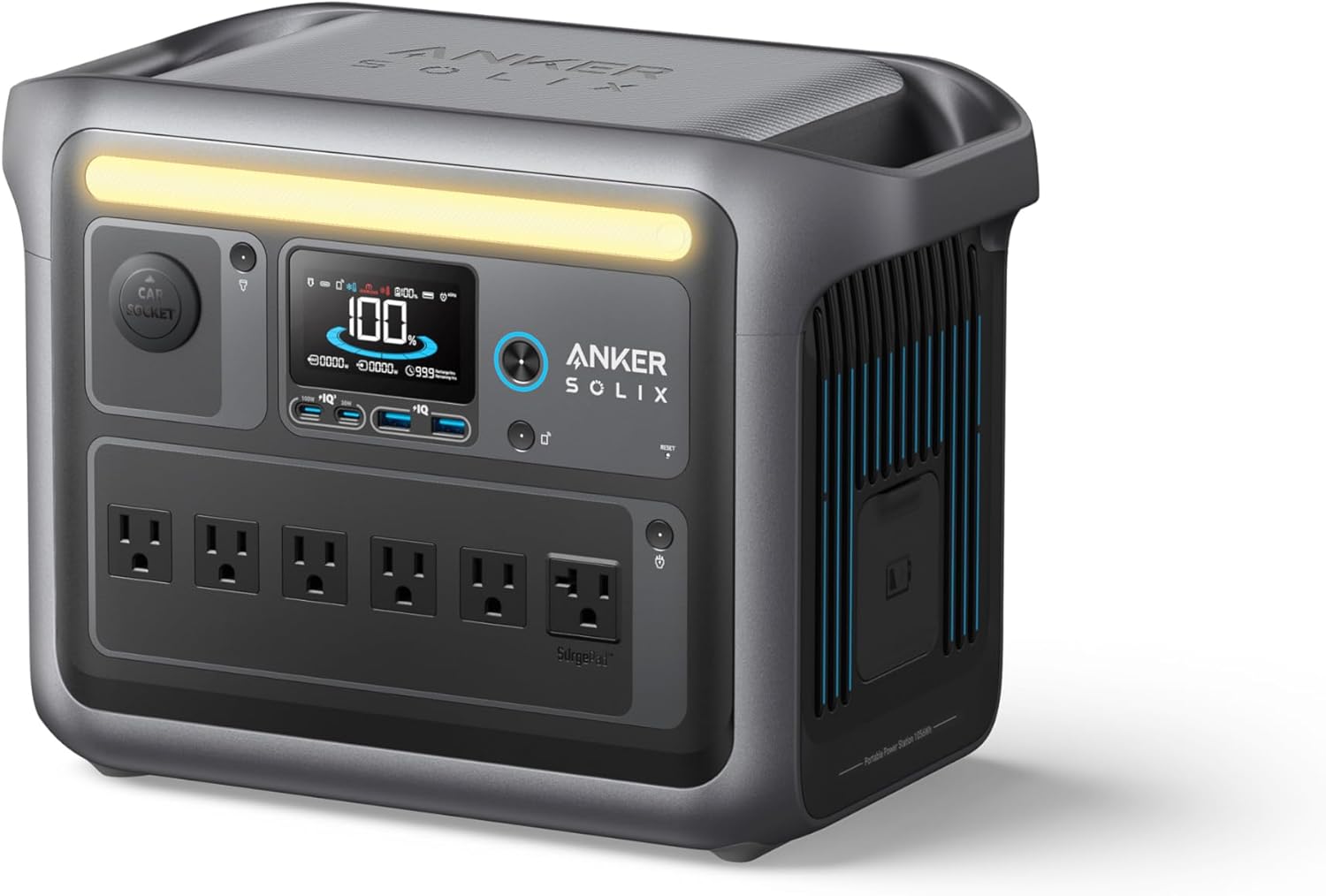
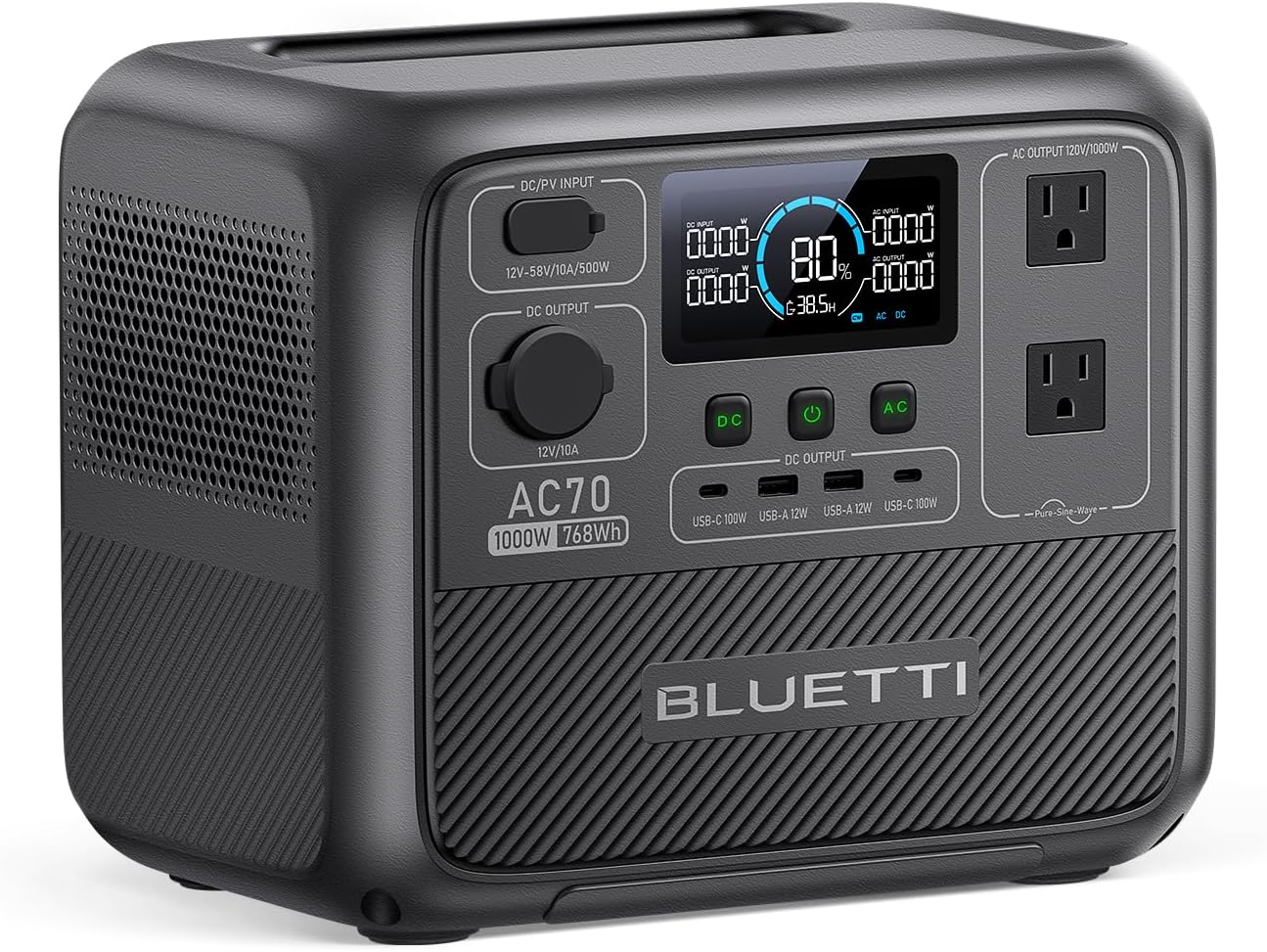
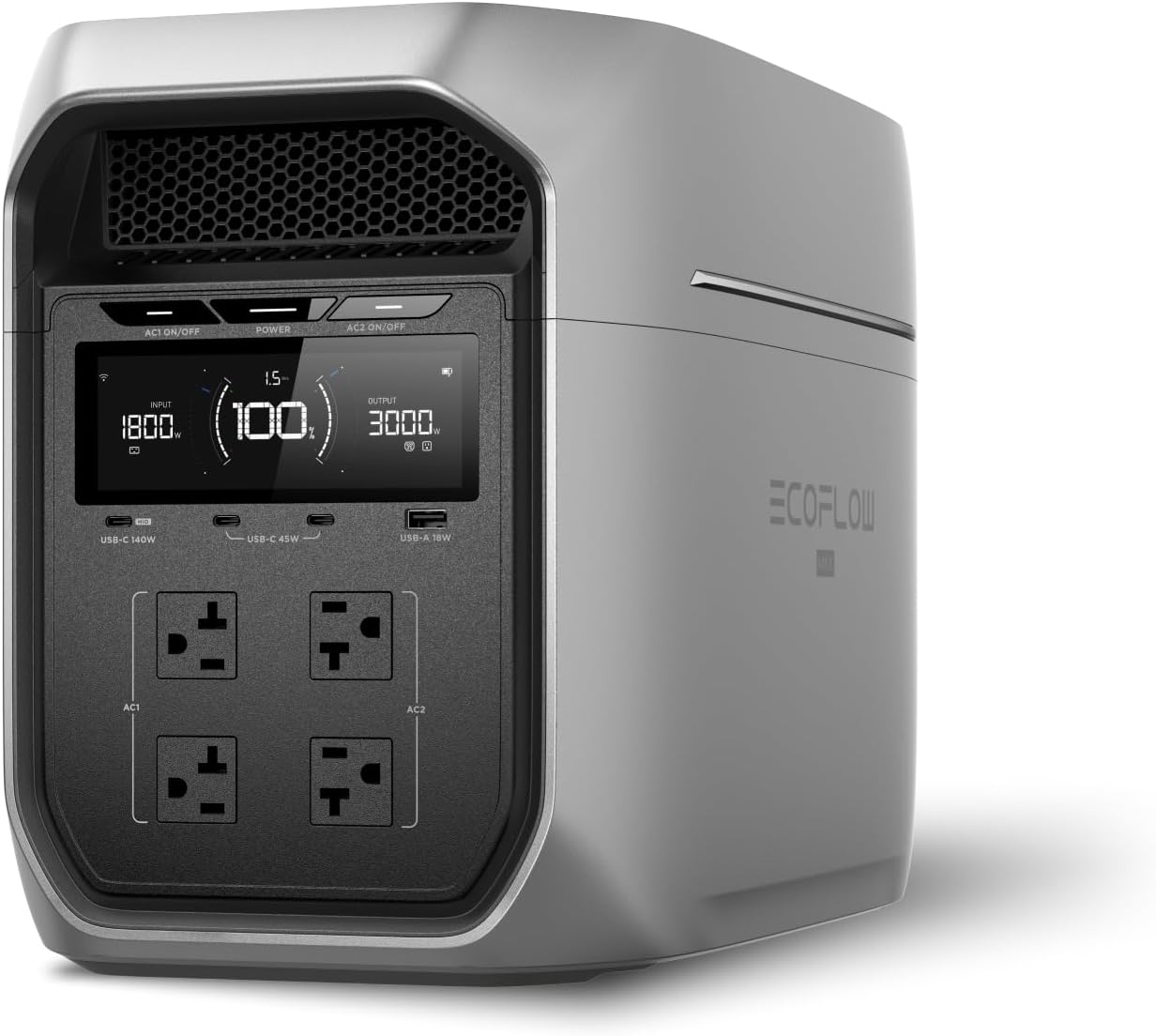
EcoFlow
EcoFlow DELTA 3 Plus
EcoFlow's newest mid-range flagship. The DELTA 3 Plus improves on the Delta 2 with faster charging, LiFePO4 chemistry, and UPS functionality — all at a lower price.
Frequently Asked Questions
What is the difference between watts and watt-hours?
Watts (W) measure the rate of energy use — how much power a device draws at any given moment. Watt-hours (Wh) measure total energy — how much power is used or stored over time. A 100W light bulb running for 10 hours uses 1,000Wh (1 kWh) of energy. Think of watts as speed and watt-hours as distance.
How many watts can a 20 amp circuit handle?
A standard US 20-amp, 120V circuit can handle 2,400 watts maximum (20A × 120V = 2,400W). However, electrical code limits continuous loads to 80% of circuit capacity, so the safe continuous limit is 1,920 watts. This is relevant when choosing a power station — most units with 2,000W output can safely power any single device you'd normally plug into a wall outlet.
Why do some power stations list peak watts separately from continuous watts?
Many devices draw a brief surge of power when starting up — especially anything with a motor (fridges, ACs, power tools). This startup surge can be 2-3x the normal running wattage and lasts only a fraction of a second. Peak (or surge) watts is the maximum the power station can handle for these brief spikes. Continuous watts is what it can sustain indefinitely. A station rated at 1,800W continuous / 3,600W peak can start a device that surges to 3,600W but can only run devices that draw up to 1,800W continuously.
What does mAh mean and how does it convert to Wh?
Milliamp-hours (mAh) measure charge capacity and are commonly used for phone batteries and power banks. To convert mAh to Wh, multiply by voltage and divide by 1,000: (mAh × V) / 1,000 = Wh. A 10,000mAh power bank at 3.7V = 37Wh. A 5,000mAh phone battery at 3.7V = 18.5Wh. Power stations use Wh because it's a more useful measure of total energy, regardless of output voltage.
Ready to Buy? Here's What We Recommend
Based on our testing and this guide, these are the best options for most people: