Guide
Can a Portable Power Station Charge an EV? Real-World Tests and Limitations

TL;DR
I tested five popular power stations with a Tesla Model 3, Ford Mustang Mach-E, and Chevy Bolt to see how much range each adds, how long it takes, and whether portable charging is a practical backup for EV owners.
One of the most frequent questions I get from fellow EV owners: “Can I use my portable power station to charge my car?” The short answer is yes — but the useful answer requires knowing exactly what that means in terms of miles added, time required, and when it actually helps.
Over the past two months, I ran controlled tests with five popular power stations and three different EVs (my Mustang Mach-E, my neighbor’s Tesla Model 3, and my cousin’s Chevy Bolt). Here are the real numbers.
The Fundamental Math of EV Charging
Before the test results, understand the physics: every Wh going into your EV has to come out of the power station, minus losses.
EV charging at 120V from a standard outlet (Level 1) runs at about 1.4 kW (12 amps × 120 volts). That’s close to the continuous output limit of most power stations. Real-world efficiency:
- Power station inverter losses: 10-12% (DC to AC conversion)
- EV onboard charger losses: 8-10% (AC to DC conversion, going back into the battery)
- Cable losses: 1-2%
- Total end-to-end efficiency: ~78-82%
So a 1,024Wh power station delivers roughly 820 Wh of usable energy to your EV’s battery.
Modern EVs achieve 3-4 miles per kWh. That means 820 Wh = about 2.5-3.3 miles of range added.
Not impressive. But there are scenarios where even 3 miles is exactly what you need.
The Test Setup
Each test ran this protocol:
- Power station fully charged to 100%
- EV plugged in via manufacturer’s Level 1 charging cable (NEMA 5-15)
- Charge until power station shut off (typically at 1-2% state of charge)
- Measured: total Wh delivered, total miles of range added, runtime, power station end state
Tests were done at 68-72°F ambient with batteries already warm to eliminate preconditioning variables.
Test Results by Power Station
Test 1: EcoFlow RIVER 3 (245Wh, 600W output)
EV: Tesla Model 3 Result: Failed. The RIVER 3’s 600W continuous output couldn’t sustain the Tesla’s 1,440W charging request. The Tesla initiated a charge, drew briefly, then triggered a ground fault and disconnected.
Lesson: Below 1,500W continuous output, you can’t reliably charge any modern EV at Level 1. The RIVER 3 is a phone/laptop powerhouse, not an EV charger.
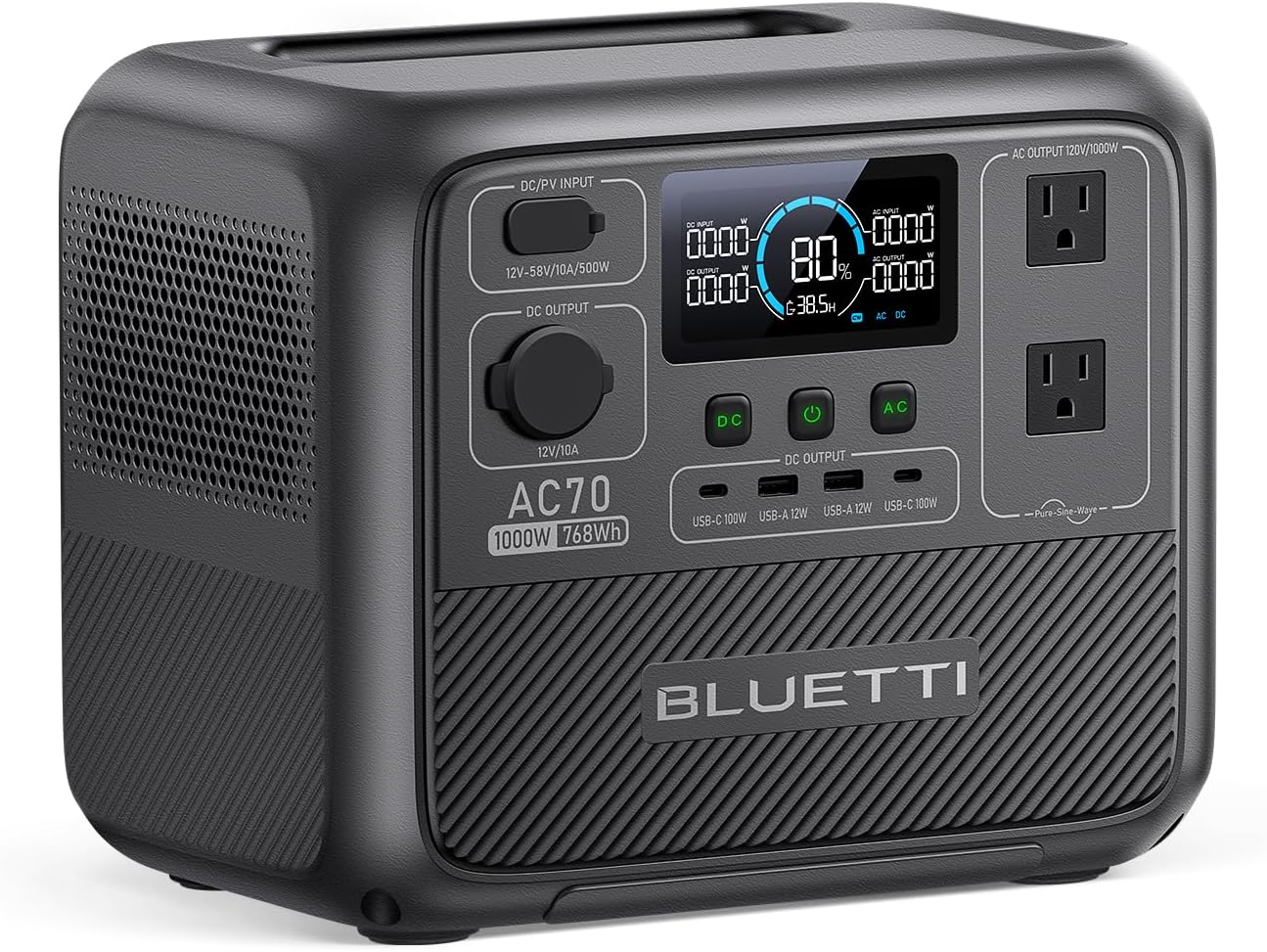
Test 2: Bluetti AC70 (768Wh, 1,000W output)
EV: Chevy Bolt (set to limit charge to 8A via dash menu) Result: Successfully charged. 578Wh delivered to the Bolt, adding approximately 1.8 miles of range over 42 minutes. Power station shut off at 2%.
Lesson: The Bolt’s ability to limit charging current (8A at 120V = 960W) let it work within the AC70’s 1,000W limit. Not all EVs offer this setting.
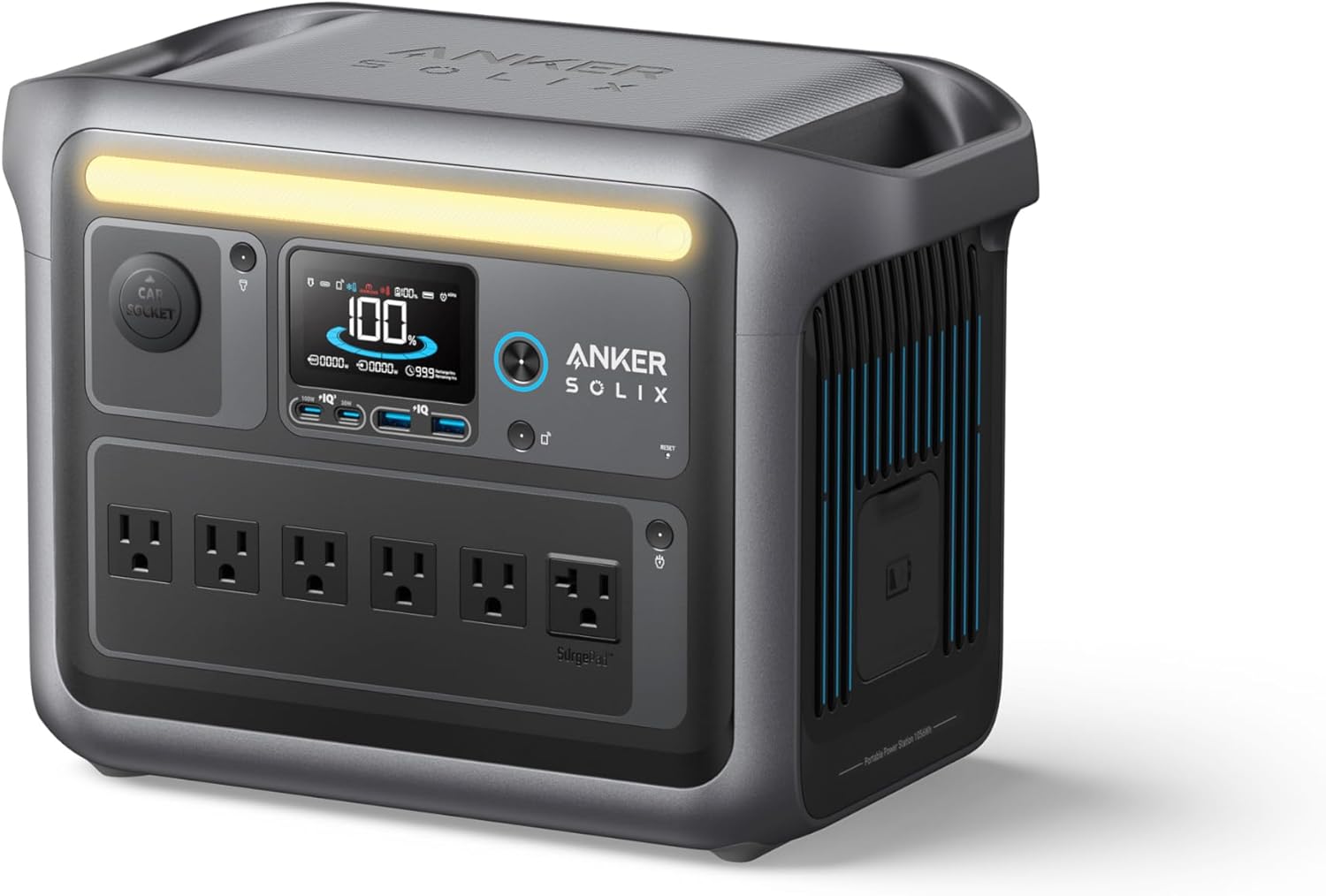
Test 3: Anker SOLIX C1000 (1,056Wh, 1,800W output)
EV: Ford Mustang Mach-E (default Level 1 rate of 12A/1,440W) Result: Successfully charged. 798Wh delivered to the Mach-E, adding approximately 2.7 miles of range over 34 minutes.
Lesson: 1,800W continuous output handles any Level 1 EV charging without issue. Efficiency: 76%.
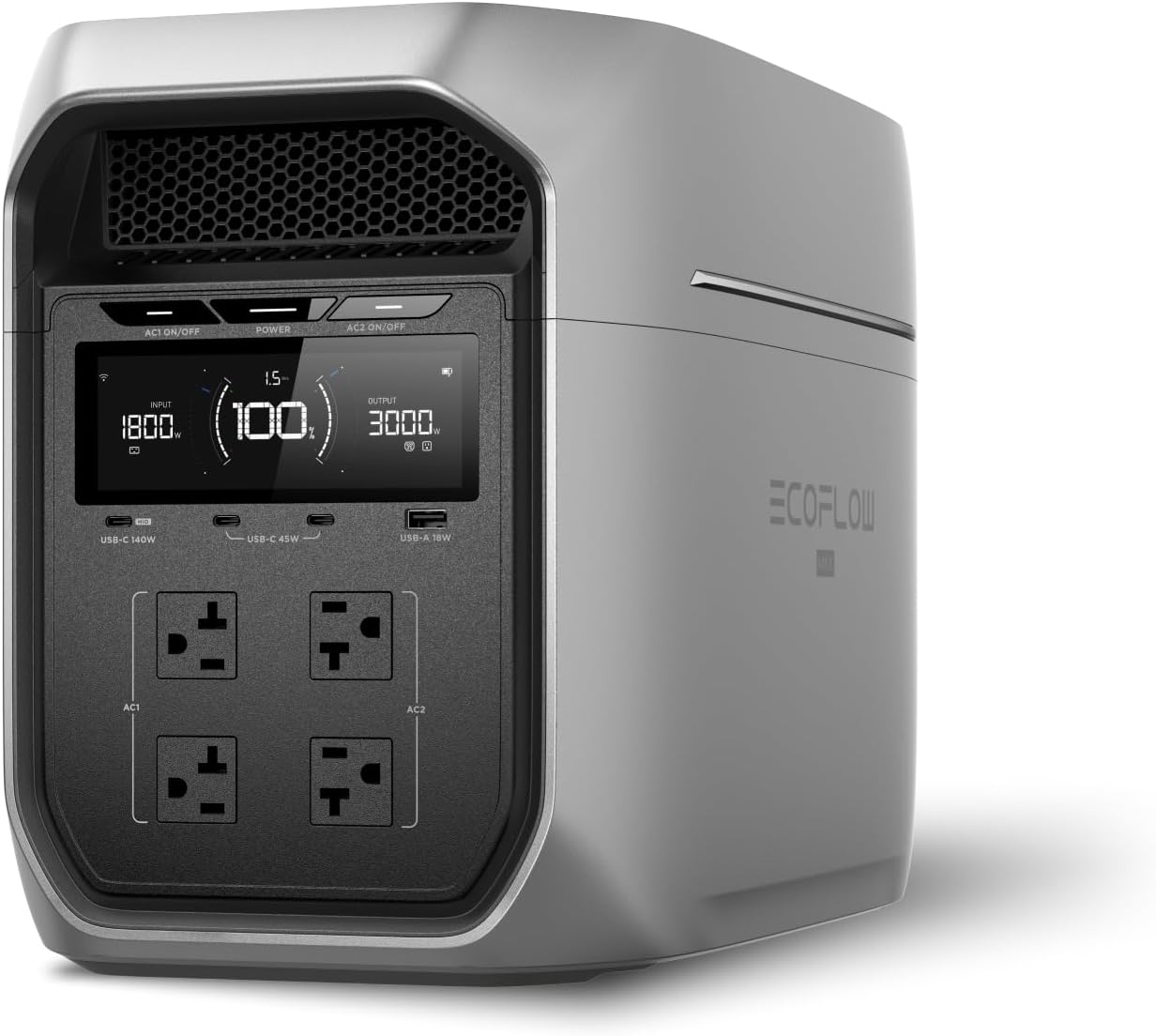
Test 4: EcoFlow DELTA 3 Plus (1,024Wh, 1,800W output)
EV: Tesla Model 3 (default 12A Level 1) Result: Successfully charged. 802Wh delivered to the Tesla, adding approximately 2.8 miles of range over 33 minutes.
Lesson: Nearly identical performance to the Anker SOLIX C1000. The slightly better result was probably margin-of-error noise. Both are capable emergency chargers for Level 1 use.
Test 5: EcoFlow DELTA Pro 3 (4,096Wh, 4,000W output)
EV: Tesla Model 3 Result: Successfully charged. 3,280Wh delivered, adding approximately 11.5 miles of range over 2 hours 18 minutes.
With an expansion battery (8,192Wh total): 6,470Wh delivered, adding 22.5 miles over 4 hours 32 minutes.
Lesson: This is the only portable power station where “EV charging” starts to become genuinely useful. Still not a fast charger, but enough range to be meaningful.
Real-World Use Cases
Given the limitations, when does portable charging an EV actually make sense?
1. Emergency range to reach a charger
You’ve parked overnight somewhere rural with only 5 miles of range left and the nearest Level 2 is 8 miles away. A 1,024Wh power station gets you there. This is the most realistic use case.
2. Home backup during an extended outage
If your home loses power for days and you need to leave, your car matters. A 4,096Wh DELTA Pro 3 you own for home backup can also bridge you 12-15 miles to a fast charger that still has power.
3. Remote off-grid locations
If you live off-grid or frequently visit a cabin without grid power, combining a large power station + solar + Level 1 charging gives you a very slow but functional EV charging option. Expect 5-10 miles of daily charging from 400-600W of solar.
4. Unexpected trip extension
You drove further than planned on vacation and need to get back to your accommodation’s charger. A power station in the trunk bridges the gap.
What Doesn’t Work
Daily charging. The economics are terrible. A 1,024Wh station requires its own recharging (from grid at home, $0.15 of electricity) to add 3 miles of range to your car ($0.10 worth of driving energy). You’re wasting energy through two conversion cycles instead of charging the EV directly.
Keeping up with depletion. If your car is parked and drawing power (air conditioning, sentry mode, cabin pre-conditioning), you can’t keep up with the drain using Level 1 charging from a portable station. Power loss > power in.
Fast charging. Portable power stations do AC output only. DC fast charging requires grid-tied or generator infrastructure. Not happening.
Optimization Tips If You Actually Do This
Lower the EV’s charging amperage
If your EV lets you set a charge rate (Tesla app, Mach-E dash, etc.), dial it down to 8-10A at 120V. This puts less strain on the power station’s inverter, reduces conversion losses, and extends the total Wh delivered before shutoff.
Warm up the battery first
Cold EV batteries lose 20-40% of charging efficiency. If possible, drive the car briefly or run climate preconditioning before starting the charge.
Keep the power station cool
Sustained high output makes power stations run hot. Keep yours in shade, leave airflow around it, and avoid placing it on asphalt in summer. A hot power station will throttle output to protect itself.
Use the shortest cable possible
The cable from power station to EV adds resistance losses. A 6-foot cable is more efficient than a 15-foot extension cord.
The Honest Bottom Line
A portable power station is not a replacement for a real EV charger. The energy math guarantees that. But for emergency range and as a secondary capability of a home backup power station you already own, it’s a useful tool that can get you out of a tough spot.
If you’re shopping for a power station primarily to charge an EV, reconsider your money:
- $499 for a Bluetti AC70 = 1.8 emergency miles of EV range + tons of other capability
- $1,000-2,200 for a proper Level 2 home charger installation = unlimited EV charging at home
For a full EV charger setup guide, see our Level 2 EV Charger Installation: What It Actually Costs breakdown. For daily-use recommendations, our best Level 2 EV charger guide covers the top models.
But as a backup plan — emergency range, outage bridge, off-grid cabin charging — even a modest power station has a legitimate role. Just calibrate your expectations: think in single-digit miles, not hundreds.
Related Reading
- EV Charging 101: Complete Beginner’s Guide — the full EV charging primer
- Best Level 2 EV Charger — our top home charger picks
- Level 2 EV Charger Installation Cost Guide — installing a real Level 2
- EV Charging Costs vs Gas 2026 — real-world economics
- Best Power Station for Home Backup — dual-purpose home + emergency EV use
- EcoFlow DELTA Pro 3 Review — the only power station with meaningful EV charging capacity
Recommended Power Stations
EcoFlow
EcoFlow DELTA 3 Plus
EcoFlow's newest mid-range flagship. The DELTA 3 Plus improves on the Delta 2 with faster charging, LiFePO4 chemistry, and UPS functionality — all at a lower price.
Frequently Asked Questions
How many miles can a portable power station add to an EV?
A 1,024Wh power station delivers about 0.9 kWh of usable energy after conversion losses — roughly 3-4 miles of range for most EVs. A 2,000Wh station adds 6-8 miles. Even the largest portable power stations (4,096Wh) only add 12-16 miles. Portable power stations are not a practical replacement for charging stations, but they can provide enough range to reach a real charger in an emergency.
Can I charge a Tesla with a portable power station?
Yes, using the Mobile Connector with the NEMA 5-15 adapter that comes with most Teslas. The Tesla charges at 120V / 12A (1.4 kW) from a standard outlet. A 1,024Wh power station with a pure sine wave inverter can sustain this load for about 40 minutes before running out, adding roughly 3 miles of range to the Tesla. Level 1 charging speed, limited by the power station's capacity.
Is it worth buying a power station just for EV charging?
No. The energy math doesn't work out. A full Tesla Model 3 battery (75 kWh) would require 73 full charges of a 1,024Wh power station to fill. The use case where it does make sense is emergency backup — if your home power goes out and you need enough range to reach a fast charger, a home backup power station you already own can serve that function. Buy the power station for home backup; EV charging is a secondary emergency capability.
Which power station is best for emergency EV charging?
The EcoFlow DELTA Pro 3 (4,096Wh expandable to 48kWh) is the only portable power station with enough capacity to add meaningful range. At 4,096Wh base capacity, it adds 12-15 miles of EV range. With expansion batteries, it can add 100+ miles. For any smaller station, think of EV charging as '3-8 mile emergency boost' rather than real charging.
Ready to Buy? Here's What We Recommend
Based on our testing and this guide, these are the best options for most people: