Guide
Inside the Inverter: How Your Power Station Converts DC to AC (Pure Sine Wave Explained)

TL;DR
Pure sine wave, modified sine wave, total harmonic distortion — what do these inverter specs actually mean, and which ones matter when you're buying a power station? A technical editor's deep dive.
Before I joined The Power Pick, I spent eight years designing power electronics for automotive traction inverters and DC-DC converters at two Tier-1 suppliers. When I see a spec sheet for a portable power station, I see dozens of engineering decisions that determine whether the device is well-designed or cutting corners. Most of those decisions live inside the inverter.
This is the component that takes DC power stored in the battery and transforms it into the AC power your household devices expect. It’s also the most common place where budget manufacturers compromise — saving a few dollars in silicon while creating problems you’ll only discover after purchase. Here’s what’s actually going on in there, and what the specs really mean.
The Core Job: DC to AC Conversion
Your power station’s battery stores energy as DC — direct current flowing in one direction at a constant voltage (typically 25.6V or 51.2V for a LiFePO4 pack, depending on cell configuration). Your household devices expect AC — alternating current that reverses direction 60 times per second at 120V RMS.
Getting from one to the other requires three stages:
Stage 1: DC-DC Boost
The battery’s 25.6V DC isn’t high enough to synthesize 120V AC directly. A DC-DC boost converter steps the voltage up to approximately 340V DC (the peak voltage of a 120V RMS sine wave). This stage uses high-frequency switching (typically 50-200 kHz) through MOSFETs or IGBTs to convert energy efficiently through a transformer.
Stage 2: DC-to-AC Inversion
The high-voltage DC is then switched by an H-bridge of transistors — four switches arranged in a configuration that can connect the output to the positive or negative DC rail. By rapidly alternating these switches (using pulse-width modulation, or PWM), the inverter produces a pulsed waveform whose time-averaged voltage follows a sine wave.
Stage 3: Output Filtering
The pulsed output from the H-bridge contains both the desired 60Hz sine wave and high-frequency switching noise. An LC filter (inductor + capacitor) smooths this out, producing the clean sine wave that reaches your outlet. The quality of this filter — how well it suppresses harmonics while keeping conversion efficiency high — is one of the biggest differentiators between quality inverters and cheap ones.
Pure Sine Wave vs. Modified Sine Wave
This is the single most important inverter spec on a power station, and it’s mostly binary: either the inverter produces a true sine wave output or it produces a stepped approximation called “modified sine wave.”
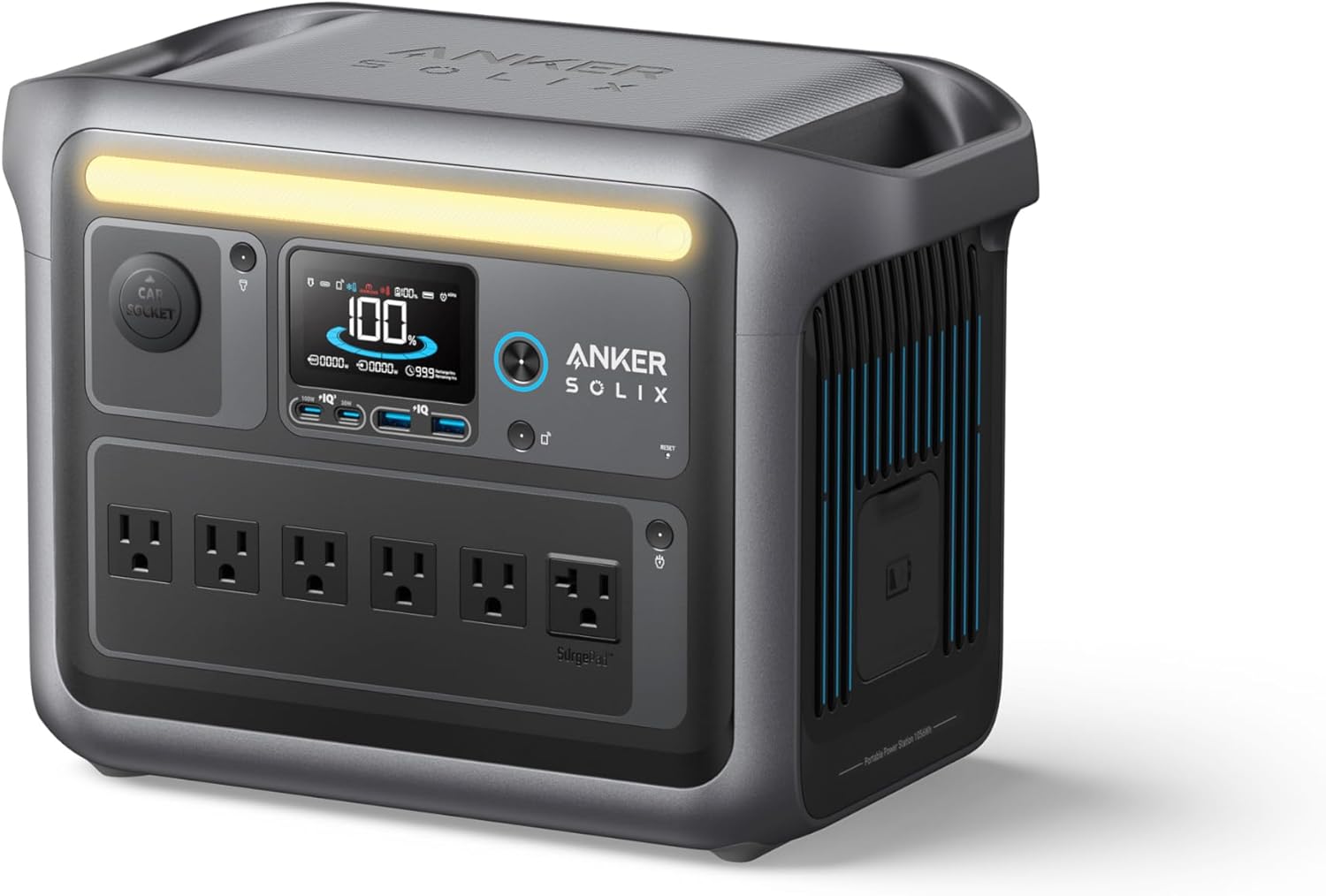
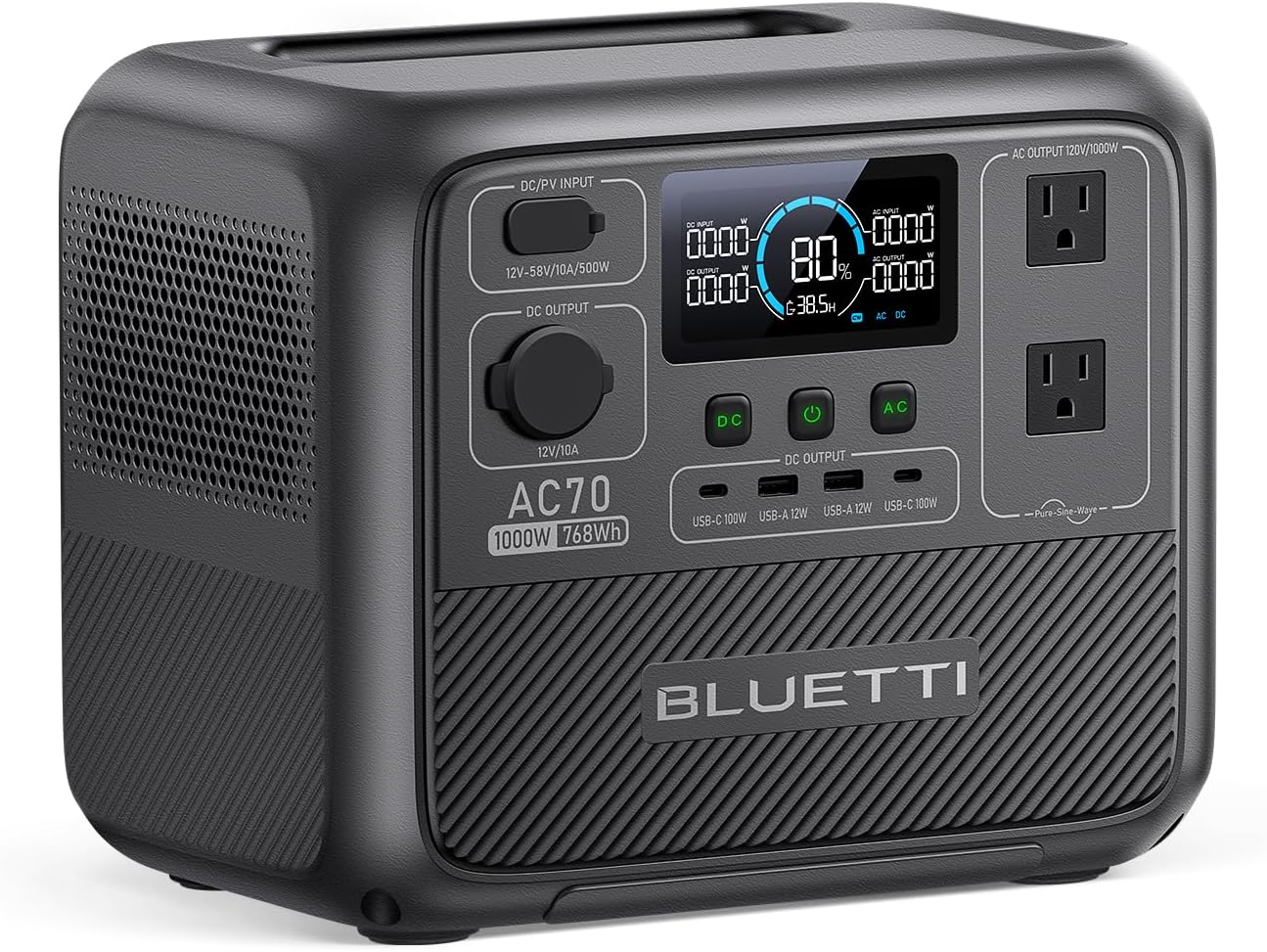
Pure sine wave is what the utility grid produces — a smooth, continuous 60Hz waveform. All modern electronics are designed assuming pure sine wave input. Every quality power station in 2026 produces pure sine wave output. The EcoFlow DELTA 3 Plus, Bluetti AC70, Anker SOLIX C1000, and every other power station we recommend are pure sine wave.
Modified sine wave is a cheaper approximation consisting of square-wave segments designed to approximate a sine wave’s average voltage. It was common in older, cheaper inverters because the electronics are simpler. With modified sine wave output you’ll see:
- Audible buzzing from motors and transformers
- Dimmable LED lights flickering or failing
- Laser printers reporting power faults
- CPAP machines displaying error codes
- Variable-speed motors running hot and failing prematurely
- Older audio equipment picking up noise
If a product page doesn’t explicitly say “pure sine wave,” assume modified sine wave. For any application involving sensitive electronics — which is essentially every modern device — pure sine wave is non-negotiable.
The Spec That Most Buyers Ignore: Total Harmonic Distortion
Pure sine wave is table stakes. The next question is: how pure?
Total Harmonic Distortion (THD) measures how much the actual output deviates from a mathematically perfect sine wave. It’s expressed as a percentage — lower is better. The measurement considers harmonic frequencies (multiples of 60Hz) that shouldn’t be there if the wave were perfect.
Typical THD figures:
| THD | Quality | What You’ll Notice |
|---|---|---|
| <1% | Excellent (studio-grade) | Imperceptible; matches or exceeds grid power |
| 1-3% | Very good | Fine for all consumer electronics, including medical devices |
| 3-5% | Acceptable | Most devices work fine; some audio equipment may show minor noise |
| 5-10% | Marginal | Sensitive equipment may exhibit issues |
| >10% | Poor | Typical of cheap inverters; problems with many devices |
The EcoFlow DELTA 3 Plus specs ≤3% THD. The Anker SOLIX C1000 specs similar values. Budget units often omit the spec entirely — which usually means it’s somewhere in the 5-8% range. This is the first thing I look for when evaluating a new power station.
For context: US utility grid power typically runs at 2-5% THD. So a quality portable inverter can produce AC that’s actually cleaner than what comes out of your wall outlet.
Continuous vs. Peak Power: What’s Actually Happening
Inverter specs typically list two power ratings that confuse many buyers:
Continuous power is the maximum output the inverter can sustain indefinitely. This is limited by thermal considerations — how much heat the MOSFETs can shed through their cooling system. If you load the inverter above its continuous rating, it will either throttle, shut down, or (in cheap units) burn out.
Peak power (also called surge power) is the maximum output the inverter can handle for a short period — typically 1-10 seconds. This exists because many devices have inrush currents far higher than their running current. When a refrigerator compressor starts, for example, it may draw 4-5x its running wattage for a fraction of a second before stabilizing.
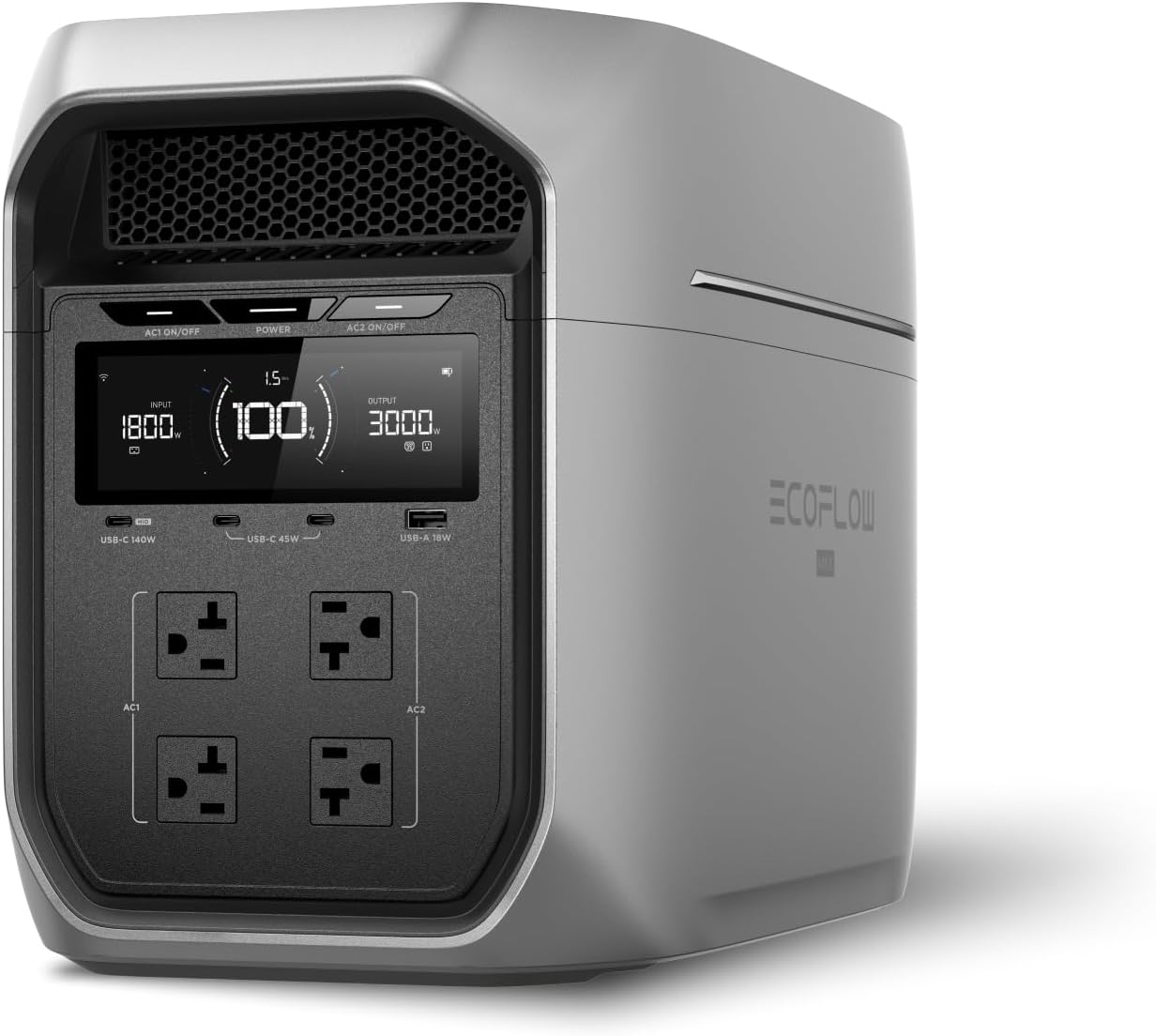
The EcoFlow DELTA 3 Plus is rated 1,800W continuous / 3,600W peak. This means it can run any device that draws up to 1,800W sustained, and can handle startup surges up to 3,600W. The Anker SOLIX C1000 is 1,800W continuous / 2,400W peak — slightly lower surge capability, which matters for starting motors.
For most household loads, both specs matter:
- TV, laptop, phone charger: No surge at startup. Only continuous rating matters.
- Refrigerator, freezer: Surge of 2-4x running power for 1-2 seconds.
- Portable AC, sump pump: Surge of 3-5x running power. Requires careful sizing.
- Power tools, blenders: Brief surges during activation.
The X-Boost / Power Lifting Feature
Some manufacturers (notably EcoFlow) implement a clever feature called X-Boost (or similar names) that lets the inverter run devices with higher rated power than its continuous rating, by intelligently reducing the output voltage.
Here’s how it works: many resistive loads — heaters, hair dryers, electric kettles — don’t need a precise 120V. If you reduce the voltage to, say, 100V, the device still works but draws less power. A 2,400W hair dryer running at 100V only draws ~1,670W, which a 1,800W inverter can handle.
This works for resistive loads (anything that converts electrical energy to heat). It does not work reliably for:
- Motor-driven appliances (compressors, pumps, tools)
- Electronic devices with switching power supplies (laptops, TVs, most modern electronics — though these are actually often quite tolerant of voltage variation)
- Anything with precise timing or voltage regulation requirements
The EcoFlow DELTA 3 Plus’s X-Boost technology can run devices rated up to 2,200W (at reduced power). It’s a legitimate capability, not marketing fluff.
Standby Consumption: The Silent Drain
Every inverter has a minimum power draw just to be “on” — the electronics that monitor for load, manage the boost stage, and drive the H-bridge. This is called standby consumption or idle draw.
Typical inverter standby draws:
- Premium power stations: 5-10W
- Mid-range: 10-20W
- Budget: 20-30W
If your power station is idling with nothing plugged in, that’s energy coming straight off the battery. A unit with 25W standby draw loses 600Wh per day — enough to discharge a 1,000Wh power station in under two days without anything plugged in.
The fix: Turn off the inverter when it’s not in use. Most power stations have a separate AC power button for exactly this reason. The EcoFlow DELTA 3 Plus has an auto-sleep feature that disables the inverter after detecting no load for a configurable time (default 30 minutes). Enable it.
Efficiency: What You Actually Get vs. What’s in the Battery
Because of these conversion losses, the actual AC energy you can extract from a power station is always less than its rated DC capacity.
A 1,024Wh power station running a 100W load (well within the inverter’s efficient range) will deliver roughly:
- 1,024Wh × 0.90 inverter efficiency = 922Wh of AC energy
At higher loads (closer to maximum output), efficiency actually improves slightly (up to ~93%). At very low loads (5W or less), efficiency drops dramatically because the inverter’s standby consumption dominates.
Practical implication: Don’t power a 5W LED lamp through the AC outlet for 100 hours. Use the DC (USB) outputs instead and skip the inverter conversion losses entirely.
What to Look for When Buying
Here’s the spec-sheet checklist I apply when evaluating any new power station for technical accuracy:
- “Pure sine wave” explicitly stated. Not just “sine wave” or “AC output.”
- THD ≤3% specified. If they don’t list it, assume ≥5%.
- Continuous wattage ≥1,500W for running household appliances.
- Peak wattage ≥2x continuous for motor startups.
- Standby consumption ≤15W (rarely listed, but if you can find it).
- Multiple AC outlets on a single inverter (not a shared bus with the battery, which causes voltage drop).
- Active cooling with a fan that only runs under load — not constantly.
Every power station in our top picks meets all seven criteria. That’s not an accident.
Related Reading
- How Lithium Batteries Work — what the inverter is drawing from
- Watts, Volts, Amps, and Watt-Hours Explained — the electrical unit fundamentals
- Portable Power Glossary — 60+ technical terms defined
- LiFePO4 vs NMC Batteries — the other half of the power station equation
- Best Portable Power Stations 2026 — our curated picks
Recommended Power Stations
EcoFlow
EcoFlow DELTA 3 Plus
EcoFlow's newest mid-range flagship. The DELTA 3 Plus improves on the Delta 2 with faster charging, LiFePO4 chemistry, and UPS functionality — all at a lower price.
Frequently Asked Questions
What is a pure sine wave inverter?
A pure sine wave inverter produces AC output that matches the smooth sinusoidal waveform of utility grid electricity. This is the same waveform your wall outlets produce. It's the 'clean' form of AC that all modern electronics are designed to use. Every power station worth buying in 2026 produces pure sine wave output — this was a differentiator a decade ago but is now the baseline.
What does total harmonic distortion (THD) mean?
Total harmonic distortion is a measurement of how much the inverter's output deviates from a theoretically perfect sine wave, expressed as a percentage. Lower is better. Quality power stations produce AC with THD under 3% — cleaner than most residential grid electricity. Anything under 5% is imperceptible to almost every device. Above 10% you may see issues with sensitive audio equipment or medical devices.
What is the difference between a modified sine wave and a pure sine wave inverter?
A modified sine wave inverter produces a stepped, rectangular approximation of a sine wave. It's cheaper to build but produces poor output: devices may buzz, run hot, or malfunction. Induction motors lose efficiency; sensitive electronics (CPAPs, medical devices, audio equipment, some TVs) may not work correctly. Pure sine wave produces a smooth, continuous curve matching grid power. For any quality portable power station, always verify it's pure sine wave.
How efficient is a power station's inverter?
Modern inverters in consumer power stations operate at 88-93% efficiency under typical loads. This means 7-12% of the energy drawn from the battery is lost as heat during conversion. Efficiency drops at very low loads (below 10% of rated output) and at maximum load. The best way to maximize runtime is to match your load to the inverter's sweet spot — roughly 20-80% of its rated capacity.
Ready to Buy? Here's What We Recommend
Based on our testing and this guide, these are the best options for most people: