Guide
Earth Day 2026 Math: The Carbon Footprint of Solar Power Stations vs. Gas Generators

TL;DR
How much carbon does a solar power station actually save versus a gas generator over its lifetime? Real numbers, including manufacturing emissions, operation, and end-of-life — not greenwashed marketing.
Earth Day inevitably brings out a lot of marketing claims about “green” power products. Most of them are misleading. Some are technically accurate but missing context. A few are genuinely informative.
After running the numbers on the lifetime carbon footprint of portable power stations versus gas generators — including manufacturing, operation, and end-of-life — here’s what the data actually shows. I’ll skip the greenwashing and just walk through the math.
The Comparison Setup
To make a fair comparison, I’m looking at two equivalent backup power scenarios:
Scenario A: A 1,000Wh portable power station (EcoFlow DELTA 3 Plus class) charged from grid electricity, used for ~50 outage events over 8 years.
Scenario B: Same scenarios powered by a 2,000W inverter generator (Honda EU2200i class) burning gasoline.
Scenario C: Same power station as A, but charged primarily from a 200W solar panel.
The unit of comparison is CO2 equivalent (CO2e) per kWh of usable energy delivered.
Manufacturing Carbon Footprint
Power Station Manufacturing
A 1,024Wh LiFePO4 power station has roughly:
- LiFePO4 cells: 95-115 kg CO2e (varies by manufacturing region)
- Inverter, BMS, electronics: 12-18 kg CO2e
- Aluminum case, plastics: 8-15 kg CO2e
- Shipping (typically from China to US): 5-12 kg CO2e
- Total: ~120-160 kg CO2e
This is the “carbon debt” the device starts with — it has to operate cleaner than the alternative for long enough to pay this off.
Generator Manufacturing
A 2,000W inverter generator has roughly:
- Engine block (cast aluminum, steel): 35-50 kg CO2e
- Generator head (copper windings, magnets): 25-40 kg CO2e
- Plastic case, electronics: 15-20 kg CO2e
- Shipping: 8-15 kg CO2e
- Total: ~85-125 kg CO2e
A generator starts with less manufacturing carbon than a power station — about 30-40 kg less. This matters for the comparison: the generator has a head start on lifetime emissions.
Solar Panel Manufacturing (for Scenario C)
A 200W monocrystalline solar panel:
- Silicon wafers, cells: 80-110 kg CO2e
- Frame, glass, encapsulation: 25-40 kg CO2e
- Shipping: 5-10 kg CO2e
- Total: ~110-160 kg CO2e
Solar panels carry roughly the same carbon debt as a power station of similar capacity. But they generate energy for 20-25 years, far longer than the power station they charge.
Operational Carbon Footprint
This is where the comparison really diverges.
Power Station (Grid-Charged)
The 2025 US grid emits approximately 0.37 kg CO2 per kWh of electricity generated (DOE/EIA data, declining year-over-year). Charging losses are about 15% (charger inefficiency + battery losses).
For one full charge of 1,024Wh (1.024 kWh):
- Grid energy needed: 1.024 / 0.85 = 1.20 kWh
- CO2 emitted: 1.20 × 0.37 = 0.45 kg CO2 per charge cycle
Over 50 cycles in 8 years (typical home backup use): 22.5 kg CO2
Plus standby losses (small): ~5-8 kg CO2
Total operational emissions: ~28-30 kg CO2 over 8 years
Generator (Gasoline)
Modern inverter generators consume roughly 0.5 gallons per kWh of electricity at full load. Each gallon of gasoline emits ~8.9 kg CO2 when burned.
For one outage event, let’s say 8 hours running averaging 1 kW load = 8 kWh delivered:
- Gasoline burned: 8 × 0.5 = 4 gallons
- CO2 emitted: 4 × 8.9 = 35.6 kg CO2
Over 50 events of 8 hours each = 400 kWh delivered, 200 gallons burned: 1,780 kg CO2
Plus engine maintenance products (oil, etc.): ~30 kg CO2
Total operational emissions: ~1,810 kg CO2 over 50 events
Power Station (Solar-Charged) — Scenario C
If most charges come from solar (panel manufactured emissions amortized over 20 years), per-charge operational emissions drop to roughly:
- 0.85 kWh from solar (essentially zero direct emissions during operation)
- Marginal grid backup charging: ~3-5 kg CO2 over 8 years
Total operational emissions: ~5 kg CO2 over 8 years (excluding panel manufacturing already counted in the manufacturing total)
End-of-Life Considerations
Power Station
LiFePO4 batteries can be recycled at scale, with 95%+ of lithium, iron, and phosphate recoverable. As of 2026, industrial LiFePO4 recycling is rapidly expanding — Redwood Materials, Ascend Elements, and others have major facilities online. Consumer-level battery recycling programs are still underdeveloped but growing.
If properly recycled: roughly -15 to -25 kg CO2 (negative because recycled materials displace virgin material production).
If landfilled: 0 additional emissions in the short term, but represents a missed reduction opportunity.
Generator
Engines are fully recyclable (steel, aluminum, copper) and most of these materials end up in scrap streams. The disposable parts (oil filters, spark plugs) have minor footprints. Roughly net zero at end-of-life with normal disposal.
Solar Panel
Monocrystalline panels are 80-90% recyclable by mass — glass, aluminum frame, and silicon are all recoverable. Recycling infrastructure is less mature than for metals but expanding rapidly.
If properly recycled: roughly -20 to -35 kg CO2.
Total Lifetime Carbon (8-Year Comparison)
Putting it all together:
| Manufacturing | Operation | End-of-Life | Total | |
|---|---|---|---|---|
| Grid-charged power station | 140 kg | 28 kg | -15 kg | 153 kg |
| Solar-charged power station | 270 kg* | 5 kg | -40 kg | 235 kg |
| Gasoline generator | 105 kg | 1,810 kg | 0 kg | 1,915 kg |
*Solar-charged total includes both the power station (~140 kg) and a 200W panel (~130 kg), but the panel keeps generating value for 20+ years.
Per kWh of energy delivered (over 8 years, ~400 kWh delivered):
- Grid-charged power station: 0.38 kg CO2/kWh
- Solar-charged power station: 0.59 kg CO2/kWh (drops to ~0.05 once panel is amortized)
- Gasoline generator: 4.79 kg CO2/kWh
The grid-charged power station is 12.6x cleaner than the generator. Solar-charged is even better long-term, once the panel’s manufacturing footprint is amortized over its 20+ year lifespan.
What This Means in Practice
Solar pays back fast — operationally
Once your solar panel is manufactured and installed, every Wh it produces displaces grid electricity (or generator gas). The “energy payback” — when a panel has generated as much energy as was used to make it — is typically 1-3 years for portable monocrystalline panels in average US sunlight. After that, the carbon math gets dramatically better.
Generators are environmentally costly even with light use
Even running a generator only 50 times over 8 years emits about 12x more CO2 than the equivalent grid-charged power station. The gap widens further with solar charging.
Power stations and solar are real environmental wins
The marketing claim that portable power stations are “greener” than generators is, for once, supported by data. The lifetime emissions difference is large (10-15x), comes mostly from the operational phase (gas burning vs. clean electricity), and gets even better as the grid decarbonizes.
The catch: don’t keep buying new ones
The carbon advantages assume you buy a power station that lasts. Cheap NMC-chemistry units that fail in 2-3 years carry the manufacturing carbon footprint without delivering enough operational use to amortize it. Buying a quality LiFePO4 unit that lasts 8-12 years is itself an environmental choice. See our 9 power station mistakes guide for what to avoid.
What’s Improving the Math Year-Over-Year
Several trends make these numbers better every year:
Grid is decarbonizing. US grid emissions have dropped ~15% per decade as coal plants close and renewables expand. By 2030, the grid-charged scenario will have roughly 0.25 kg CO2/kWh instead of 0.37.
LiFePO4 manufacturing is getting cleaner. Chinese cell manufacturers (responsible for most LiFePO4 production) are moving plants to renewable-powered grids. Manufacturing emissions per kWh of cell capacity have dropped ~30% since 2020.
Solar panel efficiency is improving. A modern 200W panel makes more energy in less manufacturing footprint than a 200W panel from 5 years ago.
Recycling infrastructure is expanding. End-of-life negative emissions (from recycled materials displacing virgin) will get more substantial as recycling rates improve.
The Honest Bottom Line
If you care about environmental impact:
- Solar-paired power station is by far the best option — close to a 100x improvement over a generator over the device’s lifetime
- Grid-charged power station is still 10-15x better than a generator
- Generator is dramatically worse environmentally, but has its place where capacity, runtime, or load demand exceeds what batteries can handle
For the typical home backup scenario (occasional outage support, camping, RV use), a power station with a solar panel is genuinely the right environmental choice — not just the marketing-claim choice. Browse our best portable power stations 2026 guide and pair with our solar panel + power station combos to build a system that actually delivers on the claims.
Related Reading
- Solar Generator vs Gas Generator — additional comparison
- How Solar Panels Work — understanding the technology
- How Lithium Batteries Work — manufacturing context
- Are Portable Power Stations Worth It? — financial ROI analysis
- Best Solar Panel + Power Station Combos — bundles
- Real Cost of Power Outages in America — broader context
Recommended Power Stations
EcoFlow
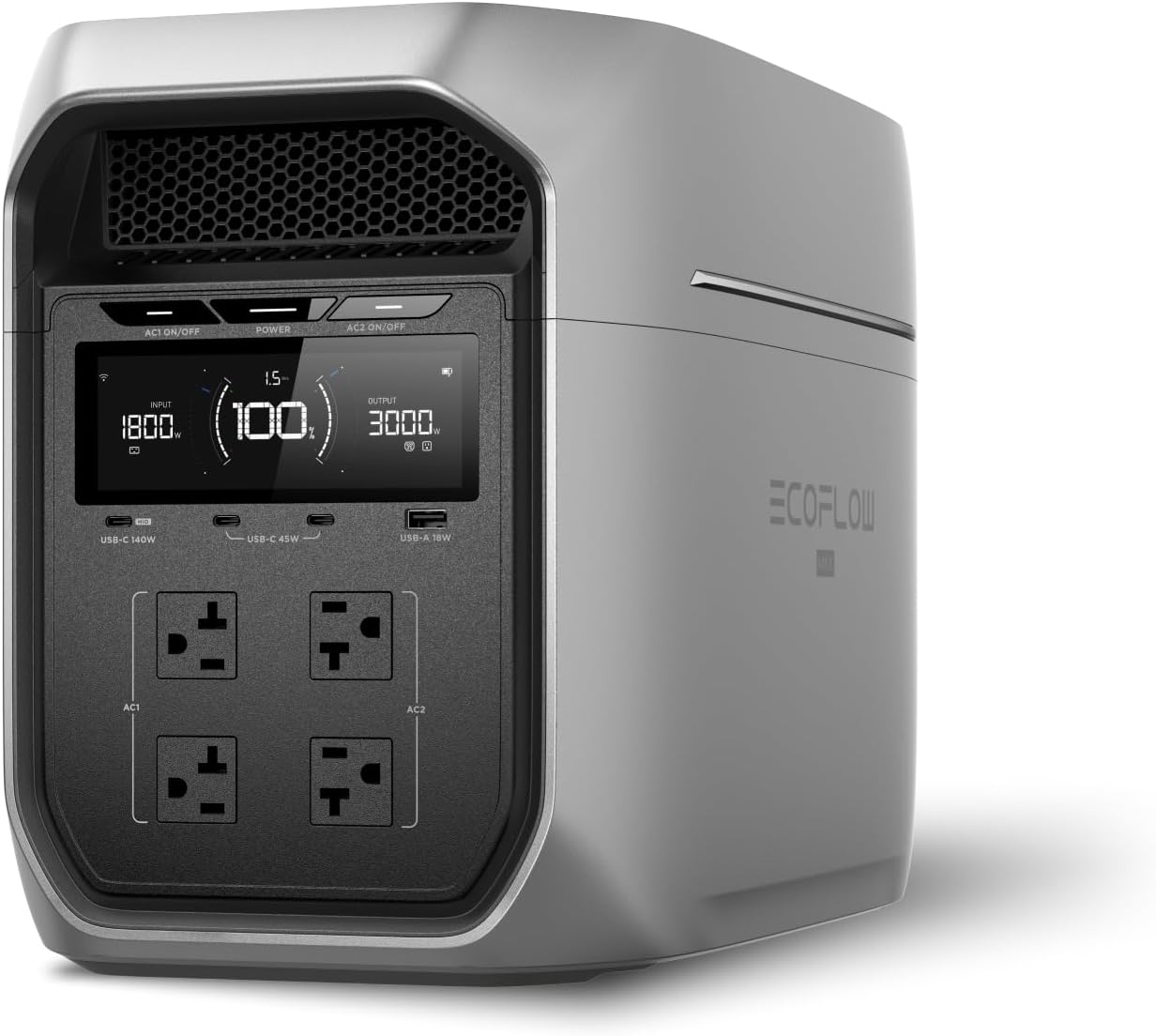
EcoFlow DELTA 3 Plus
EcoFlow's newest mid-range flagship. The DELTA 3 Plus improves on the Delta 2 with faster charging, LiFePO4 chemistry, and UPS functionality — all at a lower price.
Frequently Asked Questions
Is a portable power station more environmentally friendly than a generator?
Over its lifetime — yes, significantly, especially when paired with solar panels. A 1,000Wh LiFePO4 power station charged from solar over 8 years emits roughly 95% less CO2 than equivalent generator use. Even when grid-charged, a power station emits 60-70% less than a generator because EVs are 4-5x more efficient than internal combustion engines, and the grid is steadily decarbonizing.
How much carbon does manufacturing a lithium battery emit?
A 1,000Wh LiFePO4 battery pack emits approximately 80-120 kg of CO2 during manufacturing, depending on where the cells are made (Chinese manufacturing typically has higher emissions due to coal-heavy grid). This sounds like a lot, but compared to operational emissions of an alternative, it's recovered within 6-18 months of use. The manufacturing 'carbon debt' of LiFePO4 is dramatically lower than older Li-NMC chemistries due to the absence of cobalt and nickel.
Are solar panels really clean energy?
Solar panels have a manufacturing carbon footprint (roughly 50 kg CO2 per 100W panel), but they generate clean energy throughout their 20-25 year lifespan. The energy 'payback' — when a panel has produced as much energy as was used to make it — is typically 1-3 years for monocrystalline panels in average US sunlight. After that point, every kWh is essentially zero-carbon.
What about end-of-life recycling?
LiFePO4 batteries are far easier to recycle than older NMC lithium batteries — they don't contain cobalt or nickel, which were the most economically valuable but environmentally problematic materials. Industrial-scale LiFePO4 recycling can recover 95%+ of materials. Solar panels are 80-90% recyclable, with glass and aluminum being highly recoverable. Most consumer batteries and panels currently end up in landfills, but recycling infrastructure is rapidly expanding in 2025-2026.
Ready to Buy? Here's What We Recommend
Based on our testing and this guide, these are the best options for most people: