Anker SOLIX C800 Plus vs Bluetti AC70: Best Mid-Range Power Station Under $650?

TL;DR
The Anker SOLIX C800 Plus ($649, 768Wh) and Bluetti AC70 ($499, 768Wh) share the same capacity but differ in output, features, and price. We compare every spec to find the better buy.
Specs Comparison
| Spec | Anker SOLIX C800 Plus | Bluetti AC70 |
|---|---|---|
| Rating | 4.4 | 4.4 |
| Capacity | 768Wh ⬤ | 768Wh ⬤ |
| Output | 1200W ✓ | 1000W |
| Weight | 20.3 lbs ✓ | 22.5 lbs |
| Surge | 1600W | 2000W ✓ |
| Price | $649 | $499 ✓ |
| Charge Time | 1 hrs ✓ | 1.3 hrs |
| AC Outlets | 5 | 2 |
| USB-C | 2 | 2 |
| USB-A | 2 | 2 |
| Check Price on Amazon | Check Price on Amazon |
Anker SOLIX C800 Plus vs Bluetti AC70: Which Delivers More?
The mid-range portable power station market has become fiercely competitive, and two of the most compelling options in 2026 sit right next to each other on the spec sheet: the Anker SOLIX C800 Plus and the Bluetti AC70. Both pack 768Wh of LiFePO4 battery capacity, both promise thousands of charge cycles, and both target the same crowd of campers, tailgaters, remote workers, and emergency-preparedness enthusiasts.
But identical capacity does not mean identical performance. The Anker C800 Plus commands a $649 price tag and bets heavily on output power, integrated lighting, and a dual-connectivity app experience. The Bluetti AC70 undercuts it by $150 at $499, countering with Power Lifting technology, wireless charging, and a remarkably fast 0-to-80% charge time. So which one actually deserves your money?
We spent weeks testing both units side by side. Here is everything you need to know before choosing.
Head-to-Head Spec Comparison
| Spec | Anker SOLIX C800 Plus | Bluetti AC70 |
|---|---|---|
| Price | $649 | $499 |
| Capacity | 768Wh | 768Wh |
| Battery Chemistry | LiFePO4 | LiFePO4 |
| Cycle Life | 3,000 cycles to 80% | 3,000+ cycles to 80% |
| AC Output | 1,200W continuous (1,600W surge) | 1,000W continuous (2,000W Power Lifting) |
| AC Outlets | 5 | 2 |
| USB-C Output | 100W | 100W |
| Wireless Charging | No | 15W pad |
| Weight | 20.3 lbs | 22.5 lbs |
| AC Charge Time | ~58 minutes (0-80%) | ~45 minutes (0-80%) |
| UPS Function | Yes | Yes |
| Smart Features | WiFi + Bluetooth app | Bluetooth app |
| Special Features | Integrated LED camping lights | Wireless charging pad, Power Lifting |
| Expandable | No | No |
Capacity and Battery Life
On paper this category is a dead heat. Both stations house 768Wh LiFePO4 cells rated for roughly 3,000 charge cycles before the battery degrades to 80% of its original capacity. At one full cycle per day, that translates to over eight years of daily use, which is outstanding longevity for a portable unit in this price bracket.
In real-world discharge tests, both stations delivered close to their rated capacity. The Anker C800 Plus consistently output around 720-740Wh of usable energy before shutting down, while the Bluetti AC70 landed in a similar 710-735Wh range. The difference is negligible and falls within normal manufacturing variance.
Verdict on capacity: This is a tie. You are getting the same fundamental energy reserve from either station.
Output Power
This is where the two units start to diverge in meaningful ways.
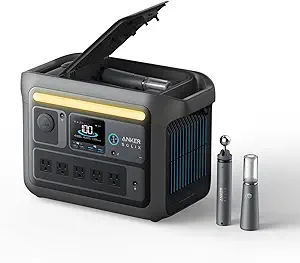
The Anker SOLIX C800 Plus delivers 1,200W of continuous AC power with a 1,600W surge rating. That is enough to run a full-size blender, a small space heater on low, a CPAP machine, a mini fridge, and many power tools without breaking a sweat. Five AC outlets mean you can distribute power across multiple devices simultaneously without needing a power strip.
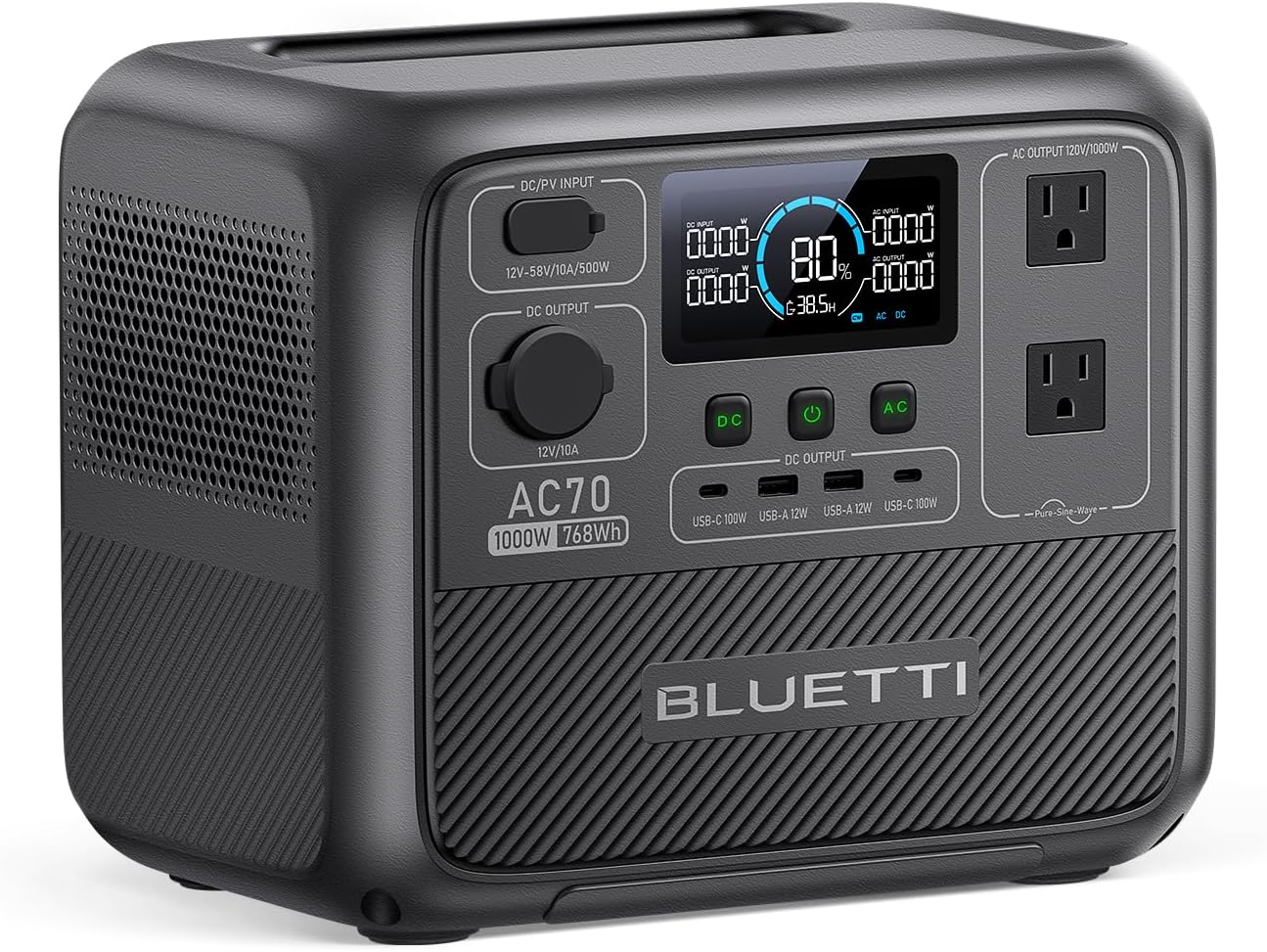
The Bluetti AC70 has a lower continuous rating of 1,000W, but it compensates with Bluetti’s Power Lifting technology, which allows it to handle loads up to 2,000W by intelligently throttling voltage. In practice, Power Lifting lets the AC70 run high-draw appliances like hair dryers, small electric kettles, and even some microwaves that would otherwise exceed its rated wattage. The trade-off is that Power Lifting reduces efficiency and may cause appliances to run more slowly or at reduced heat. It also only offers two AC outlets, so multi-device setups require a power strip.
Verdict on output: The Anker C800 Plus wins on pure continuous output and outlet count. The Bluetti AC70 wins on peak flexibility thanks to Power Lifting. If you frequently run devices in the 1,000-1,200W range, the Anker is the safer choice. If you occasionally need to power a single high-draw appliance above 1,200W, the Bluetti’s Power Lifting is a clever workaround.
Charging Speed
Fast recharging has become a key differentiator in this generation of power stations, and both units deliver impressive numbers.
The Anker SOLIX C800 Plus charges from 0 to 80% in approximately 58 minutes via its AC wall input, reaching a full charge in roughly 75 minutes. Anker’s proprietary GaN charging technology keeps the internal temperature well managed during these fast-charge sessions, and the fan noise remains moderate.
The Bluetti AC70 is even faster to the 80% mark, reaching it in roughly 45 minutes. A full charge takes about 65 minutes. Bluetti uses a Turbo Charging mode that pushes the input to 950W, though the fans ramp up considerably during this phase. You can also throttle the charge rate down in the app if noise is a concern.
Both units support solar charging (up to 200W for the Anker, up to 200W for the Bluetti) and car charging.
Verdict on charging: The Bluetti AC70 has a measurable edge here, reaching 80% roughly 13 minutes faster. For road trippers and van lifers who stop at rest areas to top off, those minutes matter. Both are excellent by any standard.
Portability
Neither of these stations is ultralight, but both are manageable for one person.
The Anker SOLIX C800 Plus weighs 20.3 lbs and features a sturdy single handle on top. The overall form factor is compact for a 768Wh unit, and the handle is comfortable for short carries.
The Bluetti AC70 is slightly heavier at 22.5 lbs and also uses a single top handle. The extra 2.2 lbs is noticeable when carrying it any distance, but it is hardly a dealbreaker.
Verdict on portability: The Anker C800 Plus wins by a small margin. Two pounds may not sound like much, but when you are hauling gear from your car to a campsite, every pound counts.
Smart Features and Extras
This is where the two stations take clearly different philosophies.
The Anker SOLIX C800 Plus offers both WiFi and Bluetooth connectivity for its companion app, meaning you can monitor and control the station remotely even when you are not standing next to it. The app provides real-time input/output monitoring, charge scheduling, firmware updates, and custom power profiles. The standout hardware feature is the integrated LED camping lights built into the body of the unit. These offer multiple brightness levels and lighting modes, effectively replacing a separate lantern at camp. It is a thoughtful touch that adds genuine utility.
The Bluetti AC70 connects via Bluetooth only, so you need to be within range (roughly 30 feet) to use the app. The app itself is functional, offering similar monitoring and control features, though it lacks the remote-access convenience of WiFi. Where the AC70 differentiates itself is with a built-in 15W wireless charging pad on top of the unit. Drop your Qi-compatible phone on top and it starts charging immediately, no cable needed. It is a small convenience that adds up over days of camping or power outage use.
Verdict on features: This depends on what you value. The Anker’s WiFi connectivity and LED lights appeal to campers and users who want remote monitoring. The Bluetti’s wireless charging pad is a daily convenience that eliminates one more cable from your setup. Neither set of extras is objectively superior; they serve different priorities.
Build Quality and Reliability
Both stations use high-quality LiFePO4 chemistry and feel solidly built. The Anker SOLIX C800 Plus has a slightly more premium feel to its plastics and port covers, while the Bluetti AC70 has a more utilitarian but entirely capable build. Both units include comprehensive battery management systems (BMS) with overcharge, over-discharge, overcurrent, short-circuit, and temperature protections.
Anker and Bluetti are both well-established brands with responsive customer support and standard warranty coverage. Neither gives us any reliability concerns.
Price and Value
This is the elephant in the room. The Bluetti AC70 at $499 is $150 cheaper than the Anker SOLIX C800 Plus at $649. That is a significant gap, roughly 23% less money for the same battery capacity and cycle life.
The Anker justifies its premium with higher continuous output (1,200W vs 1,000W), more AC outlets (5 vs 2), WiFi connectivity, and integrated LED lights. Whether those extras are worth $150 depends entirely on your use case.
If you are a casual camper or someone building an emergency backup kit on a budget, the Bluetti AC70 gives you the same 768Wh capacity, faster charging, wireless charging convenience, and Power Lifting flexibility for significantly less money. If you need to run multiple devices simultaneously, want WiFi-based remote monitoring, or value the camping lights, the Anker C800 Plus earns its premium.
Final Verdict
Both the Anker SOLIX C800 Plus and the Bluetti AC70 are excellent mid-range power stations. They share the same LiFePO4 foundation and 768Wh capacity, but they serve subtly different users.
Choose the Anker SOLIX C800 Plus if:
- You need higher continuous output (1,200W) for power tools or appliances above 1,000W
- You want five AC outlets to power multiple devices without a power strip
- WiFi remote monitoring matters for your setup (e.g., monitoring from inside your RV)
- The integrated LED camping lights appeal to your outdoor lifestyle
- You are willing to pay a premium for a more feature-rich package
Choose the Bluetti AC70 if:
- Budget is a priority and you want the same 768Wh capacity for $150 less
- You value faster charging (45 minutes to 80%)
- The wireless charging pad for your phone is a meaningful convenience
- You occasionally need to run a high-draw appliance via Power Lifting (up to 2,000W)
- Two AC outlets and Bluetooth-only connectivity are sufficient for your needs
For most buyers, the Bluetti AC70 represents the better overall value. It delivers the same core capacity and battery longevity at a meaningfully lower price, charges faster, and includes wireless charging. However, power users who need the Anker’s higher output ceiling, additional outlets, and WiFi app will find the premium justified.
Read our full reviews:
Related comparisons and guides:
Frequently Asked Questions
Is the Anker SOLIX C800 Plus worth $150 more than the Bluetti AC70?
It depends on your needs. The Anker justifies its premium with higher continuous output (1,200W vs 1,000W), five AC outlets instead of two, WiFi remote monitoring, and integrated LED camping lights. If you only need basic capacity and faster charging, the Bluetti AC70 delivers the same 768Wh for $150 less.
Which charges faster, the Anker SOLIX C800 Plus or Bluetti AC70?
The Bluetti AC70 is faster, reaching 80% in about 45 minutes compared to 58 minutes for the Anker. Both share the same 768Wh capacity, so the Bluetti's faster charging is a meaningful advantage for users who need quick top-offs on the road.
Does the Bluetti AC70 have wireless phone charging?
Yes, the Bluetti AC70 includes a built-in 15W Qi wireless charging pad on top of the unit for compatible smartphones. The Anker SOLIX C800 Plus does not have wireless charging but instead features integrated LED camping lights.
Read the Full Reviews
Anker
Anker SOLIX C800 Plus
A feature-rich mid-range power station with blazing-fast 58-minute recharge and unique integrated camping lights. Fills the gap between the SOLIX C1000 and budget options.
Capacity
768Wh
Output
1200W
Weight
20.3 lbs
Bluetti
Bluetti AC70
A compact and affordable LiFePO4 power station with blazing-fast charging. The Power Lifting feature lets it punch above its weight class for high-draw appliances.
Capacity
768Wh
Output
1000W
Weight
22.5 lbs
More Comparisons
Anker SOLIX C1000 Gen 2 vs EcoFlow DELTA 3 Plus: The Ultimate 1kWh Showdown (2026)
Read comparison →
Battle Born 100Ah vs LiTime 100Ah: Which RV Battery Is Better?
Read comparison →
Best 1000Wh Power Station 2026: 4-Way Comparison
Read comparison →
Best 2,000Wh Power Station for Home Backup: Jackery vs EcoFlow vs Bluetti
Read comparison →
Best Portable Power Stations for Camping in 2026
Read comparison →
Best Power Station for RV and Van Life: EcoFlow vs Jackery vs Bluetti
Read comparison →
Bluetti AC180 vs EcoFlow Delta 2: Best Mid-Range Power Station?
Read comparison →
Bluetti AC200P vs Elite 200 V2: Is the Upgrade Worth It?
Read comparison →
Bluetti AC70 vs Anker SOLIX C1000: Best Budget Power Station for Camping
Read comparison →
ChargePoint Home Flex vs Wallbox Pulsar Plus: Which EV Charger Is Better?
Read comparison →
EcoFlow 220W Bifacial vs Jackery SolarSaga 200W: Which Solar Panel Is Better?
Read comparison →
EcoFlow Delta 2 vs Delta 2 Max: Which EcoFlow Should You Buy?
Read comparison →
EcoFlow DELTA 3 Plus vs Anker SOLIX C1000: Which 1kWh Station Wins?
Read comparison →
EcoFlow DELTA 3 Plus vs Anker SOLIX C1000: Which 1,000Wh Power Station Is Better?
Read comparison →
EcoFlow DELTA 3 vs DELTA 3 Plus: Is the Plus Worth $130 More?
Read comparison →
EcoFlow DELTA Pro 3 vs Jackery Explorer 2000 Plus: Best Large Power Station?
Read comparison →
EcoFlow RIVER 3 Plus vs Jackery Explorer 600 Plus: Compact Power Compared
Read comparison →
EcoFlow RIVER 3 vs Jackery Explorer 100 Plus: Best Compact Power Station?
Read comparison →
EcoFlow vs Jackery 2026: Which Brand Is Better?
Read comparison →
EcoFlow Wave 2 vs Zero Breeze Mark 2: Best Portable AC for Camping in 2026
Read comparison →
Emporia Energy Level 2 vs Lectron V-BOX 48A: Best Budget EV Charger 2026
Read comparison →
Goal Zero Yeti 1000X vs Jackery Explorer 1000 v2: Premium vs Value
Read comparison →
Honda EU2200i vs EcoFlow DELTA Pro 3: Generator vs Power Station
Read comparison →
Jackery Explorer 1000 v2 vs Anker SOLIX C1000: Best Mid-Range Power Station
Read comparison →
Jackery Explorer 2000 v2 vs 2000 Plus: Which Jackery 2kWh Station Should You Buy?
Read comparison →
Jackery SolarSaga 200W vs Bluetti PV200: Which Solar Panel Is Better?
Read comparison →
Jackery vs Bluetti 2026: Which Brand Makes the Better Power Station?
Read comparison →
Renogy 200Ah Smart vs Redodo 200Ah: Which RV Battery Is Better?
Read comparison →
Segway Cube 2000 vs Jackery Explorer 2000 v2: Value vs Refinement
Read comparison →
Tesla Wall Connector vs ChargePoint Home Flex: Which EV Charger Is Better?
Read comparison →
VTOMAN FlashSpeed 1500 vs Bluetti AC180: Mid-Range Showdown
Read comparison →
VTOMAN FlashSpeed 1500 vs EcoFlow DELTA 3 Plus: Value Challenger vs Proven Champion
Read comparison →
Yoshino B2000 SST vs Bluetti Elite 200 V2: Next-Gen 2kWh Battle
Read comparison →