VTOMAN FlashSpeed 1500 vs EcoFlow DELTA 3 Plus: Value Challenger vs Proven Champion

TL;DR
The VTOMAN FlashSpeed 1500 offers 50% more capacity than the EcoFlow DELTA 3 Plus for $350 more. We compare specs, charging speed, expandability, ecosystem, and real-world value to help you decide which power station is the better buy.
Specs Comparison
| Spec | VTOMAN FlashSpeed 1500 | EcoFlow DELTA 3 Plus |
|---|---|---|
| Rating | 4.3 | 4.7 |
| Capacity | 1548Wh ✓ | 1024Wh |
| Output | 1500W | 1800W ✓ |
| Weight | 41 lbs | 27.6 lbs ✓ |
| Surge | 3000W | 3600W ✓ |
| Price | $999 | $649 ✓ |
| Charge Time | 1 hrs | 0.9 hrs ✓ |
| AC Outlets | 3 | 6 |
| USB-C | 2 | 2 |
| USB-A | 4 | 2 |
| Check Price on Amazon | Check Price on Amazon |
VTOMAN FlashSpeed 1500 vs EcoFlow DELTA 3 Plus: Which Offers Better Value?
The portable power station market in 2026 isn’t just about EcoFlow, Bluetti, and Jackery anymore. VTOMAN has emerged as a serious challenger, and their FlashSpeed 1500 goes head-to-head with one of our favorite stations — the EcoFlow DELTA 3 Plus. The VTOMAN brings 50% more capacity for a higher price, while the EcoFlow counters with faster charging, longer battery life, and a deeper ecosystem. Let’s break down which one deserves your money.
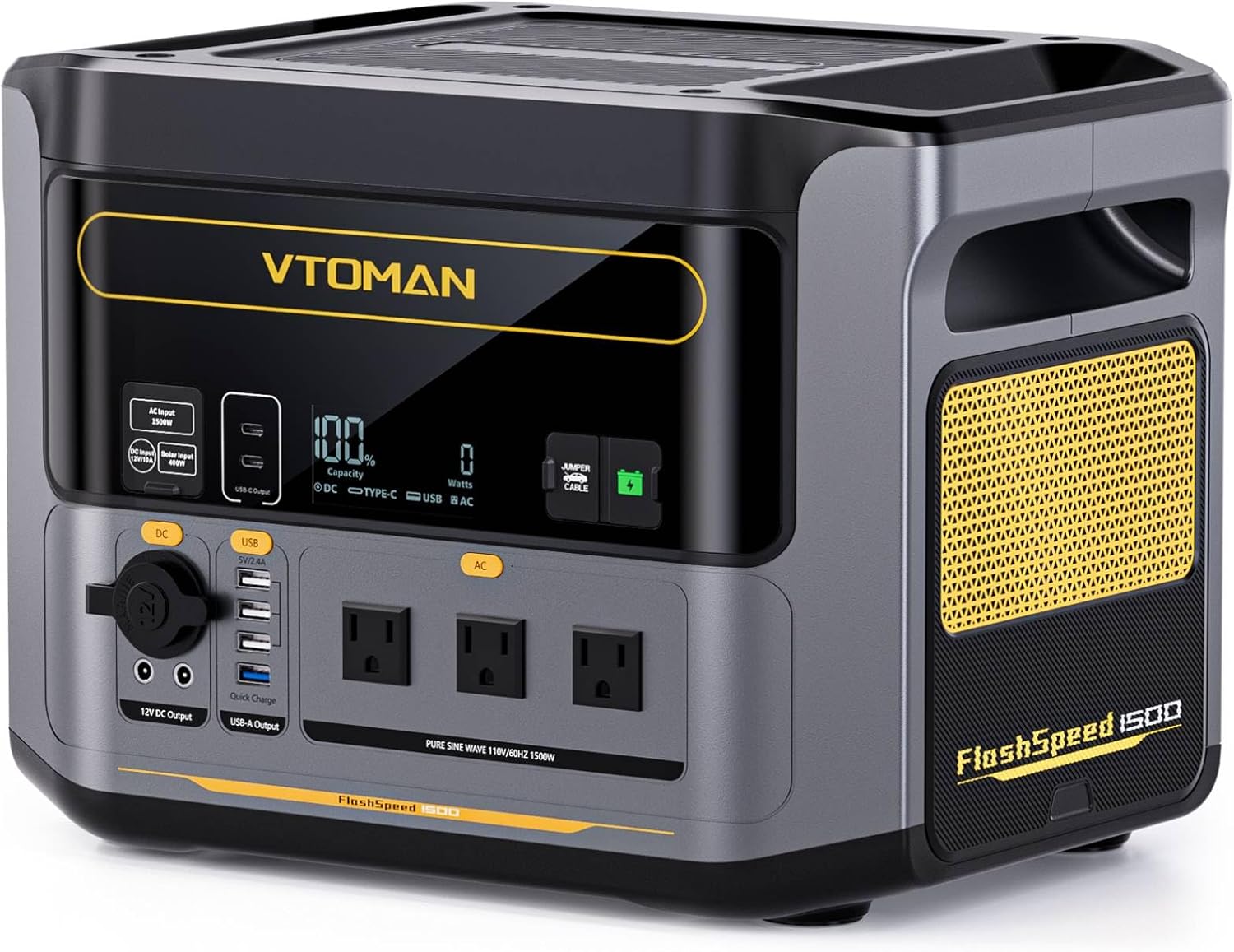
Head-to-Head Spec Comparison
| Spec | VTOMAN FlashSpeed 1500 | EcoFlow DELTA 3 Plus |
|---|---|---|
| Capacity | 1,548Wh | 1,024Wh |
| AC Output | 1,500W (3,000W V-Beyond) | 1,800W (3,600W X-Boost) |
| Battery Type | LFP (LiFePO4) | LFP (LiFePO4) |
| Cycle Life | 3,000+ cycles to 80% | 4,000+ cycles to 80% |
| AC Charging Speed | 0-100% in ~60 minutes | 0-100% in 56 minutes |
| Expandable | Yes, up to 3,096Wh | Yes, up to 5,120Wh |
| UPS Mode | No | Yes (20ms switchover) |
| Weight | 41 lbs | 27.6 lbs |
| Output Ports | 10 total (3 AC, 2 USB-C, 4 USB-A, 1 car) | 6+ total (AC, USB-C, USB-A) |
| Price (MSRP) | $999 | $649 |
Capacity
This is VTOMAN’s headline advantage. The FlashSpeed 1500 packs 1,548Wh compared to the DELTA 3 Plus’s 1,024Wh — a 51% capacity lead. In practical terms, that’s the difference between running a fridge for 12 hours versus 18 hours, or getting an extra full laptop charge cycle out of each battery fill.
However, the EcoFlow’s expansion ecosystem partially negates this advantage. The DELTA 3 Plus expands to 5,120Wh with additional batteries, while the VTOMAN maxes out at 3,096Wh. If your long-term plan includes building a larger system, the EcoFlow scales much further.
Edge: VTOMAN for out-of-the-box capacity. EcoFlow for maximum expanded capacity.
Output Power
Both stations use surge-boost technology to handle loads above their rated continuous output. The EcoFlow’s X-Boost pushes up to 3,600W, while VTOMAN’s V-Beyond reaches 3,000W. The EcoFlow also has a higher continuous rating at 1,800W versus 1,500W.
In practice, this means the DELTA 3 Plus handles a slightly wider range of high-draw appliances without relying on surge mode. For most camping and emergency use, both stations power the same equipment. But if you’re running power tools or high-wattage kitchen appliances, the EcoFlow’s extra 300W of continuous headroom matters.
Edge: EcoFlow for higher continuous and surge output.
Charging Speed
Both stations charge remarkably fast. The EcoFlow DELTA 3 Plus reaches 100% in approximately 56 minutes, while the VTOMAN FlashSpeed 1500 takes about 60 minutes. Given the VTOMAN is charging a 50% larger battery in nearly the same time, its charging rate is actually more impressive on a per-Wh basis. But if you need a full battery as fast as possible, the EcoFlow finishes first.
Edge: Slight edge to EcoFlow on absolute speed. VTOMAN is more impressive relative to its capacity.
Battery Longevity
The EcoFlow DELTA 3 Plus is rated for 4,000+ cycles to 80% capacity, while the VTOMAN offers 3,000+ cycles. If you cycle daily, that’s 11+ years versus 8+ years before the battery degrades to 80%. Both are excellent, but the EcoFlow’s extra 1,000 cycles provide meaningful additional lifespan — especially if you use it frequently for home backup.
Edge: EcoFlow.
Portability
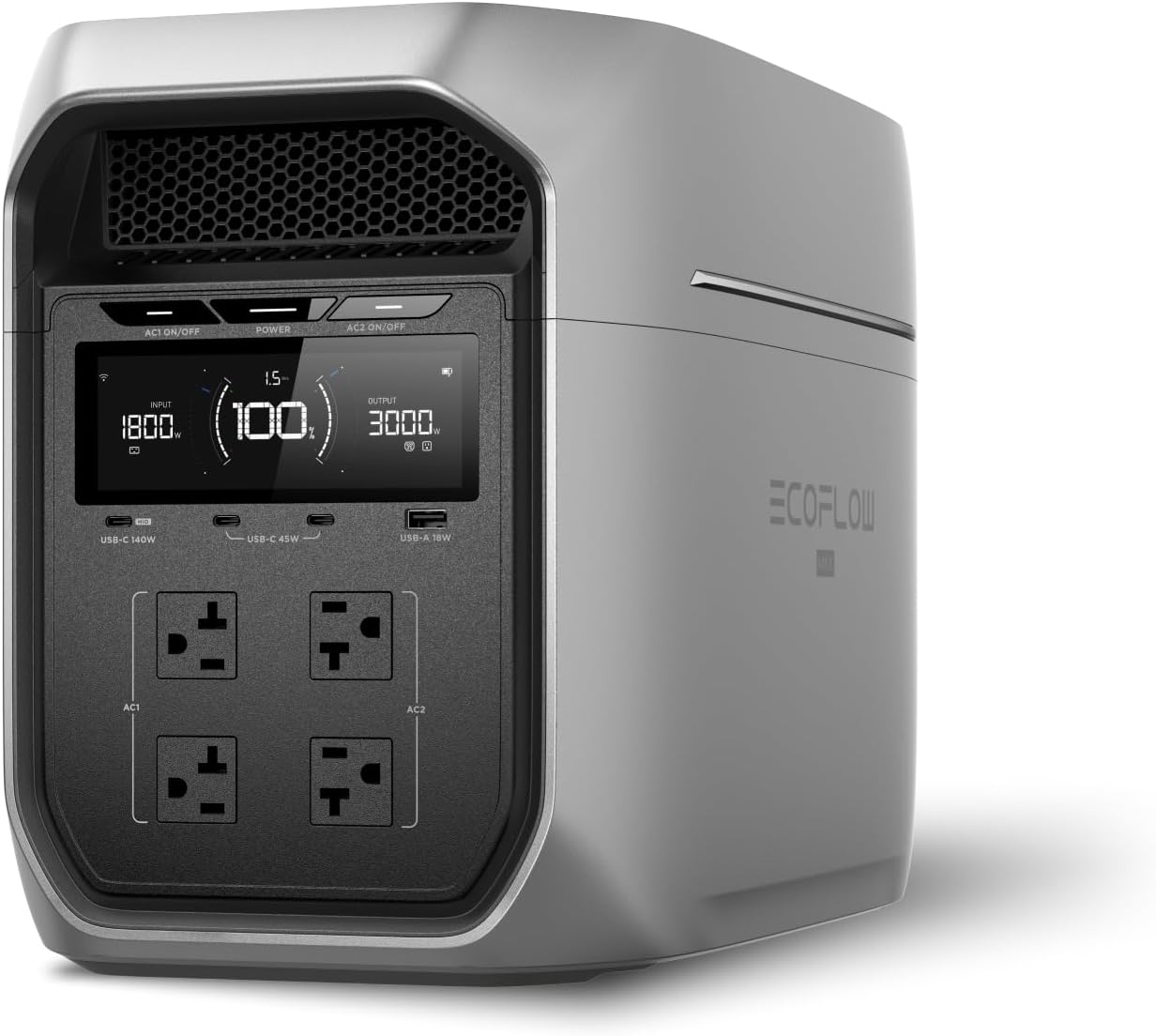
This is a significant differentiator. The EcoFlow DELTA 3 Plus weighs 27.6 lbs — manageable for one person to carry from a car to a campsite. The VTOMAN FlashSpeed 1500 weighs 41 lbs, which is noticeably heavier and less comfortable for extended carries. If portability matters to you (camping, tailgating, moving between locations), the 13-pound weight difference is hard to ignore.
Edge: EcoFlow, decisively.
Ecosystem and Features
The EcoFlow ecosystem is significantly more developed. The DELTA 3 Plus offers:
- UPS mode with 20ms switchover — keeps computers and networking gear running during outages
- EcoFlow app with detailed monitoring, scheduling, and firmware updates
- Smart home integration via Alexa, Google Home
- Extensive expansion path up to 5kWh
- Broad solar panel compatibility and a mature accessory ecosystem
The VTOMAN FlashSpeed 1500 has an app and WiFi connectivity, but the ecosystem is younger and less feature-rich. There’s no UPS mode, and the expansion path tops out at ~3kWh. VTOMAN’s advantage is the sheer number of output ports — 10 total, including 4 USB-A ports, which is more than most competitors.
Edge: EcoFlow for ecosystem depth. VTOMAN for port count.
Price and Value
The VTOMAN FlashSpeed 1500 costs $999. The EcoFlow DELTA 3 Plus costs $649. That’s a $350 difference.
For that $350, you get 524Wh more capacity with the VTOMAN, but you give up 300W of continuous output, 1,000 battery cycles, UPS mode, a lighter build, and a more mature ecosystem. On a per-Wh basis, the VTOMAN costs $0.65/Wh and the EcoFlow costs $0.63/Wh — nearly identical.
The value calculation depends on what you prioritize. If raw capacity matters most and you want the most watt-hours for your money, the VTOMAN delivers. If you want the better-rounded product with longer lifespan and more features, the EcoFlow justifies its lower price.
Verdict
These stations target different buyers, and both are good products.
Choose the VTOMAN FlashSpeed 1500 if you prioritize raw capacity over features, want the most watt-hours in a single unit under $1,000, need lots of output ports (especially USB-A), or plan to use it primarily as a stationary backup where weight doesn’t matter.
Choose the EcoFlow DELTA 3 Plus if you want the best-rounded 1kWh power station on the market, value portability (13 lbs lighter), need UPS functionality for home office backup, plan to expand your system over time (up to 5kWh), or prefer a proven brand with a mature ecosystem. At $649, the DELTA 3 Plus remains our top overall recommendation for most buyers.
For more comparisons in this class, see our best 1,000Wh power station roundup and our full VTOMAN FlashSpeed 1500 vs Bluetti AC180 comparison.
Frequently Asked Questions
Is the VTOMAN FlashSpeed 1500 worth $350 more than the EcoFlow DELTA 3 Plus?
Only if raw capacity is your top priority. The VTOMAN offers 50% more watt-hours (1,548Wh vs 1,024Wh), but the EcoFlow counters with higher output power, 1,000 more battery cycles, UPS mode, a lighter build (27.6 lbs vs 41 lbs), and a more mature ecosystem.
Which power station charges faster, VTOMAN FlashSpeed 1500 or EcoFlow DELTA 3 Plus?
The EcoFlow DELTA 3 Plus reaches a full charge in about 56 minutes versus 60 minutes for the VTOMAN. However, the VTOMAN is charging a 50% larger battery in nearly the same time, making its per-Wh charging rate more impressive.
Does the VTOMAN FlashSpeed 1500 have UPS backup capability?
No, the VTOMAN FlashSpeed 1500 does not include UPS mode. If you need uninterruptible power for computers or networking equipment during outages, the EcoFlow DELTA 3 Plus offers UPS functionality with a 20ms switchover time.
Read the Full Reviews
VTOMAN
VTOMAN FlashSpeed 1500
A value-packed challenger from VTOMAN. The FlashSpeed 1500 offers more capacity per dollar than most big-name competitors, with V-Beyond technology to handle high-draw devices.
Capacity
1548Wh
Output
1500W
Weight
41 lbs
EcoFlow
EcoFlow DELTA 3 Plus
EcoFlow's newest mid-range flagship. The DELTA 3 Plus improves on the Delta 2 with faster charging, LiFePO4 chemistry, and UPS functionality — all at a lower price.
Capacity
1024Wh
Output
1800W
Weight
27.6 lbs
More Comparisons
Anker SOLIX C1000 Gen 2 vs EcoFlow DELTA 3 Plus: The Ultimate 1kWh Showdown (2026)
Read comparison →
Anker SOLIX C800 Plus vs Bluetti AC70: Best Mid-Range Power Station Under $650?
Read comparison →
Battle Born 100Ah vs LiTime 100Ah: Which RV Battery Is Better?
Read comparison →
Best 1000Wh Power Station 2026: 4-Way Comparison
Read comparison →
Best 2,000Wh Power Station for Home Backup: Jackery vs EcoFlow vs Bluetti
Read comparison →
Best Portable Power Stations for Camping in 2026
Read comparison →
Best Power Station for RV and Van Life: EcoFlow vs Jackery vs Bluetti
Read comparison →
Bluetti AC180 vs EcoFlow Delta 2: Best Mid-Range Power Station?
Read comparison →
Bluetti AC200P vs Elite 200 V2: Is the Upgrade Worth It?
Read comparison →
Bluetti AC70 vs Anker SOLIX C1000: Best Budget Power Station for Camping
Read comparison →
ChargePoint Home Flex vs Wallbox Pulsar Plus: Which EV Charger Is Better?
Read comparison →
EcoFlow 220W Bifacial vs Jackery SolarSaga 200W: Which Solar Panel Is Better?
Read comparison →
EcoFlow Delta 2 vs Delta 2 Max: Which EcoFlow Should You Buy?
Read comparison →
EcoFlow DELTA 3 Plus vs Anker SOLIX C1000: Which 1kWh Station Wins?
Read comparison →
EcoFlow DELTA 3 Plus vs Anker SOLIX C1000: Which 1,000Wh Power Station Is Better?
Read comparison →
EcoFlow DELTA 3 vs DELTA 3 Plus: Is the Plus Worth $130 More?
Read comparison →
EcoFlow DELTA Pro 3 vs Jackery Explorer 2000 Plus: Best Large Power Station?
Read comparison →
EcoFlow RIVER 3 Plus vs Jackery Explorer 600 Plus: Compact Power Compared
Read comparison →
EcoFlow RIVER 3 vs Jackery Explorer 100 Plus: Best Compact Power Station?
Read comparison →
EcoFlow vs Jackery 2026: Which Brand Is Better?
Read comparison →
EcoFlow Wave 2 vs Zero Breeze Mark 2: Best Portable AC for Camping in 2026
Read comparison →
Emporia Energy Level 2 vs Lectron V-BOX 48A: Best Budget EV Charger 2026
Read comparison →
Goal Zero Yeti 1000X vs Jackery Explorer 1000 v2: Premium vs Value
Read comparison →
Honda EU2200i vs EcoFlow DELTA Pro 3: Generator vs Power Station
Read comparison →
Jackery Explorer 1000 v2 vs Anker SOLIX C1000: Best Mid-Range Power Station
Read comparison →
Jackery Explorer 2000 v2 vs 2000 Plus: Which Jackery 2kWh Station Should You Buy?
Read comparison →
Jackery SolarSaga 200W vs Bluetti PV200: Which Solar Panel Is Better?
Read comparison →
Jackery vs Bluetti 2026: Which Brand Makes the Better Power Station?
Read comparison →
Renogy 200Ah Smart vs Redodo 200Ah: Which RV Battery Is Better?
Read comparison →
Segway Cube 2000 vs Jackery Explorer 2000 v2: Value vs Refinement
Read comparison →
Tesla Wall Connector vs ChargePoint Home Flex: Which EV Charger Is Better?
Read comparison →
VTOMAN FlashSpeed 1500 vs Bluetti AC180: Mid-Range Showdown
Read comparison →
Yoshino B2000 SST vs Bluetti Elite 200 V2: Next-Gen 2kWh Battle
Read comparison →