Renogy 200Ah Smart vs Redodo 200Ah: Which RV Battery Is Better?

TL;DR
Comparing the Renogy 200Ah Smart and Redodo 200Ah 12V LiFePO4 batteries. We analyze Bluetooth monitoring, self-heating BMS, weight, and price to find the best 200Ah battery for RV and off-grid use.
Specs Comparison
| Spec | Renogy 200Ah Smart LiFePO4 | Redodo 12V 200Ah LiFePO4 Battery |
|---|---|---|
| Rating | 4.5 | 4.5 |
| Capacity | 200Ah ⬤ | 200Ah ⬤ |
| Amps | 200A ⬤ | 200A ⬤ |
| Weight | 52.9 lbs | 47.1 lbs ✓ |
| Price | $700 | $460 ✓ |
| Check Price on Amazon | Check Price on Amazon |
Renogy 200Ah Smart vs Redodo 200Ah: Which RV Battery Is Better?
When you need 200Ah of lithium capacity for your RV, van build, or off-grid cabin, the Renogy 200Ah Smart and the Redodo 200Ah 12V represent two different approaches to the same problem. The Renogy packs in Bluetooth monitoring and a self-heating BMS that enables charging in freezing temperatures, features that justify its higher price for certain use cases. The Redodo strips away the extras and delivers raw capacity at $240 less. Understanding which features you actually need is the key to making the right call.
Head-to-Head Spec Comparison
| Spec | Renogy 200Ah Smart | Redodo 200Ah 12V |
|---|---|---|
| Capacity | 200Ah (2560Wh) | 200Ah (2560Wh) |
| Voltage | 12V | 12V |
| Battery Chemistry | LiFePO4 | LiFePO4 |
| BMS Rating | 200A | 200A |
| Cycle Life | 4000+ cycles | 4000+ cycles |
| Bluetooth | Yes | No |
| Self-Heating BMS | Yes | No |
| Weight | 52.9 lbs | 47.1 lbs |
| Low-Temp Charging Cutoff | Heats to enable charging below 32F | Cuts off below 32F |
| Warranty | 5 years | 5 years |
| Price (MSRP) | ~$700 | ~$460 |
Capacity and Core Performance
Both batteries are rated at 200Ah and 12V, delivering 2560Wh of usable energy. They use the same LiFePO4 chemistry, share identical 200A BMS ratings, and claim the same 4000+ cycle life to 80% capacity. In terms of raw electrical performance, running your fridge, lights, fans, water pump, and devices, these two batteries are functionally interchangeable.
Both include standard BMS protections: overcharge, over-discharge, short circuit, and over-temperature safeguards. The BMS in each unit will disconnect the battery if conditions fall outside safe parameters. For a deeper dive into lithium battery technology, see our guide on LiFePO4 vs NMC batteries.
Bluetooth Monitoring
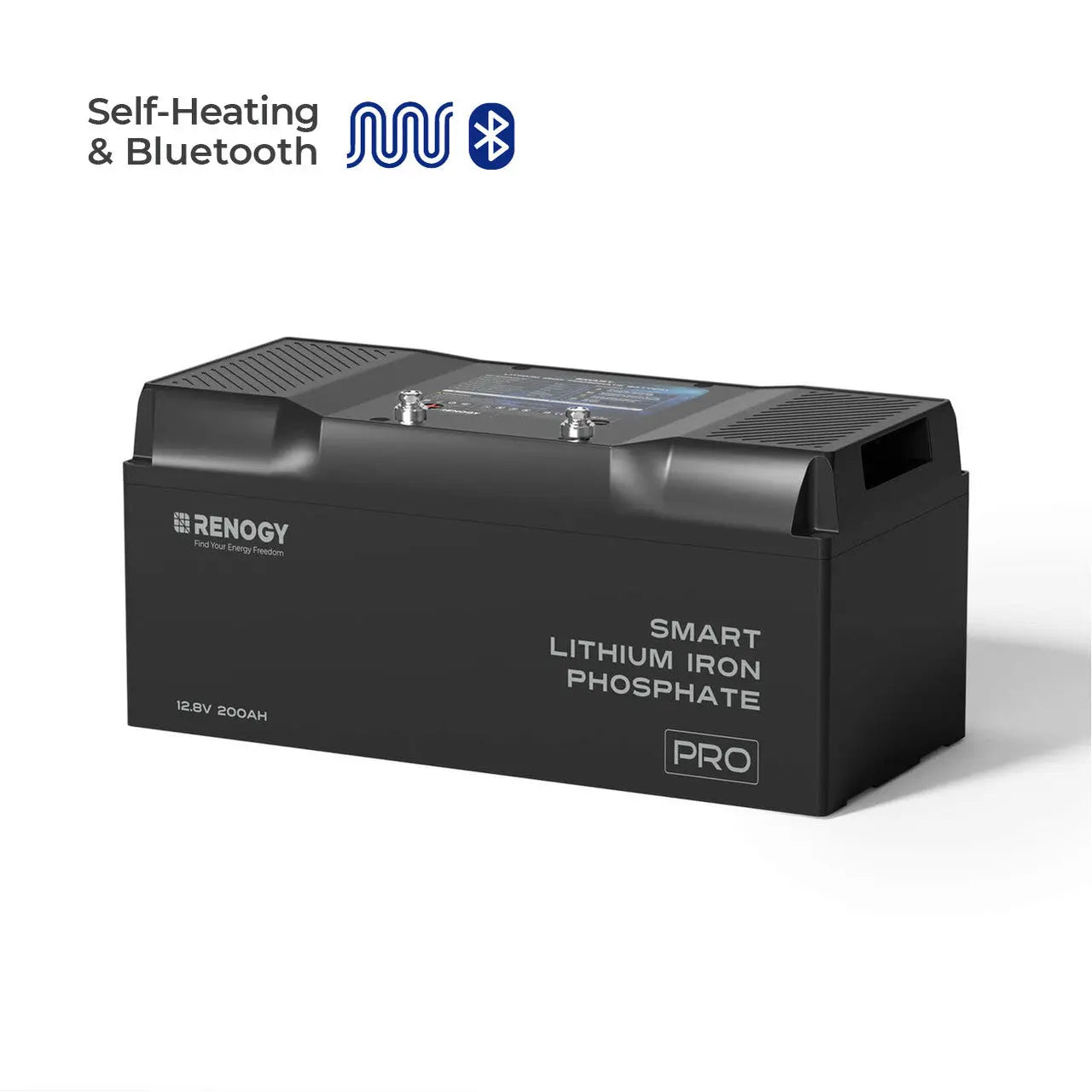
The Renogy 200Ah Smart includes built-in Bluetooth that connects to the Renogy DC Home app on your smartphone. This gives you real-time data on voltage, current, state of charge, temperature, and charge/discharge cycle count without installing any additional hardware. You can check your battery from inside the RV while lying in bed, which is a genuine convenience.
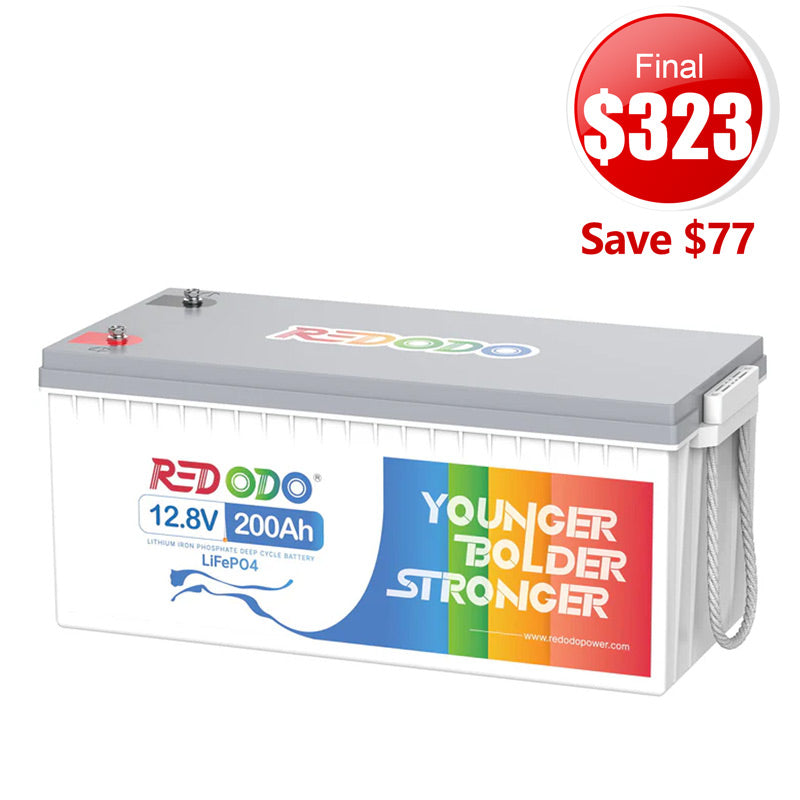
The Redodo 200Ah has no Bluetooth capability. To monitor this battery, you would need to install a standalone battery monitor like a Victron SmartShunt or a simple voltage display, adding $30-$150 to your total cost depending on the monitor you choose. For RV owners who want to keep their builds simple with fewer separate components, the Renogy’s integrated Bluetooth is an elegant solution.
That said, many experienced RV owners prefer a dedicated external battery monitor anyway, because it works across all batteries in a bank regardless of brand and provides more detailed data than most built-in Bluetooth systems. If you already have or plan to install a standalone battery monitor, the Renogy’s Bluetooth is a nice bonus but not essential.
Self-Heating BMS: The Cold Weather Game-Changer
This is the Renogy’s marquee feature and the single biggest differentiator in this comparison. LiFePO4 batteries should never be charged below 32 degrees Fahrenheit (0 degrees Celsius). Charging lithium cells in freezing conditions causes lithium plating on the anode, which permanently and irreversibly damages the battery. Most LiFePO4 batteries, including the Redodo, simply cut off charging below 32 degrees Fahrenheit via their BMS. This protects the cells but means your battery cannot accept charge on a cold morning until it warms up naturally, which can take hours.
The Renogy 200Ah Smart solves this problem with a self-heating BMS. When the battery detects temperatures below freezing, it uses a small amount of stored energy to warm the cells up to a safe charging temperature before allowing current to flow in. This is critical for RV owners who camp in cold climates, ski towns, or shoulder seasons when overnight temperatures drop below freezing. Without self-heating, you could find yourself unable to charge from solar panels during the most productive morning hours because your battery is still too cold.
If you exclusively camp in warm climates like the American Southwest or Florida, this feature is irrelevant. But if you boondock in Colorado, Utah, the Pacific Northwest, or anywhere that sees freezing nights, the self-heating BMS could save your battery from permanent damage and keep your system running when you need it most. For more on battery selection for RV use, check out our roundup of the best RV lithium batteries.
Weight
The Redodo 200Ah weighs 47.1 lbs, nearly 6 lbs lighter than the Renogy’s 52.9 lbs. The Renogy’s extra weight comes partly from the self-heating element and Bluetooth hardware. For a single-battery installation, 6 lbs is manageable. For builds using multiple batteries, the weight difference adds up. In a van conversion where every pound is budgeted, the lighter Redodo has an edge.
Price
The Redodo 200Ah retails for approximately $460, while the Renogy 200Ah Smart costs around $700. The $240 difference is significant, especially for budget-conscious builders. With the Redodo, you could use the savings to buy a quality external battery monitor and still come out well ahead financially.
The question is whether Bluetooth monitoring and a self-heating BMS are worth $240. For warm-weather campers who already plan to install a standalone battery monitor, they clearly are not. For cold-weather campers who want integrated monitoring and freeze protection, $240 is a reasonable price for features that genuinely solve real problems.
Verdict
The right choice here is more situational than in most battery comparisons. Climate and camping style matter more than usual.
Choose the Renogy 200Ah Smart if you camp in cold weather or at elevation where overnight temperatures regularly drop below freezing. The self-heating BMS is not a luxury in these conditions; it is essential protection that prevents permanent battery damage and keeps your system charging on cold mornings. Bluetooth monitoring is a convenient bonus that simplifies your installation. The $700 price is fair for a 200Ah battery with these features.
Choose the Redodo 200Ah 12V if you camp primarily in mild to warm climates and want the most capacity for your dollar. At $460, you get the same 200Ah of LiFePO4 storage with the same cycle life and BMS protection, just without the cold-weather and Bluetooth extras. The 47.1 lb weight makes it one of the lighter 200Ah options available. Invest the $240 savings in solar panels, wiring, or a standalone battery monitor.
Frequently Asked Questions
Do I need a self-heating battery for my RV if I camp in cold weather?
Yes, if you camp where temperatures drop below 32F. Charging LiFePO4 batteries in freezing conditions causes permanent damage. The Renogy 200Ah Smart has a self-heating BMS that warms the cells before charging, while the Redodo simply cuts off charging below freezing, leaving you unable to charge until temperatures rise.
Is the Renogy 200Ah Smart worth $240 more than the Redodo 200Ah?
It depends on your camping climate. For cold-weather campers, the self-heating BMS and Bluetooth monitoring justify the premium. For warm-climate campers, the Redodo delivers identical capacity and cycle life at $460, and you can add a standalone battery monitor with the savings.
Does the Redodo 200Ah have Bluetooth monitoring?
No, the Redodo 200Ah does not include Bluetooth. To monitor state of charge, voltage, and current, you would need to install a separate battery monitor like a Victron SmartShunt, which adds $30-$150 to your total cost. The Renogy 200Ah Smart has Bluetooth built in.
Read the Full Reviews
Renogy
Renogy 200Ah Smart LiFePO4
The best value in high-capacity RV batteries. 200Ah with built-in Bluetooth monitoring and a self-heating BMS that enables charging in sub-freezing temperatures — all for $700.
Capacity
200Ah
Amps
200A
Weight
52.9 lbs
A high-capacity 200Ah battery at a rock-bottom price point. Redodo's 200A BMS and support for series/parallel configurations make it ideal for building large off-grid battery banks.
Capacity
200Ah
Amps
200A
Weight
47.1 lbs
More Comparisons
Anker SOLIX C1000 Gen 2 vs EcoFlow DELTA 3 Plus: The Ultimate 1kWh Showdown (2026)
Read comparison →
Anker SOLIX C800 Plus vs Bluetti AC70: Best Mid-Range Power Station Under $650?
Read comparison →
Battle Born 100Ah vs LiTime 100Ah: Which RV Battery Is Better?
Read comparison →
Best 1000Wh Power Station 2026: 4-Way Comparison
Read comparison →
Best 2,000Wh Power Station for Home Backup: Jackery vs EcoFlow vs Bluetti
Read comparison →
Best Portable Power Stations for Camping in 2026
Read comparison →
Best Power Station for RV and Van Life: EcoFlow vs Jackery vs Bluetti
Read comparison →
Bluetti AC180 vs EcoFlow Delta 2: Best Mid-Range Power Station?
Read comparison →
Bluetti AC200P vs Elite 200 V2: Is the Upgrade Worth It?
Read comparison →
Bluetti AC70 vs Anker SOLIX C1000: Best Budget Power Station for Camping
Read comparison →
ChargePoint Home Flex vs Wallbox Pulsar Plus: Which EV Charger Is Better?
Read comparison →
EcoFlow 220W Bifacial vs Jackery SolarSaga 200W: Which Solar Panel Is Better?
Read comparison →
EcoFlow Delta 2 vs Delta 2 Max: Which EcoFlow Should You Buy?
Read comparison →
EcoFlow DELTA 3 Plus vs Anker SOLIX C1000: Which 1kWh Station Wins?
Read comparison →
EcoFlow DELTA 3 Plus vs Anker SOLIX C1000: Which 1,000Wh Power Station Is Better?
Read comparison →
EcoFlow DELTA 3 vs DELTA 3 Plus: Is the Plus Worth $130 More?
Read comparison →
EcoFlow DELTA Pro 3 vs Jackery Explorer 2000 Plus: Best Large Power Station?
Read comparison →
EcoFlow RIVER 3 Plus vs Jackery Explorer 600 Plus: Compact Power Compared
Read comparison →
EcoFlow RIVER 3 vs Jackery Explorer 100 Plus: Best Compact Power Station?
Read comparison →
EcoFlow vs Jackery 2026: Which Brand Is Better?
Read comparison →
EcoFlow Wave 2 vs Zero Breeze Mark 2: Best Portable AC for Camping in 2026
Read comparison →
Emporia Energy Level 2 vs Lectron V-BOX 48A: Best Budget EV Charger 2026
Read comparison →
Goal Zero Yeti 1000X vs Jackery Explorer 1000 v2: Premium vs Value
Read comparison →
Honda EU2200i vs EcoFlow DELTA Pro 3: Generator vs Power Station
Read comparison →
Jackery Explorer 1000 v2 vs Anker SOLIX C1000: Best Mid-Range Power Station
Read comparison →
Jackery Explorer 2000 v2 vs 2000 Plus: Which Jackery 2kWh Station Should You Buy?
Read comparison →
Jackery SolarSaga 200W vs Bluetti PV200: Which Solar Panel Is Better?
Read comparison →
Jackery vs Bluetti 2026: Which Brand Makes the Better Power Station?
Read comparison →
Segway Cube 2000 vs Jackery Explorer 2000 v2: Value vs Refinement
Read comparison →
Tesla Wall Connector vs ChargePoint Home Flex: Which EV Charger Is Better?
Read comparison →
VTOMAN FlashSpeed 1500 vs Bluetti AC180: Mid-Range Showdown
Read comparison →
VTOMAN FlashSpeed 1500 vs EcoFlow DELTA 3 Plus: Value Challenger vs Proven Champion
Read comparison →
Yoshino B2000 SST vs Bluetti Elite 200 V2: Next-Gen 2kWh Battle
Read comparison →