Emporia Energy Level 2 vs Lectron V-BOX 48A: Best Budget EV Charger 2026

TL;DR
Comparing the two best budget Level 2 EV chargers in 2026: the Emporia Energy 48A ($460) vs Lectron V-BOX 48A ($380). Both deliver 48 amps of smart charging at hundreds less than premium brands — here's which one to buy.
Specs Comparison
| Spec | Emporia EV Charger 48A | Lectron V-Box 48 Amp EV Charger |
|---|---|---|
| Rating | 4.3 | 4.2 |
| Max Power | 11.5kW ⬤ | 11.5kW ⬤ |
| Amps | 48A ⬤ | 48A ⬤ |
| Cord | 24ft ✓ | 21ft |
| Price | $460 | $380 ✓ |
| Check Price on Amazon | Check Price on Amazon |
Emporia Energy vs Lectron V-BOX: Which Budget EV Charger Wins?
You don’t need to spend $700+ on a ChargePoint or Wallbox to get a great home EV charger. The Emporia Energy Level 2 48A and Lectron V-BOX 48A both deliver the same 48-amp, 11.5kW charging speed as premium competitors — at roughly half the price. But they’re not identical. One integrates with a whole-home energy monitoring ecosystem, while the other wins on pure price. Here’s how to choose.
Head-to-Head Spec Comparison
| Spec | Emporia Energy 48A | Lectron V-BOX 48A |
|---|---|---|
| Amperage | 48A | 48A |
| Max Power | 11.5kW | 11.5kW |
| Cord Length | 24 feet | 21 feet |
| Connector | J1772 (universal) | J1772 (universal) |
| Plug Type | NEMA 14-50 | NEMA 14-50 |
| WiFi | Yes | Yes |
| Bluetooth | Yes | No |
| App | Yes (Emporia Energy) | Yes (Lectron) |
| Energy Star | No | Yes |
| Weight | 20 lbs | 15 lbs |
| Price | ~$460 | ~$380 |
Charging Speed
Identical. Both chargers deliver 48 amps at 240V for a maximum of 11.5kW. This translates to approximately 30-37 miles of range added per hour of charging, depending on your vehicle’s efficiency. A typical EV with a 60kWh battery charges from 20% to 80% in about 3-4 hours on either charger.
Both use the J1772 connector standard, which works with every EV sold in North America (Tesla vehicles use an adapter or have a built-in J1772 port on newer models). Both plug into a standard NEMA 14-50 outlet — the same outlet used by electric dryers — making DIY installation straightforward if you already have the outlet.
Edge: Tie.
Cord Length
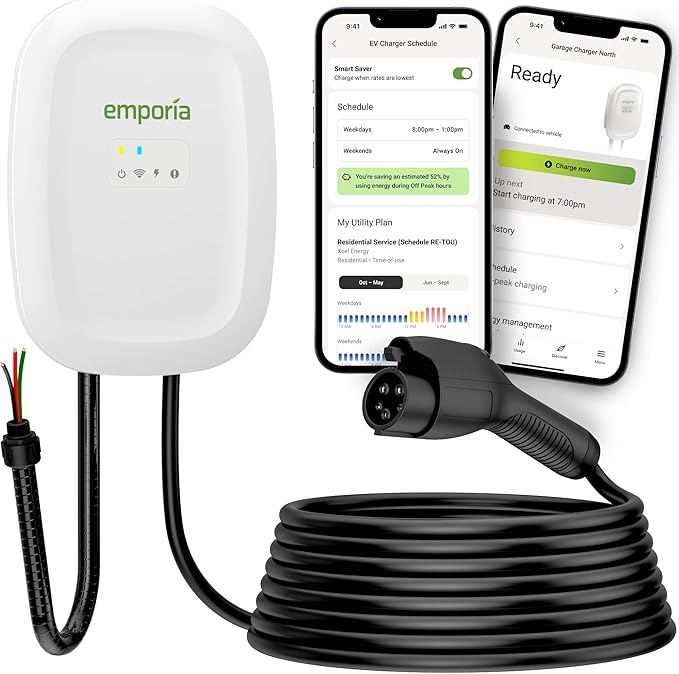
The Emporia Energy comes with a 24-foot charging cable. The Lectron V-BOX includes a 21-foot cable. Three feet doesn’t sound like much, but it can make the difference between comfortably reaching your charge port and having to park at an awkward angle.
If your charger location and parking spot are close together, either cable works fine. If you’re stretching to reach — say, mounting the charger on the back garage wall and parking nose-in — the Emporia’s extra 3 feet provides useful slack.
Edge: Emporia, slightly.
Smart Features and App
Both chargers are WiFi-connected with companion apps for scheduling, monitoring, and control. But the Emporia has a meaningful advantage in software depth.
Emporia Energy app:
- Charge scheduling (charge during off-peak electricity hours)
- Real-time energy usage monitoring
- Integration with Emporia Vue energy monitor — if you have Emporia’s whole-home energy monitor, you get a unified dashboard showing your EV charging costs alongside total home energy consumption
- Charge history with cost calculations
- Bluetooth + WiFi for setup (Bluetooth makes initial configuration easier)
Lectron app:
- Charge scheduling
- Energy usage monitoring
- Charge history
- WiFi only (no Bluetooth fallback)
The Emporia’s killer feature is its energy monitoring ecosystem integration. If you’re an energy-conscious homeowner who wants to track exactly how much your EV costs to charge relative to your total electricity bill, the Emporia + Vue combo provides that visibility at a price that’s hard to beat.
The Lectron app is functional but more basic. Some users report occasional WiFi connectivity issues, though firmware updates have improved stability.
Edge: Emporia, especially for energy-conscious buyers.
Installation
Both chargers plug into a NEMA 14-50 outlet, which means installation is as simple as:
- Have a 14-50 outlet installed by an electrician (if you don’t already have one) — typically $200-$500 depending on your electrical panel’s location and capacity
- Plug in the charger
- Mount it to the wall with the included bracket
- Connect via WiFi and configure the app
Neither charger requires hardwiring, which keeps installation costs down and means you can take it with you if you move. Both include wall-mounting hardware.
The Lectron at 15 lbs is lighter and slightly easier to handle during mounting. The Emporia at 20 lbs is heavier but not difficult to install. Both are straightforward DIY projects for anyone comfortable with a drill.
Edge: Tie (both are NEMA 14-50 plug-in).
Build Quality
This is where the price difference shows. The Emporia Energy charger has a more solid feel with a better-quality cable jacket and a sturdier wall mount. It’s rated for indoor and outdoor use (NEMA 4 enclosure).
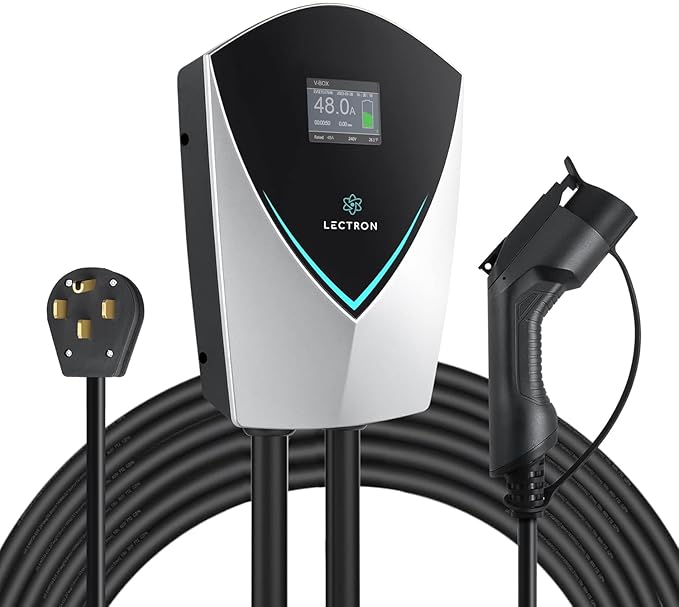
The Lectron V-BOX is well-built for its price point but the cable and housing feel slightly less premium. It’s also rated for outdoor use, but some users report the housing showing wear faster than premium alternatives.
Both chargers carry appropriate safety certifications (UL listed) and include overcurrent, overvoltage, and ground fault protection. Neither has had safety recalls.
Edge: Emporia, marginally.
Energy Star and Rebates
The Lectron V-BOX is Energy Star certified, while the Emporia is not. This matters because many utility companies and state programs offer rebates of $200-$500 for Energy Star certified EV chargers. Depending on your location, the Lectron’s rebate eligibility could make it significantly cheaper than its sticker price — potentially under $200 after rebates.
Check your local utility’s EV charger rebate program before purchasing. The Database of State Incentives for Renewables & Efficiency (DSIRE) tracks available programs by ZIP code.
Edge: Lectron, potentially by a lot depending on available rebates.
Price and Value
The Lectron V-BOX at $380 is $80 cheaper than the Emporia at $460. Both deliver identical 48A charging speed.
That $80 buys you: a longer cable (3 extra feet), Bluetooth for easier setup, energy monitoring ecosystem integration, and marginally better build quality. Whether that’s worth it depends on whether you’ll use the Emporia’s energy management features.
However, if the Lectron qualifies for an Energy Star rebate in your area, the post-rebate price could be dramatically lower — potentially making it the better financial decision regardless of feature differences.
| Scenario | Emporia Total Cost | Lectron Total Cost |
|---|---|---|
| No rebate | $460 | $380 |
| $200 rebate (Lectron only) | $460 | $180 |
| $300 rebate (Lectron only) | $460 | $80 |
Edge: Lectron on sticker price. Check rebates before deciding.
Verdict
Both chargers deliver premium-level 48A charging at budget prices. The choice comes down to your priorities:
Choose the Emporia Energy Level 2 48A if you want the better overall smart charger experience, value the longer 24-foot cable, already own or plan to buy Emporia’s Vue energy monitor for whole-home tracking, or want the easier Bluetooth-assisted setup. At $460, it’s the most feature-rich charger under $500.
Choose the Lectron V-BOX 48A if you want the absolute lowest price for 48A charging, qualify for Energy Star rebates in your area (which could make this charger nearly free), or simply want a no-frills smart charger that does the job without paying for extras. At $380 — or potentially much less with rebates — it’s the best value in EV charging.
Either way, you’re getting 90% of what $700+ premium chargers deliver at roughly half the price. For more EV charging options, see our best Level 2 EV charger rankings and our ChargePoint Home Flex vs Wallbox Pulsar Plus comparison for premium alternatives.
Frequently Asked Questions
Is the Lectron V-BOX eligible for Energy Star rebates?
Yes, the Lectron V-BOX 48A is Energy Star certified, which may qualify it for utility company or state rebates of $200-$500 depending on your location. The Emporia Energy charger is not Energy Star certified. Check your local utility's rebate program before purchasing.
Do the Emporia Energy and Lectron V-BOX charge at the same speed?
Yes, both deliver identical 48A charging at 240V for a maximum of 11.5kW. This adds approximately 30-37 miles of range per hour. Both use the universal J1772 connector and plug into a standard NEMA 14-50 outlet.
What makes the Emporia Energy charger worth $80 more than the Lectron V-BOX?
The Emporia offers a longer 24-foot cable (vs 21 feet), Bluetooth for easier setup, better build quality, and integration with Emporia's Vue whole-home energy monitor for tracking EV charging costs alongside total electricity usage. Whether that justifies $80 depends on whether you will use the energy management features.
Read the Full Reviews
Emporia Energy
Emporia EV Charger 48A
The best budget-friendly smart EV charger. Emporia pairs a 48A charger with their energy monitoring ecosystem, giving you whole-home energy visibility at a price $200+ below premium competitors.
Max Power
11.5kW
Amps
48A
Cord
24ft
Lectron
Lectron V-Box 48 Amp EV Charger
An affordable 48A smart charger that punches above its price class. WiFi connectivity and Energy Star certification at under $400 make the V-Box a compelling value pick.
Max Power
11.5kW
Amps
48A
Cord
21ft
More Comparisons
Anker SOLIX C1000 Gen 2 vs EcoFlow DELTA 3 Plus: The Ultimate 1kWh Showdown (2026)
Read comparison →
Anker SOLIX C800 Plus vs Bluetti AC70: Best Mid-Range Power Station Under $650?
Read comparison →
Battle Born 100Ah vs LiTime 100Ah: Which RV Battery Is Better?
Read comparison →
Best 1000Wh Power Station 2026: 4-Way Comparison
Read comparison →
Best 2,000Wh Power Station for Home Backup: Jackery vs EcoFlow vs Bluetti
Read comparison →
Best Portable Power Stations for Camping in 2026
Read comparison →
Best Power Station for RV and Van Life: EcoFlow vs Jackery vs Bluetti
Read comparison →
Bluetti AC180 vs EcoFlow Delta 2: Best Mid-Range Power Station?
Read comparison →
Bluetti AC200P vs Elite 200 V2: Is the Upgrade Worth It?
Read comparison →
Bluetti AC70 vs Anker SOLIX C1000: Best Budget Power Station for Camping
Read comparison →
ChargePoint Home Flex vs Wallbox Pulsar Plus: Which EV Charger Is Better?
Read comparison →
EcoFlow 220W Bifacial vs Jackery SolarSaga 200W: Which Solar Panel Is Better?
Read comparison →
EcoFlow Delta 2 vs Delta 2 Max: Which EcoFlow Should You Buy?
Read comparison →
EcoFlow DELTA 3 Plus vs Anker SOLIX C1000: Which 1kWh Station Wins?
Read comparison →
EcoFlow DELTA 3 Plus vs Anker SOLIX C1000: Which 1,000Wh Power Station Is Better?
Read comparison →
EcoFlow DELTA 3 vs DELTA 3 Plus: Is the Plus Worth $130 More?
Read comparison →
EcoFlow DELTA Pro 3 vs Jackery Explorer 2000 Plus: Best Large Power Station?
Read comparison →
EcoFlow RIVER 3 Plus vs Jackery Explorer 600 Plus: Compact Power Compared
Read comparison →
EcoFlow RIVER 3 vs Jackery Explorer 100 Plus: Best Compact Power Station?
Read comparison →
EcoFlow vs Jackery 2026: Which Brand Is Better?
Read comparison →
EcoFlow Wave 2 vs Zero Breeze Mark 2: Best Portable AC for Camping in 2026
Read comparison →
Goal Zero Yeti 1000X vs Jackery Explorer 1000 v2: Premium vs Value
Read comparison →
Honda EU2200i vs EcoFlow DELTA Pro 3: Generator vs Power Station
Read comparison →
Jackery Explorer 1000 v2 vs Anker SOLIX C1000: Best Mid-Range Power Station
Read comparison →
Jackery Explorer 2000 v2 vs 2000 Plus: Which Jackery 2kWh Station Should You Buy?
Read comparison →
Jackery SolarSaga 200W vs Bluetti PV200: Which Solar Panel Is Better?
Read comparison →
Jackery vs Bluetti 2026: Which Brand Makes the Better Power Station?
Read comparison →
Renogy 200Ah Smart vs Redodo 200Ah: Which RV Battery Is Better?
Read comparison →
Segway Cube 2000 vs Jackery Explorer 2000 v2: Value vs Refinement
Read comparison →
Tesla Wall Connector vs ChargePoint Home Flex: Which EV Charger Is Better?
Read comparison →
VTOMAN FlashSpeed 1500 vs Bluetti AC180: Mid-Range Showdown
Read comparison →
VTOMAN FlashSpeed 1500 vs EcoFlow DELTA 3 Plus: Value Challenger vs Proven Champion
Read comparison →
Yoshino B2000 SST vs Bluetti Elite 200 V2: Next-Gen 2kWh Battle
Read comparison →