EcoFlow RIVER 3 vs Jackery Explorer 100 Plus: Best Compact Power Station?

TL;DR
Comparing the EcoFlow RIVER 3 and Jackery Explorer 100 Plus, two compact portable power stations for lightweight use. We compare capacity, output, charging, portability, and price to help you pick the right one.
Specs Comparison
| Spec | EcoFlow RIVER 3 | Jackery Explorer 100 Plus |
|---|---|---|
| Rating | 4.3 | 4 |
| Capacity | 245Wh ✓ | 99Wh |
| Output | 300W ✓ | 128W |
| Weight | 7.8 lbs | 2.1 lbs ✓ |
| Surge | 600W ✓ | 128W |
| Price | $199 | $149 ✓ |
| Charge Time | 1 hrs ✓ | 1.8 hrs |
| AC Outlets | 2 | 0 |
| USB-C | 1 | 2 |
| USB-A | 2 | 1 |
| Check Price on Amazon | Check Price on Amazon |
EcoFlow RIVER 3 vs Jackery Explorer 100 Plus: Best Compact Power Station?
Compact portable power stations fill an important niche for travelers, day-trippers, and anyone who needs a reliable charge without lugging around a heavy unit. Two of the most popular options in this space are the EcoFlow RIVER 3 and the Jackery Explorer 100 Plus. While both are marketed as small, portable power solutions, they actually target quite different use cases. The RIVER 3 is a feature-rich mini station with AC output, while the Jackery Explorer 100 Plus is an ultra-compact power bank designed for maximum portability. Understanding where each one excels is essential to making the right purchase.
Head-to-Head Spec Comparison
| Spec | EcoFlow RIVER 3 | Jackery Explorer 100 Plus |
|---|---|---|
| Capacity | 245Wh | 99Wh |
| AC Output | 300W (600W surge) | None |
| USB-C Output | 100W max | 100W max |
| Battery Type | LFP (LiFePO4) | Li-ion (NMC) |
| Cycle Life | 3000+ cycles to 80% | 500+ cycles to 80% |
| AC Charging Speed | 0-100% in ~50 minutes | 0-100% in ~1.7 hours |
| Solar Input | 110W max | 65W max |
| Weight | 7.5 lbs | 2.15 lbs |
| Dimensions | 8.5 x 8.5 x 5.4 in | 6.5 x 3.3 x 3.3 in |
| Price (MSRP) | $199 | $149 |
Capacity
The capacity gap between these two stations is significant. The EcoFlow RIVER 3 packs 245Wh, nearly 2.5 times the Jackery Explorer 100 Plus’s 99Wh. In practical terms, the RIVER 3 can charge a MacBook Pro roughly 3 to 4 times, while the Jackery will manage about 1 to 1.5 full charges. For a smartphone, the RIVER 3 offers approximately 15 or more full charges versus around 6 from the Jackery.
The battery chemistry also tells an important story. The RIVER 3 uses LFP (lithium iron phosphate) chemistry rated for 3000+ cycles to 80% capacity. The Jackery Explorer 100 Plus uses standard Li-ion (NMC) cells rated for only 500+ cycles to 80%. That is a six-fold difference in expected battery lifespan. If you plan to use your compact station frequently over many years, the RIVER 3 will outlast the Jackery by a wide margin.
Output
This category highlights the fundamental difference between these two products. The EcoFlow RIVER 3 includes a true AC outlet rated at 300W continuous with a 600W surge. This means it can power small appliances like a desk lamp, a laptop charger, a small fan, a drone charger, or even a mini blender. Having an AC outlet in a station this compact is genuinely useful and expands the range of devices you can run.
The Jackery Explorer 100 Plus has no AC outlet at all. Its primary output is a 100W USB-C port, which is excellent for charging laptops, tablets, phones, and other USB-powered devices. It also includes a USB-A port for smaller accessories. For purely USB-based charging, the 100W USB-C output matches the RIVER 3’s USB-C capability. But if you ever need to plug in a standard wall-plug device, the Jackery simply cannot do it.
Charging Speed
The EcoFlow RIVER 3 charges from empty to full in approximately 50 minutes from a wall outlet, which is remarkably fast for any portable power station. The Jackery Explorer 100 Plus takes about 1.7 hours for a full wall charge. While the Jackery has a much smaller battery, the RIVER 3 still fills its larger battery faster in absolute terms, thanks to EcoFlow’s fast-charging technology.
Solar charging follows a similar pattern. The RIVER 3 accepts up to 110W of solar input versus 65W for the Jackery. Combined with the RIVER 3’s larger battery, it is better equipped for sustained off-grid use where you are relying on solar panels to keep the station topped off throughout the day.
Portability
This is where the Jackery Explorer 100 Plus shines brightest. At just 2.15 lbs, it weighs less than a third of the RIVER 3’s 7.5 lbs. Its compact dimensions of 6.5 x 3.3 x 3.3 inches allow it to slip into a daypack, purse, or jacket pocket with ease. It is barely larger than a couple of smartphones stacked together.
The RIVER 3 is still considered compact by power station standards at 7.5 lbs, and many users will find it perfectly manageable for car camping or keeping in a bag. But it is a fundamentally different kind of portable. You’ll notice it in a backpack. The Jackery, by contrast, is the kind of device you can carry and forget about until you need it.
For hikers, cyclists, ultralight travelers, and anyone who counts ounces, the Jackery’s form factor is hard to beat. For car campers, van lifers, and desk-based remote workers, the RIVER 3’s extra weight is a non-issue.
Price
The Jackery Explorer 100 Plus comes in at $149, while the EcoFlow RIVER 3 is priced at $199. The $50 difference is modest, but the value equation depends on what you need. The Jackery offers a capable USB charging solution at a lower entry price. The RIVER 3 costs $50 more but delivers 2.5 times the capacity, an AC outlet, LFP battery chemistry, and much faster charging.
On a cost-per-watt-hour basis, the RIVER 3 comes in at approximately $0.81 per Wh versus $1.51 per Wh for the Jackery. The EcoFlow delivers significantly more value per dollar when measured by capacity alone.
Verdict
These two compact stations serve genuinely different purposes despite occupying the same general product category. Your choice depends almost entirely on how you plan to use it.
Choose the EcoFlow RIVER 3 if you want a versatile compact power station with AC output, strong capacity, and long-lasting LFP battery chemistry. It is the better choice for car camping, remote work, light emergency backup, and anyone who needs to power devices with a standard wall plug. The extra $50 buys significantly more capability.
Choose the Jackery Explorer 100 Plus if ultralight portability is your top priority and you only need to charge USB devices like phones, tablets, and laptops. It is ideal for day hikes, air travel, bike touring, and situations where every ounce counts. Its 2.15 lb weight and pocket-friendly size make it the go-anywhere power bank that won’t slow you down.
Frequently Asked Questions
Does the Jackery Explorer 100 Plus have an AC outlet?
No, the Jackery Explorer 100 Plus does not have an AC outlet. It charges devices exclusively via USB-C (100W) and USB-A ports. If you need to power standard wall-plug devices, the EcoFlow RIVER 3 is the better choice with its 300W AC outlet.
Is the EcoFlow RIVER 3 or Jackery Explorer 100 Plus better for backpacking?
The Jackery Explorer 100 Plus is far better for backpacking at just 2.15 lbs compared to the RIVER 3's 7.5 lbs. It fits in a daypack or jacket pocket and is ideal for hikers and ultralight travelers who only need USB charging.
How many phone charges can I get from the EcoFlow RIVER 3?
The EcoFlow RIVER 3 with its 245Wh capacity can charge a smartphone approximately 15 or more times. The Jackery Explorer 100 Plus with 99Wh provides about 6 full phone charges.
Read the Full Reviews
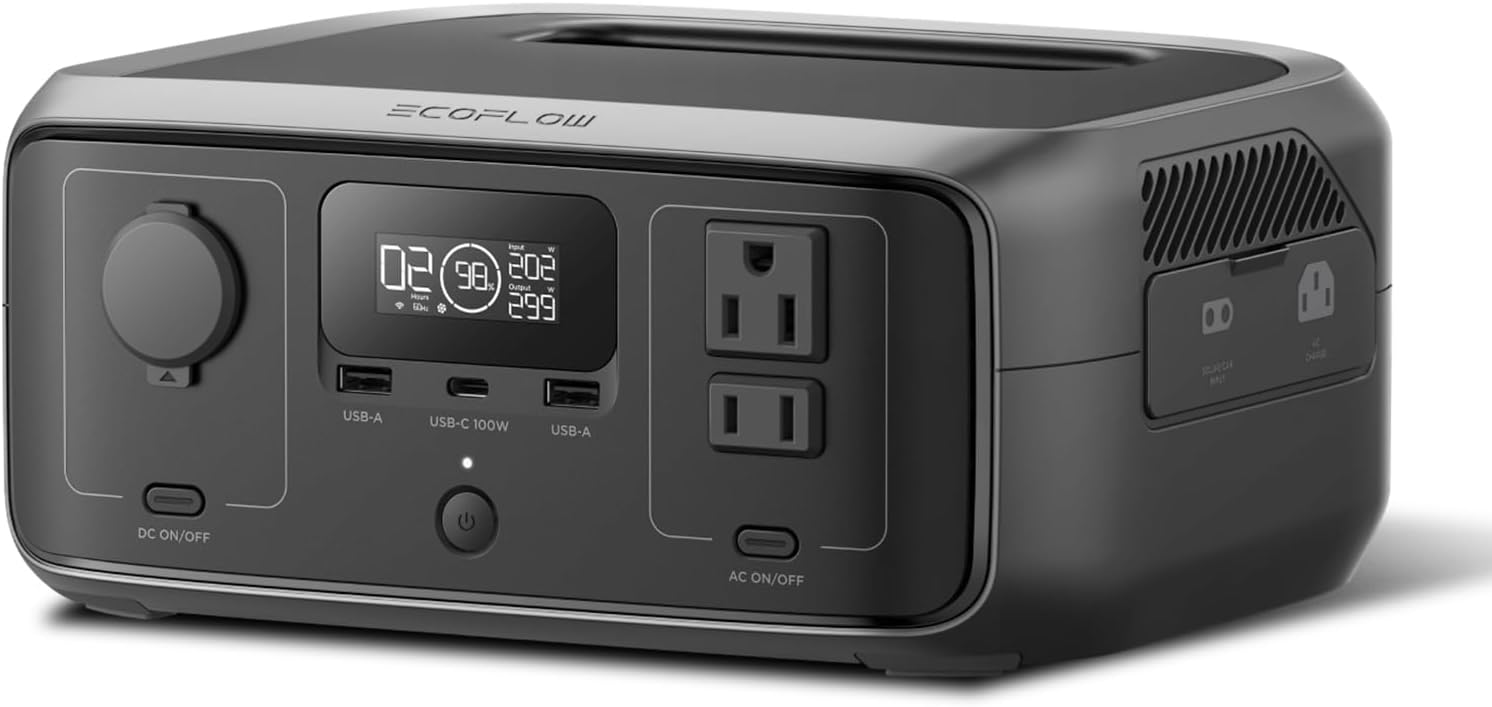
EcoFlow
EcoFlow RIVER 3
EcoFlow's most portable power station. At under 8 lbs with a 1-hour charge time, the RIVER 3 is perfect for day trips, phone and laptop charging, and lightweight camping.
Capacity
245Wh
Output
300W
Weight
7.8 lbs
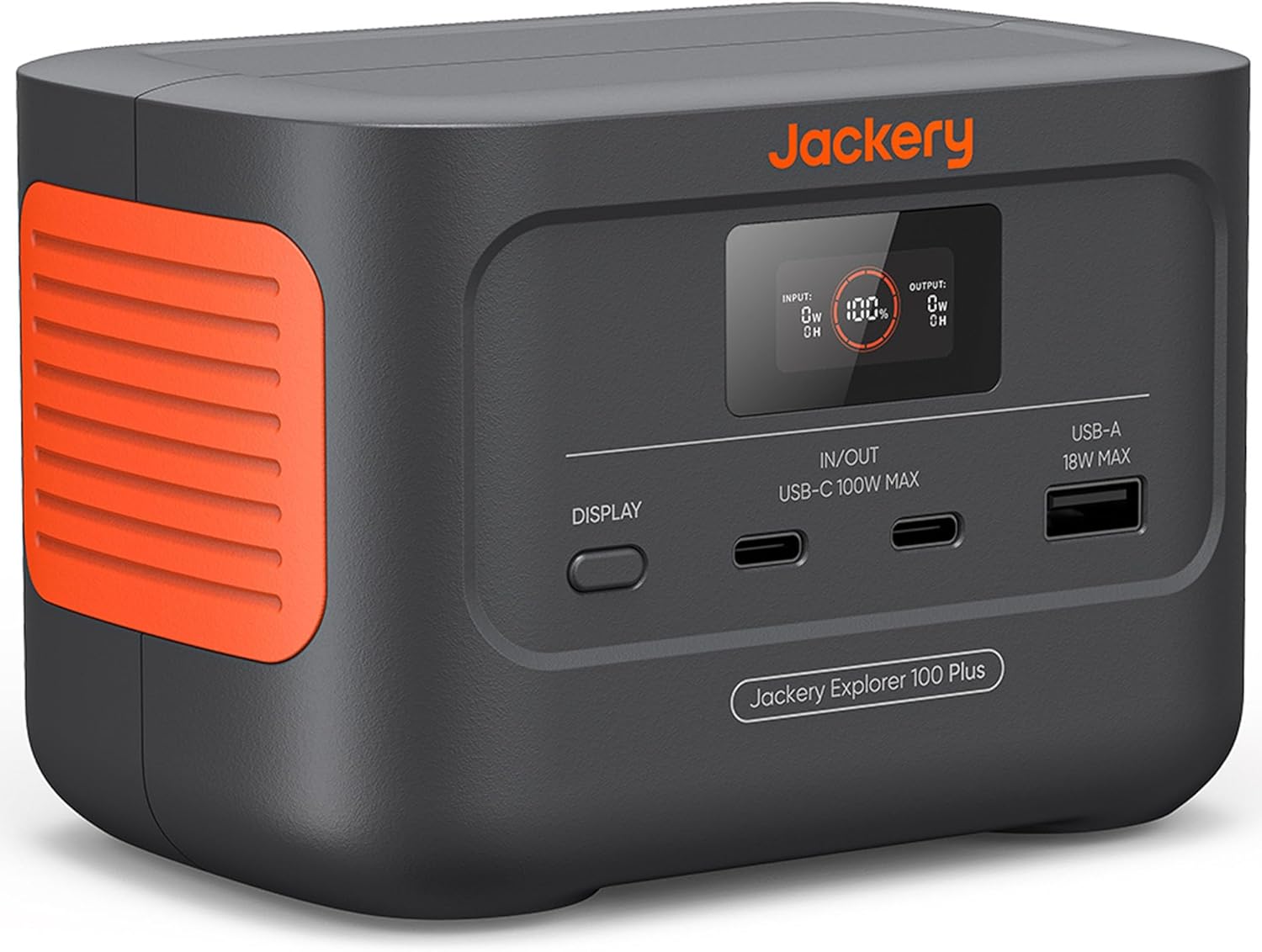
Jackery
Jackery Explorer 100 Plus
The ultimate ultraportable charging station. No AC outlets, but the dual USB-C PD ports can charge laptops and phones anywhere. Weighs about as much as a water bottle.
Capacity
99Wh
Output
128W
Weight
2.1 lbs
More Comparisons
Anker SOLIX C1000 Gen 2 vs EcoFlow DELTA 3 Plus: The Ultimate 1kWh Showdown (2026)
Read comparison →
Anker SOLIX C800 Plus vs Bluetti AC70: Best Mid-Range Power Station Under $650?
Read comparison →
Battle Born 100Ah vs LiTime 100Ah: Which RV Battery Is Better?
Read comparison →
Best 1000Wh Power Station 2026: 4-Way Comparison
Read comparison →
Best 2,000Wh Power Station for Home Backup: Jackery vs EcoFlow vs Bluetti
Read comparison →
Best Portable Power Stations for Camping in 2026
Read comparison →
Best Power Station for RV and Van Life: EcoFlow vs Jackery vs Bluetti
Read comparison →
Bluetti AC180 vs EcoFlow Delta 2: Best Mid-Range Power Station?
Read comparison →
Bluetti AC200P vs Elite 200 V2: Is the Upgrade Worth It?
Read comparison →
Bluetti AC70 vs Anker SOLIX C1000: Best Budget Power Station for Camping
Read comparison →
ChargePoint Home Flex vs Wallbox Pulsar Plus: Which EV Charger Is Better?
Read comparison →
EcoFlow 220W Bifacial vs Jackery SolarSaga 200W: Which Solar Panel Is Better?
Read comparison →
EcoFlow Delta 2 vs Delta 2 Max: Which EcoFlow Should You Buy?
Read comparison →
EcoFlow DELTA 3 Plus vs Anker SOLIX C1000: Which 1kWh Station Wins?
Read comparison →
EcoFlow DELTA 3 Plus vs Anker SOLIX C1000: Which 1,000Wh Power Station Is Better?
Read comparison →
EcoFlow DELTA 3 vs DELTA 3 Plus: Is the Plus Worth $130 More?
Read comparison →
EcoFlow DELTA Pro 3 vs Jackery Explorer 2000 Plus: Best Large Power Station?
Read comparison →
EcoFlow RIVER 3 Plus vs Jackery Explorer 600 Plus: Compact Power Compared
Read comparison →
EcoFlow vs Jackery 2026: Which Brand Is Better?
Read comparison →
EcoFlow Wave 2 vs Zero Breeze Mark 2: Best Portable AC for Camping in 2026
Read comparison →
Emporia Energy Level 2 vs Lectron V-BOX 48A: Best Budget EV Charger 2026
Read comparison →
Goal Zero Yeti 1000X vs Jackery Explorer 1000 v2: Premium vs Value
Read comparison →
Honda EU2200i vs EcoFlow DELTA Pro 3: Generator vs Power Station
Read comparison →
Jackery Explorer 1000 v2 vs Anker SOLIX C1000: Best Mid-Range Power Station
Read comparison →
Jackery Explorer 2000 v2 vs 2000 Plus: Which Jackery 2kWh Station Should You Buy?
Read comparison →
Jackery SolarSaga 200W vs Bluetti PV200: Which Solar Panel Is Better?
Read comparison →
Jackery vs Bluetti 2026: Which Brand Makes the Better Power Station?
Read comparison →
Renogy 200Ah Smart vs Redodo 200Ah: Which RV Battery Is Better?
Read comparison →
Segway Cube 2000 vs Jackery Explorer 2000 v2: Value vs Refinement
Read comparison →
Tesla Wall Connector vs ChargePoint Home Flex: Which EV Charger Is Better?
Read comparison →
VTOMAN FlashSpeed 1500 vs Bluetti AC180: Mid-Range Showdown
Read comparison →
VTOMAN FlashSpeed 1500 vs EcoFlow DELTA 3 Plus: Value Challenger vs Proven Champion
Read comparison →
Yoshino B2000 SST vs Bluetti Elite 200 V2: Next-Gen 2kWh Battle
Read comparison →