EcoFlow RIVER 3 Plus vs Jackery Explorer 600 Plus: Compact Power Compared

TL;DR
The EcoFlow RIVER 3 Plus ($269, 286Wh expandable) and Jackery Explorer 600 Plus ($429, 632Wh) take different approaches to compact portable power. We break down which one fits your needs.
Specs Comparison
| Spec | EcoFlow RIVER 3 Plus | Jackery Explorer 600 Plus |
|---|---|---|
| Rating | 4.5 | 4.4 |
| Capacity | 286Wh | 632Wh ✓ |
| Output | 600W | 800W ✓ |
| Weight | 10.4 lbs ✓ | 16.1 lbs |
| Surge | 1200W | 1600W ✓ |
| Price | $269 ✓ | $429 |
| Charge Time | 1 hrs ✓ | 1.6 hrs |
| AC Outlets | 3 | 2 |
| USB-C | 1 | 2 |
| USB-A | 2 | 1 |
| Check Price on Amazon | Check Price on Amazon |
EcoFlow RIVER 3 Plus vs Jackery Explorer 600 Plus: Which Compact Station Wins?
Compact portable power stations have a unique challenge: they need to pack enough energy to be genuinely useful while staying light and small enough to justify the word “portable.” The EcoFlow RIVER 3 Plus and the Jackery Explorer 600 Plus both target this sweet spot, but they approach it from fundamentally different directions.
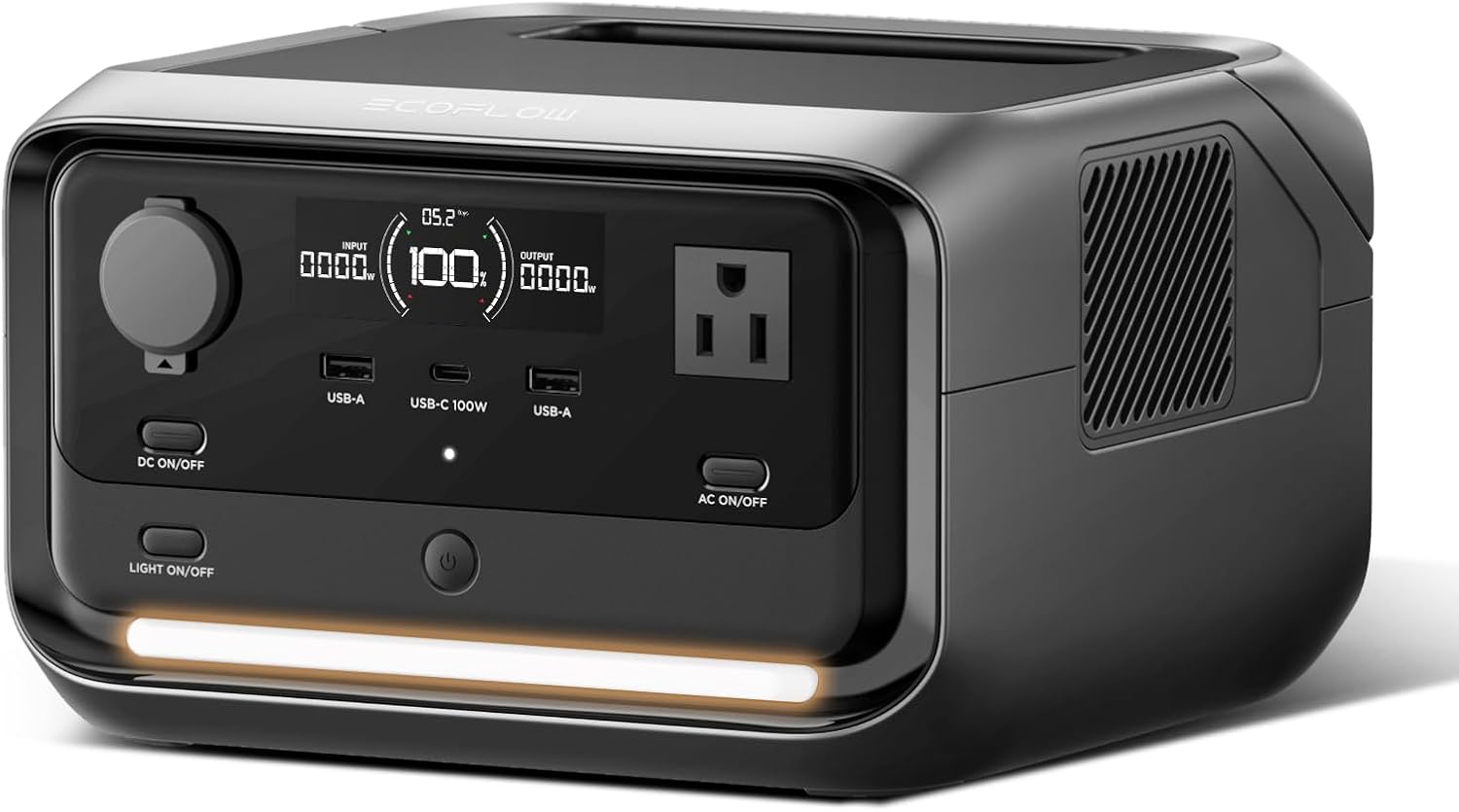
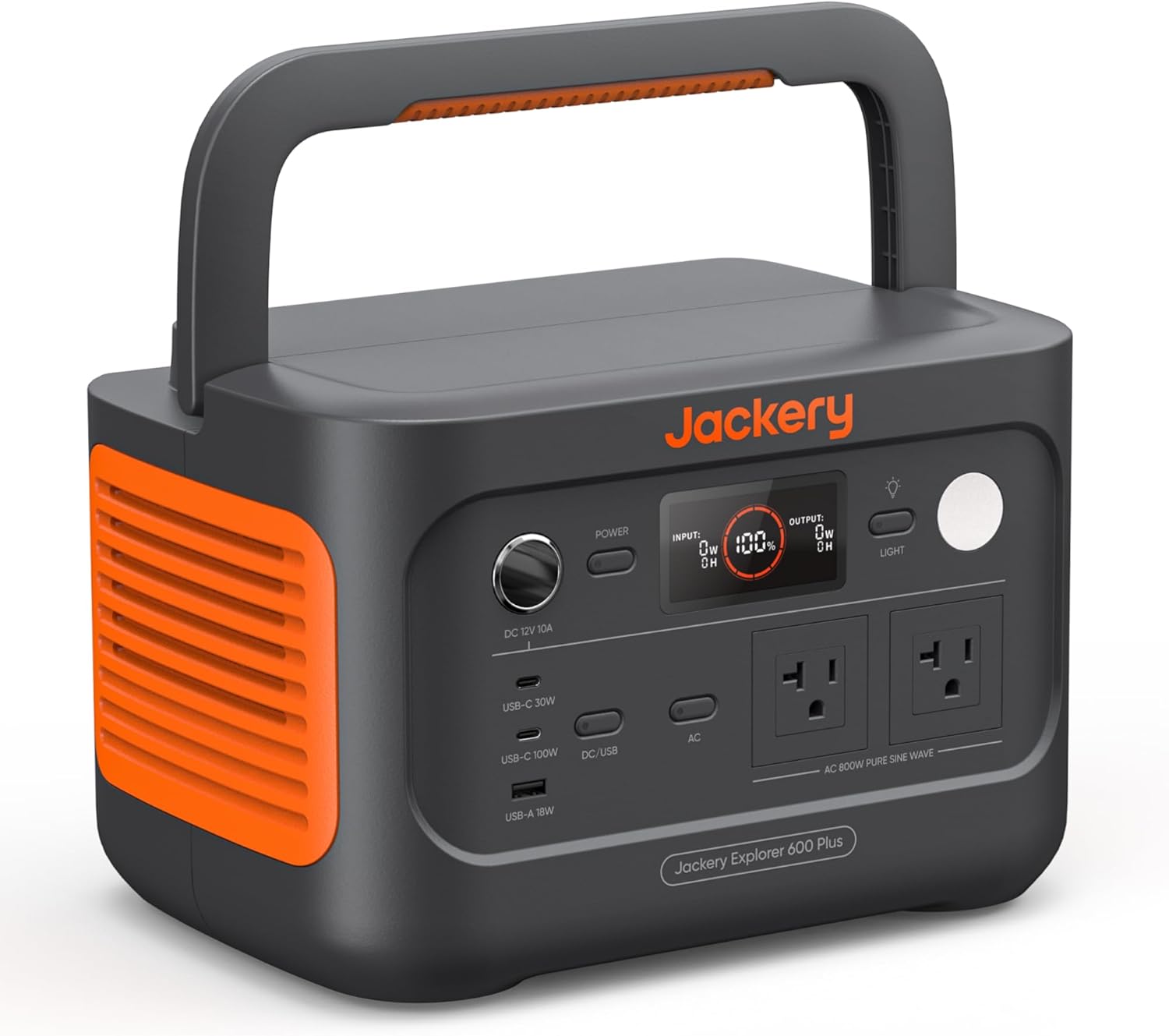
The EcoFlow RIVER 3 Plus starts at just 286Wh and 10.4 lbs with a remarkably low $269 price tag, but it can expand up to 858Wh through EcoFlow’s wire-free stacking battery system. The Jackery Explorer 600 Plus offers a fixed 632Wh capacity at 16.1 lbs and $429, betting on higher output power, an industry-leading 4,000-cycle battery, and a built-in LED light that lasts 150 hours.
Two philosophies, one goal: reliable portable power that you can actually carry. We tested both extensively to determine which compact station truly wins.
Head-to-Head Spec Comparison
| Spec | EcoFlow RIVER 3 Plus | Jackery Explorer 600 Plus |
|---|---|---|
| Price | $269 | $429 |
| Capacity | 286Wh (expandable to 858Wh) | 632Wh (fixed) |
| Battery Chemistry | LFP (LiFePO4) | LFP (LiFePO4) |
| Cycle Life | 3,000 cycles to 80% | 4,000 cycles to 80% |
| AC Output | 600W continuous (1,200W X-Boost) | 800W continuous (1,600W surge) |
| AC Outlets | 3 | 2 |
| USB-C Output | 100W | 100W |
| Weight | 10.4 lbs (base unit) | 16.1 lbs |
| AC Charge Time | ~50 minutes (0-80%) | ~60 minutes (Emergency Super Charge) |
| UPS Switchover | <10ms | <20ms |
| Noise Level | <30dB | Not specified |
| IP Rating | IP54 | Not rated |
| Special Features | Wire-free stacking expansion, IP54 | Built-in LED light (150hrs), 4,000 cycle battery |
| Smart Features | WiFi + Bluetooth app | Bluetooth app |
| Expandable | Yes (up to 858Wh with extra batteries) | No |
Capacity: Flexibility vs Fixed Power
This is the most important distinction between these two stations, and it shapes the entire buying decision.
The EcoFlow RIVER 3 Plus starts with 286Wh, which is modest by any measure. That is enough to charge a laptop roughly 3-4 times, run a CPAP machine for one night, or keep a few devices topped off during a short power outage. Where it gets interesting is EcoFlow’s wire-free stacking expansion system: you can add one or two additional 286Wh battery modules that physically stack beneath the base unit, tripling your capacity to 858Wh without any cables between the units. The stacking mechanism is magnetic and secure, creating a single integrated column of power.
The Jackery Explorer 600 Plus offers a fixed 632Wh capacity with no expansion option. Out of the box, it provides more than double the RIVER 3 Plus’s base capacity. That is enough to charge a laptop 7-8 times, run a mini fridge for 6-8 hours, or power a CPAP machine for two full nights.
Verdict on capacity: If you value a modular, grow-as-you-go system, the EcoFlow RIVER 3 Plus is brilliant. You start small and light, then add capacity when (and only when) you need it. But if you want to buy one unit and be done with it, the Jackery Explorer 600 Plus offers substantially more capacity out of the box. It is also worth noting that expanding the RIVER 3 Plus to 858Wh with two extra batteries significantly increases the total system cost, potentially exceeding the Jackery’s price for less total capacity per dollar.
Output Power
The Jackery Explorer 600 Plus has the edge in raw output, delivering 800W of continuous AC power with a 1,600W surge rating. That comfortably handles blenders, small power tools, electric grills, and most other campsite or emergency appliances.
The EcoFlow RIVER 3 Plus is rated at 600W continuous but includes EcoFlow’s X-Boost technology, which intelligently manages voltage to run devices drawing up to 1,200W. Similar to Bluetti’s Power Lifting, X-Boost reduces the voltage delivered to high-draw appliances, allowing them to function but potentially at reduced performance (a hair dryer may blow warm instead of hot, for example). It works remarkably well for resistive loads like heaters and kettles but is less effective with devices that have sensitive electronics.
The EcoFlow offers three AC outlets to the Jackery’s two, giving it more flexibility for multi-device setups.
Verdict on output: The Jackery Explorer 600 Plus wins on continuous output power. The EcoFlow RIVER 3 Plus counters with X-Boost flexibility and an extra AC outlet. If you regularly run devices in the 600-800W range, the Jackery handles them natively while the EcoFlow relies on X-Boost compromises.
Charging Speed
Both stations have embraced fast-charging technology, and both deliver impressive results for their size.
The EcoFlow RIVER 3 Plus charges from 0 to 80% in approximately 50 minutes via AC wall input. A full charge takes about 70 minutes. This is exceptionally fast for a 286Wh unit and means you can top it off during a lunch break. Solar input supports up to 110W.
The Jackery Explorer 600 Plus features an Emergency Super Charge mode that fills the larger 632Wh battery in roughly 60 minutes. Considering it is charging more than twice the capacity of the base RIVER 3 Plus in a comparable time frame, the Jackery’s charging rate is objectively more impressive. Standard solar input supports up to 100W.
Verdict on charging: The Jackery Explorer 600 Plus charges a much larger battery in a similar time frame, making it the winner in charging efficiency. The EcoFlow RIVER 3 Plus is faster in absolute terms simply because it has a smaller battery to fill, but watt-for-watt, the Jackery is doing more work in less time.
Portability
This is where the EcoFlow RIVER 3 Plus makes its strongest argument.
At just 10.4 lbs, the RIVER 3 Plus is remarkably light. You can toss it into a backpack, carry it one-handed for extended distances, or slip it into an overhead bin on a plane (TSA regulations permitting based on Wh capacity). It also carries an IP54 rating, meaning it is protected against dust and water splashes. For hikers, kayakers, and anyone who might encounter rain or trail dust, that weather resistance is a genuine advantage.
The Jackery Explorer 600 Plus weighs 16.1 lbs, which is 55% heavier than the EcoFlow. It is still portable by power station standards, but 16 lbs is firmly in the “carry it to the car and from the car to the campsite” category rather than the “throw it in a daypack” category. It does not carry an official IP rating, so you will want to keep it sheltered from rain.
Verdict on portability: The EcoFlow RIVER 3 Plus wins decisively. It is nearly six pounds lighter, has weather resistance, and operates at under 30dB, making it one of the most travel-friendly power stations available.
Battery Longevity
Both stations use LiFePO4 (LFP) chemistry, the gold standard for cycle life in portable power.
The EcoFlow RIVER 3 Plus is rated for 3,000 cycles to 80% capacity, which is the industry standard for LFP stations. At one cycle per day, that is over eight years of daily use.
The Jackery Explorer 600 Plus raises the bar with a 4,000-cycle rating to 80% capacity. That translates to nearly 11 years of daily cycling, a full 33% more longevity than the EcoFlow. For a product you expect to own for many years, that extra cycle life adds real long-term value.
Verdict on battery life: The Jackery Explorer 600 Plus wins with its 4,000-cycle battery. This is one of the longest-lasting batteries in the compact power station category.
Smart Features and Extras
The EcoFlow RIVER 3 Plus connects via both WiFi and Bluetooth, enabling remote monitoring and control from anywhere with an internet connection. The EcoFlow app is one of the best in the industry, offering detailed energy statistics, firmware updates, charge scheduling, and customizable output settings. The station’s <10ms UPS switchover time makes it fast enough to keep sensitive electronics like NAS drives and networking equipment running during power transitions. The <30dB operating noise means it is essentially silent in most conditions. And the IP54 rating provides peace of mind in outdoor environments.
The Jackery Explorer 600 Plus connects via Bluetooth only, limiting app control to close range. However, it includes a built-in LED light rated for an impressive 150 hours of runtime. For camping, emergency use, or any situation where you need ambient lighting, having a powerful integrated light eliminates the need to pack a separate lantern. The <20ms UPS switchover is slightly slower than the EcoFlow but still fast enough for most electronics. The 4,000-cycle battery also qualifies as a significant “feature” in its own right.
Verdict on features: The EcoFlow RIVER 3 Plus leads with WiFi connectivity, faster UPS, quieter operation, and weather resistance. The Jackery Explorer 600 Plus offers the practical advantage of a 150-hour LED light and superior battery longevity. Both have their merits, but the EcoFlow’s broader smart-feature set gives it the edge for tech-forward users.
Price and Value
The price gap here is significant: the EcoFlow RIVER 3 Plus at $269 costs $160 less than the Jackery Explorer 600 Plus at $429. But the value equation is not straightforward because the Jackery offers more than double the base capacity of the EcoFlow.
Looking at cost per watt-hour: the EcoFlow RIVER 3 Plus costs roughly $0.94/Wh at its base 286Wh capacity, while the Jackery Explorer 600 Plus costs approximately $0.68/Wh for its 632Wh capacity. The Jackery actually delivers significantly better energy density per dollar.
If you expand the RIVER 3 Plus to 572Wh (one extra battery) or 858Wh (two extra batteries), the total system cost rises substantially. EcoFlow’s extra batteries are not cheap, and by the time you reach comparable capacity to the Jackery, you may be spending more for a more complex multi-unit system.
Verdict on value: If you only need 286Wh and want the cheapest entry point, the EcoFlow RIVER 3 Plus is the obvious winner. If you need 600+ Wh of capacity, the Jackery Explorer 600 Plus offers better cost-per-watt-hour and does it in a single, simpler package.
Final Verdict
The EcoFlow RIVER 3 Plus and Jackery Explorer 600 Plus are both excellent compact power stations, but they serve distinctly different users and use cases.
Choose the EcoFlow RIVER 3 Plus if:
- Ultralight portability is your top priority (10.4 lbs)
- You want a modular system that can grow from 286Wh to 858Wh as your needs evolve
- Weather resistance (IP54) matters for your outdoor activities
- You need WiFi remote monitoring and the fastest UPS switchover (<10ms)
- Quiet operation (<30dB) is essential, such as bedside CPAP use
- You want the lowest entry price ($269) and plan to add capacity later only if needed
Choose the Jackery Explorer 600 Plus if:
- You need more capacity out of the box (632Wh vs 286Wh) without managing expansion batteries
- Higher continuous output (800W vs 600W) matters for your devices
- Battery longevity is a priority (4,000 cycles vs 3,000)
- The built-in 150-hour LED light adds genuine value for your camping or emergency kit
- You prefer the better cost-per-watt-hour ($0.68/Wh vs $0.94/Wh)
- You want a single, self-contained unit without expansion complexity
For weekend campers, hikers, and travelers who prize lightness and flexibility above all else, the EcoFlow RIVER 3 Plus is the superior choice. Its modular design, featherweight portability, and weather resistance make it the most versatile compact station on the market.
For those who want a reliable, higher-capacity companion that is ready to go out of the box with industry-leading battery longevity, the Jackery Explorer 600 Plus delivers more power and more value per dollar in a single package.
Read our full reviews:
Related comparisons and guides:
Frequently Asked Questions
Can the EcoFlow RIVER 3 Plus be expanded to match the Jackery Explorer 600 Plus capacity?
Yes, the RIVER 3 Plus supports wire-free stacking expansion up to 858Wh with two additional battery modules, exceeding the Jackery's fixed 632Wh. However, the extra batteries add significant cost, potentially making the expanded system more expensive than the Jackery for comparable capacity.
Which is more portable, the EcoFlow RIVER 3 Plus or Jackery Explorer 600 Plus?
The EcoFlow RIVER 3 Plus is significantly more portable at 10.4 lbs versus the Jackery's 16.1 lbs. The RIVER 3 Plus also has an IP54 weather resistance rating and operates at under 30dB, making it one of the most travel-friendly compact power stations available.
Which compact power station has better battery longevity?
The Jackery Explorer 600 Plus is rated for 4,000 cycles to 80% capacity, which is 33% more than the EcoFlow RIVER 3 Plus at 3,000 cycles. At one cycle per day, the Jackery lasts roughly 11 years versus 8 years for the EcoFlow before degrading to 80% capacity.
Read the Full Reviews
EcoFlow
EcoFlow RIVER 3 Plus
A compact, whisper-quiet power station with expandable capacity up to 858Wh. Differentiates from the RIVER 3 with 600W output, X-Boost to 1200W, and UPS protection.
Capacity
286Wh
Output
600W
Weight
10.4 lbs
Jackery
Jackery Explorer 600 Plus
Jackery's mid-range LiFePO4 station with 632Wh capacity, 4,000-cycle battery life, and UPS capability. Bridges the gap between the Explorer 100 Plus and Explorer 1000 v2.
Capacity
632Wh
Output
800W
Weight
16.1 lbs
More Comparisons
Anker SOLIX C1000 Gen 2 vs EcoFlow DELTA 3 Plus: The Ultimate 1kWh Showdown (2026)
Read comparison →
Anker SOLIX C800 Plus vs Bluetti AC70: Best Mid-Range Power Station Under $650?
Read comparison →
Battle Born 100Ah vs LiTime 100Ah: Which RV Battery Is Better?
Read comparison →
Best 1000Wh Power Station 2026: 4-Way Comparison
Read comparison →
Best 2,000Wh Power Station for Home Backup: Jackery vs EcoFlow vs Bluetti
Read comparison →
Best Portable Power Stations for Camping in 2026
Read comparison →
Best Power Station for RV and Van Life: EcoFlow vs Jackery vs Bluetti
Read comparison →
Bluetti AC180 vs EcoFlow Delta 2: Best Mid-Range Power Station?
Read comparison →
Bluetti AC200P vs Elite 200 V2: Is the Upgrade Worth It?
Read comparison →
Bluetti AC70 vs Anker SOLIX C1000: Best Budget Power Station for Camping
Read comparison →
ChargePoint Home Flex vs Wallbox Pulsar Plus: Which EV Charger Is Better?
Read comparison →
EcoFlow 220W Bifacial vs Jackery SolarSaga 200W: Which Solar Panel Is Better?
Read comparison →
EcoFlow Delta 2 vs Delta 2 Max: Which EcoFlow Should You Buy?
Read comparison →
EcoFlow DELTA 3 Plus vs Anker SOLIX C1000: Which 1kWh Station Wins?
Read comparison →
EcoFlow DELTA 3 Plus vs Anker SOLIX C1000: Which 1,000Wh Power Station Is Better?
Read comparison →
EcoFlow DELTA 3 vs DELTA 3 Plus: Is the Plus Worth $130 More?
Read comparison →
EcoFlow DELTA Pro 3 vs Jackery Explorer 2000 Plus: Best Large Power Station?
Read comparison →
EcoFlow RIVER 3 vs Jackery Explorer 100 Plus: Best Compact Power Station?
Read comparison →
EcoFlow vs Jackery 2026: Which Brand Is Better?
Read comparison →
EcoFlow Wave 2 vs Zero Breeze Mark 2: Best Portable AC for Camping in 2026
Read comparison →
Emporia Energy Level 2 vs Lectron V-BOX 48A: Best Budget EV Charger 2026
Read comparison →
Goal Zero Yeti 1000X vs Jackery Explorer 1000 v2: Premium vs Value
Read comparison →
Honda EU2200i vs EcoFlow DELTA Pro 3: Generator vs Power Station
Read comparison →
Jackery Explorer 1000 v2 vs Anker SOLIX C1000: Best Mid-Range Power Station
Read comparison →
Jackery Explorer 2000 v2 vs 2000 Plus: Which Jackery 2kWh Station Should You Buy?
Read comparison →
Jackery SolarSaga 200W vs Bluetti PV200: Which Solar Panel Is Better?
Read comparison →
Jackery vs Bluetti 2026: Which Brand Makes the Better Power Station?
Read comparison →
Renogy 200Ah Smart vs Redodo 200Ah: Which RV Battery Is Better?
Read comparison →
Segway Cube 2000 vs Jackery Explorer 2000 v2: Value vs Refinement
Read comparison →
Tesla Wall Connector vs ChargePoint Home Flex: Which EV Charger Is Better?
Read comparison →
VTOMAN FlashSpeed 1500 vs Bluetti AC180: Mid-Range Showdown
Read comparison →
VTOMAN FlashSpeed 1500 vs EcoFlow DELTA 3 Plus: Value Challenger vs Proven Champion
Read comparison →
Yoshino B2000 SST vs Bluetti Elite 200 V2: Next-Gen 2kWh Battle
Read comparison →